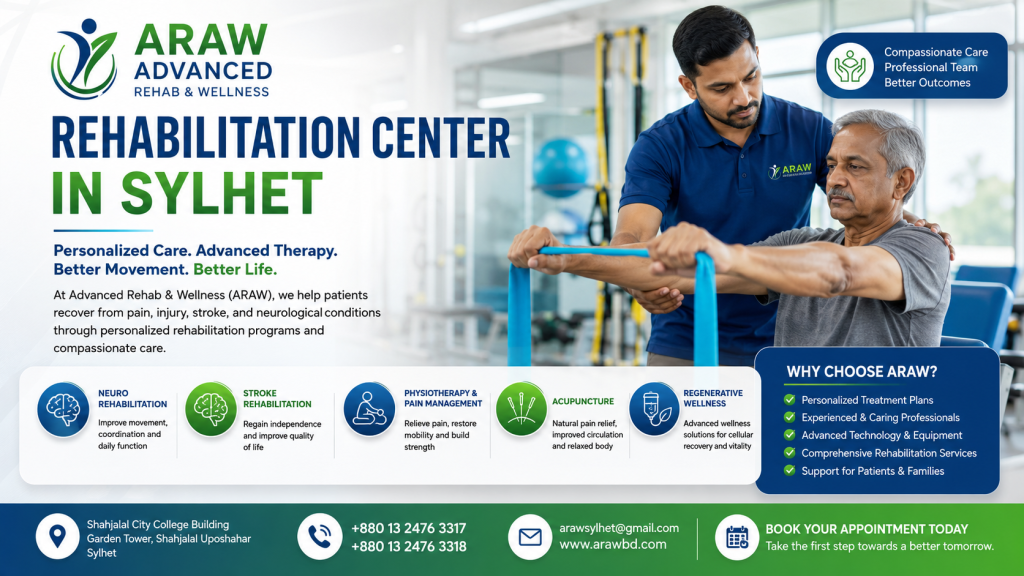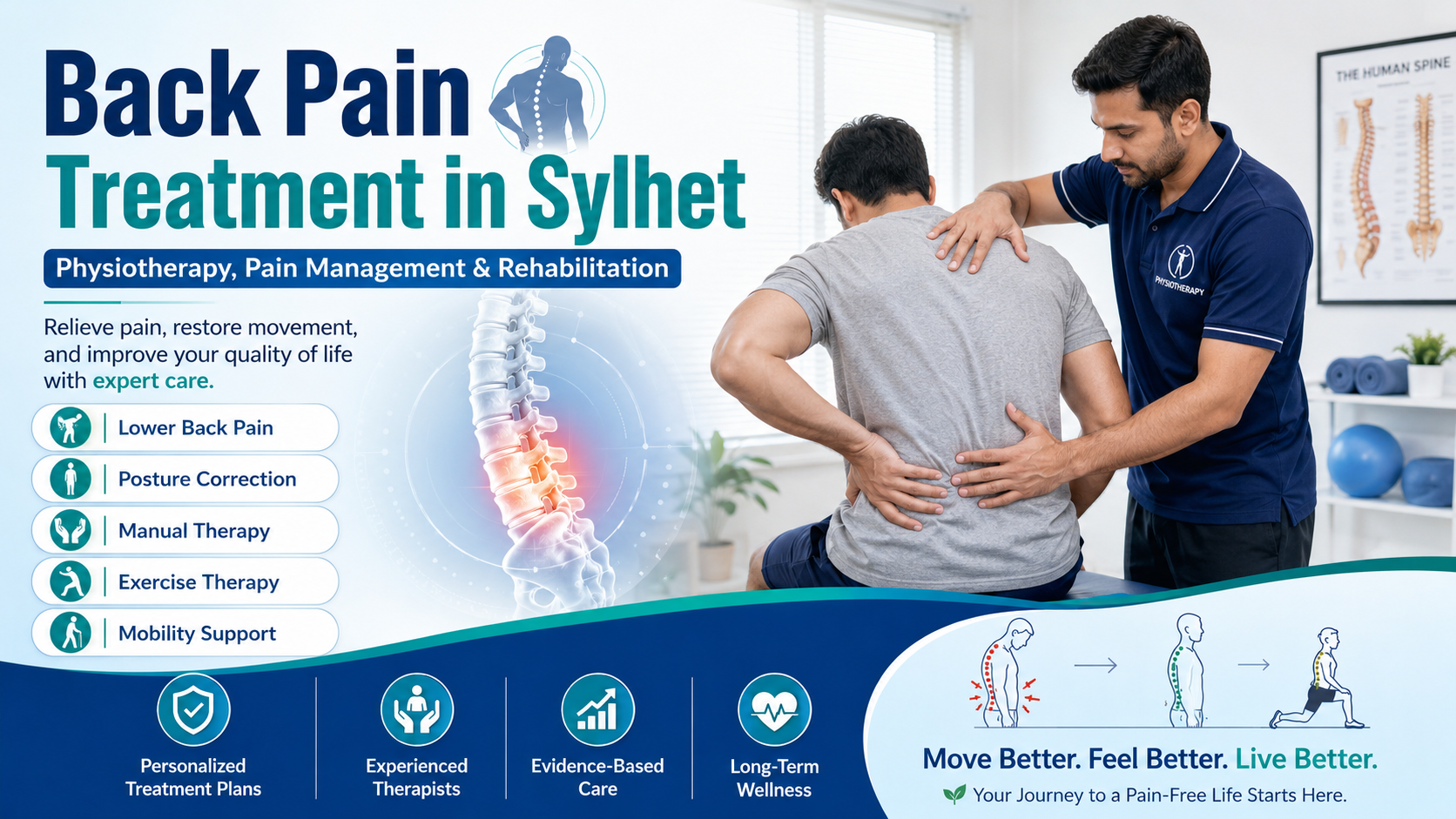
Looking for back pain treatment in Sylhet? Discover personalised physiotherapy, posture assessment, core stabilisation, manual therapy, pain management, and rehabilitation at Advanced Rehab & Wellness.
Back pain can make even ordinary activities difficult. Sitting at work, getting out of bed, walking, lifting an object, driving, climbing stairs, or sleeping comfortably may become challenging when pain affects the lower, middle, or upper back.
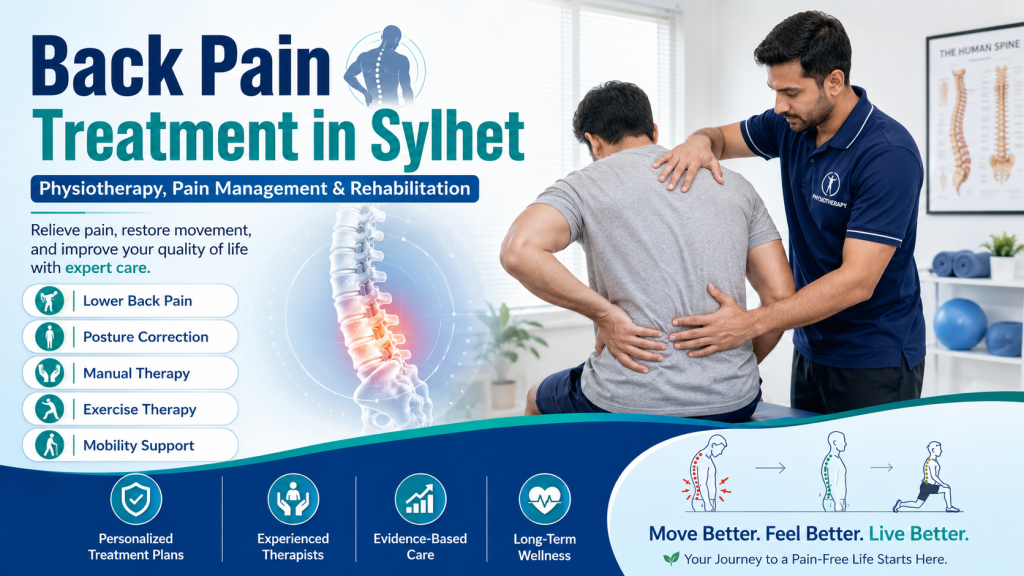
Some episodes of back pain improve within a few weeks. However, pain that continues, repeatedly returns, spreads into the legs, or limits daily activities may require a professional assessment. Back pain can have many possible causes, including muscle strain, joint stiffness, nerve irritation, physical injury, prolonged sitting, reduced strength, or an underlying medical condition.
For people seeking professional back pain treatment in Sylhet, Advanced Rehab & Wellness (ARAW) provides physiotherapy and pain-management services at Shahjalal Uposhahar in Sylhet.
ARAW’s physiotherapy and pain-management clinic focuses on musculoskeletal biomechanics, joint mechanics, core stability, mobility, posture, and physical rehabilitation. Its services include manual joint mobilisation, electrotherapy, therapeutic ultrasound, kinetic core stabilisation, spinal and posture assessment, and workplace ergonomics support.
This guide explains the common causes of back pain, available treatment approaches, warning signs requiring urgent medical care, and what patients can expect when visiting ARAW for back pain treatment in Sylhet.
What Is Back Pain?
Back pain refers to discomfort, stiffness, aching, burning, or sharp pain affecting the muscles, joints, nerves, discs, or other structures of the back.
The pain may affect one specific area or spread into another part of the body. Lower-back pain may sometimes travel into the buttock or leg and may be accompanied by tingling, numbness, or weakness.
The World Health Organisation defines lower-back pain as pain occurring between the lower edge of the ribs and the buttocks. It may be acute, subacute, or chronic and can affect people of any age.
Acute back pain and treatment in Sylhet
Acute back pain usually lasts for less than six weeks. It may begin suddenly after lifting, twisting, falling, exercising, or performing physically demanding work.
Many acute episodes improve over time, but an assessment may be necessary when the pain is severe, worsening, or accompanied by concerning symptoms.
Subacute back pain treatment in Sylhet
Subacute pain continues for approximately six to twelve weeks. Persistent symptoms during this period may require a more structured rehabilitation and pain-management plan.
Chronic back pain treatment in Sylhet
Chronic back pain continues for more than twelve weeks or repeatedly returns over an extended period. It may affect movement, sleep, work, emotional well-being, family activities, and general quality of life.
Why Is Professional Back Pain Assessment Important?
Back pain is not a single condition. Two patients may experience pain in the same area but have different causes, physical limitations, and treatment needs.
For example, one patient may develop pain after lifting a heavy object. Another may have symptoms related to prolonged office work, reduced core strength, or limited spinal mobility. A third patient may have leg pain and numbness caused by nerve irritation.
A professional assessment helps determine:
- Where the pain is located
- When and how it began
- Which movements increase the symptoms
- Whether pain travels into the legs
- Whether numbness or weakness is present
- How posture and physical activity affect the pain
- Whether there are warning signs
- How the condition affects work and daily activities
- Whether physiotherapy is appropriate
- Whether referral to a doctor or another specialist is needed
WHO recommends a comprehensive clinical assessment for lower-back pain so that treatment can be adapted to the patient’s condition, preferences, priorities, physical health, and psychosocial circumstances.
Common Causes of Back Pain
Back pain may result from a variety of injuries, habits, health conditions, or physical demands.
Muscle strain, back pain treatment in Sylhet
A muscle strain may occur after lifting, bending, twisting, sudden exercise, or physically demanding work. Symptoms may include localized pain, muscle spasm, stiffness, and difficulty moving comfortably.
Poor lifting technique, back pain treatment in Sylhet
Lifting a heavy object while bending or twisting awkwardly may increase stress on the lower back. Repeated unsafe lifting can also contribute to recurring symptoms.
Prolonged sitting
People who spend many hours working at a computer, driving, or sitting without regular movement breaks may experience stiffness and discomfort.
Prolonged sitting does not automatically cause every case of back pain, but workstation setup, physical inactivity, movement habits, and muscle endurance may influence symptoms.
Reduced core strength
The muscles around the abdomen, pelvis, hips, and lower back support the body during sitting, standing, lifting, walking, and exercise.
Reduced strength or poor coordination may make some daily activities more difficult. A physiotherapist may recommend carefully selected core-stability exercises when clinically appropriate.
Joint stiffness
Reduced movement in the spinal or surrounding joints may contribute to stiffness and restricted function. A physiotherapist may assess range of motion and determine whether movement exercises or manual therapy are suitable.
Disc-related conditions
The discs between the spinal bones help absorb load and allow movement. Disc-related problems can sometimes cause back pain, leg pain, tingling, or numbness.
Not every disc change seen on an imaging report is necessarily responsible for the patient’s symptoms. Clinical examination and medical history should be considered alongside imaging findings.
Sciatica and nerve irritation
Sciatica generally refers to pain caused by irritation or compression involving the sciatic nerve or its nerve roots.
Symptoms may include:
- Pain travelling from the lower back into the buttock or leg
- Burning or electric-shock sensations
- Tingling
- Numbness
- Muscle weakness
WHO notes that spine-related leg pain may be associated with numbness, tingling, weakness, or sharp electric-shock-like sensations.
Arthritis and age-related changes
Arthritis and other age-related changes can contribute to stiffness, reduced movement, and pain. Rehabilitation may help selected patients maintain strength, mobility, physical confidence, and independence.
Sports injuries
Running, football, cricket, gym training, cycling, and other activities may place repeated or sudden loads on the back.
Sports-related pain may be connected to muscle strain, poor technique, reduced mobility, overtraining, insufficient recovery, or returning to activity too quickly after an injury.
Workplace demands
Heavy lifting, repeated bending, prolonged standing, driving, and desk-based work may contribute to back discomfort.
WHO includes reducing strain during physical work and making ergonomic workplace adjustments among the strategies that may support lower-back pain management.
Previous surgery or injury
Patients may experience weakness, stiffness, or altered movement patterns following surgery, an accident, or prolonged inactivity. Rehabilitation may be needed to restore movement and physical confidence.
Symptoms That May Accompany Back Pain
Back pain symptoms vary between individuals. A patient may experience:
- Dull aching
- Sharp pain
- Burning discomfort
- Muscle spasm
- Morning stiffness
- Pain while sitting
- Pain while bending
- Difficulty standing upright
- Pain while walking
- Pain travelling into a leg
- Numbness or tingling
- Reduced flexibility
- Difficulty sleeping
- Weakness in a leg
- Pain following physical work
An assessment is particularly important when symptoms significantly limit normal movement or continue despite basic self-care.
When Should You Seek Back Pain Treatment?
Consider consulting an appropriate healthcare professional when back pain:
- Does not improve after several weeks
- Keeps returning
- Interferes with work or household activities
- Makes walking, bending, or sitting difficult
- Prevents comfortable sleep
- Spreads into a leg
- Causes tingling or numbness
- Develops after an accident
- Becomes progressively worse
- Is accompanied by unexplained weakness
- Does not improve with appropriate basic care
- Makes you worried or unable to cope
The NHS recommends seeking professional advice when back pain continues despite home care, interferes with daily activities, causes concern, is worse at night, or is associated with unexplained weight loss or changes in the shape of the back.
Back Pain Treatment in Sylhet at Advanced Rehab & Wellness
Advanced Rehab & Wellness provides physiotherapy and pain-management care for acute injuries, persistent back pain, neck pain, joint stiffness, and mobility limitations.
The clinic states that it looks beyond temporary symptom relief by considering joint mechanics, core stability, deep-tissue concerns, movement, and posture.
Treatment should begin with an assessment. The appropriate plan may differ depending on whether the patient has an acute muscle strain, long-term lower-back pain, posture-related discomfort, reduced spinal movement, weakness, or nerve-related symptoms.
Back Pain Services Available at ARAW
1. Initial consultation and mobility assessment
During the initial consultation, the healthcare professional may review:
- The location and intensity of pain
- How and when symptoms began
- Movements that worsen or reduce the pain
- Previous injuries or operations
- Medication
- Medical conditions
- Work activities
- Exercise habits
- Sleep difficulties
- Numbness, tingling, or weakness
- Previous treatments
- Functional limitations
The physical assessment may examine posture, spinal movement, muscle strength, flexibility, walking, balance, and the patient’s ability to perform specific movements.
ARAW describes its general care process as appointment scheduling, initial consultation, personalized treatment planning, and follow-up monitoring.
2. Personalized physiotherapy plan
A personalized treatment plan may include a combination of education, exercise, hands-on treatment, posture guidance, activity modification, and home exercises.
The plan should be based on the patient’s condition and recovery goals rather than using the same routine for every person.
The NHS states that physiotherapy may help ease pain and improve movement through exercise, manual therapy, symptom-management advice, and selected treatment modalities.
3. Manual joint mobilisation
ARAW lists controlled manual joint-mobilisation techniques among its physiotherapy services. These hands-on techniques are intended to address joint stiffness and support improved movement.
Manual therapy should be performed by an appropriately trained professional after assessment. It is generally most useful when combined with active rehabilitation rather than used as a complete treatment by itself.
4. Kinetic core stabilisation
ARAW offers kinetic core-stabilisation exercises intended to support important load-bearing regions of the body.
A core-stability program may focus on the muscles surrounding the abdomen, lower back, pelvis, and hips.
Depending on the patient’s condition, exercises may be used to improve:
- Movement control
- Spinal support
- Strength
- Balance
- Lifting ability
- Sitting tolerance
- Walking
- Functional confidence
Exercises should be introduced gradually and adjusted according to the patient’s symptoms and abilities.
5. Spine and posture assessment
ARAW lists clinical spinal-alignment and posture evaluations as part of its pain-free mobility assessments. The evaluation may include physical-load, postural-deviation, and joint-range measurements.
A posture assessment may consider:
- Sitting position
- Standing alignment
- Shoulder position
- Spinal mobility
- Repeated movement habits
- Workstation arrangement
- Lifting techniques
- Physical activity level
The purpose should not be to label one posture as perfect. Instead, assessment can help identify positions, movement patterns, or physical demands that may be influencing the patient’s symptoms.
6. Therapeutic exercise
Exercise is an important component of many back-pain rehabilitation programs.
Depending on the assessment findings, exercises may focus on:
- Strength
- Flexibility
- Spinal mobility
- Core control
- Hip strength
- Balance
- Coordination
- Endurance
- Functional movement
- Gradual return to activity
WHO recommends exercise programs as part of a person-centred approach for adults with chronic primary lower-back pain.
7. Electrotherapy and therapeutic ultrasound
ARAW lists electrotherapy and therapeutic ultrasound among its available physical modalities.
These treatments may be considered for selected patients as part of a broader rehabilitation plan. They should not automatically be used for every type of back pain and should not replace assessment, education, exercise, or appropriate medical care.
8. Workplace ergonomics
ARAW offers a corporate desk-ergonomics package combining physical adjustments with muscle-preservation training.
Ergonomic guidance may include:
- Adjusting chair height
- Improving screen placement
- Positioning the keyboard and mouse
- Using appropriate back support
- Taking regular movement breaks
- Changing position throughout the day
- Learning safe lifting techniques
- Performing simple workplace exercises
These adjustments can be especially useful for office employees, drivers, teachers, freelancers, and people who work for long periods in the same position.
9. Home exercise guidance
Patients may receive exercises to perform between appointments. Home exercises are intended to reinforce the progress made during supervised sessions.
Exercises should be performed exactly as instructed. Stop and contact the relevant healthcare professional when an exercise causes severe pain, new numbness, significant weakness, dizziness, or other concerning symptoms.
Evidence-Based Management of Chronic Back Pain
Long-term back pain is often influenced by a combination of physical, psychological, occupational, and social factors.
WHO recommends a holistic, person-centred, coordinated approach rather than relying on a single treatment. Recommended options may include education, exercise, selected physical therapies, psychological interventions, and appropriate medication where clinically necessary.
A complete back-pain program may therefore focus on:
- Understanding the condition
- Reducing fear of safe movement
- Improving strength and mobility
- Gradually returning to daily activities
- Supporting sleep and general health
- Managing work-related physical demands
- Establishing realistic recovery goals
- Developing long-term self-management skills
Treatment should be adjusted according to the patient’s individual needs and should not promise an instant or guaranteed cure.
Does Every Patient Need an MRI or X-Ray?
Not every episode of back pain requires imaging.
A healthcare professional may recommend an X-ray, MRI, CT scan, or another investigation when the medical history, physical examination, injury, or warning signs suggest that imaging may influence treatment.
Imaging should not replace clinical assessment. The presence of changes on a scan does not always prove that those findings are the cause of pain.
Bring any existing imaging reports, prescriptions, hospital records, and previous treatment documents to your appointment.
What to Expect During Your First Appointment
Medical-history review
The healthcare professional may ask about symptoms, injuries, operations, medication, work, exercise, sleep, and previous treatment.
Physical examination
The assessment may include spinal movement, muscle strength, posture, flexibility, walking, balance, and nerve-related tests.
Discussion of goals
Practical treatment goals may include:
- Sitting comfortably at work
- Sleeping with less discomfort
- Walking for a longer period
- Returning to physical work
- Lifting safely
- Driving comfortably
- Resuming exercise
- Reducing pain-related limitations
Treatment explanation
The healthcare professional should explain the assessment findings, recommended care, safety precautions, home exercises, and follow-up plan.
Progress monitoring
Treatment may be adjusted according to changes in pain, mobility, strength, sitting tolerance, walking, sleep, and daily activities.
How Many Back Pain Treatment Sessions Are Needed?
There is no fixed number of treatment sessions suitable for every patient.
The required duration may depend on:
- Cause of pain
- Severity
- Duration of symptoms
- Presence of leg pain
- Muscle strength
- Spinal mobility
- Age
- General health
- Work demands
- Previous injuries
- Exercise participation
- Attendance
- Response to treatment
ARAW states that many soft-tissue or spinal-tracking problems may show baseline functional improvement within four to six focused sessions. This should not be interpreted as a guarantee, because individual conditions and recovery timelines differ.
Long-term pain, nerve-related symptoms, severe weakness, significant injuries, or post-surgical rehabilitation may require a longer treatment period.
Benefits of Physiotherapy for Back Pain
A properly designed physiotherapy program may help suitable patients:
- Improve spinal movement
- Increase muscle strength
- Reduce stiffness
- Improve flexibility
- Develop better movement control
- Return to work
- Resume exercise
- Improve sitting and standing tolerance
- Learn safer lifting techniques
- Increase physical confidence
- Manage recurring symptoms
- Improve independence
Physiotherapy is used for bone, joint, and muscle conditions including back pain, neck pain, arthritis, sports injuries, and post-surgical weakness.
How to Support Your Recovery at Home
Remain appropriately active
Long periods of bed rest are generally discouraged for ordinary back pain. The NHS recommends remaining active and continuing daily activities when possible, provided no serious condition or medical restriction is present.
Follow the prescribed exercises
Perform only the exercises recommended for your condition. Stop and seek advice if symptoms worsen significantly.
Take movement breaks
Avoid sitting or standing in one position for several hours. Change position and move regularly.
Improve your workstation
Adjust your chair, screen, keyboard, and desk so you can work without repeatedly leaning, twisting, or reaching awkwardly.
Use safe lifting techniques
Keep the object close to your body, avoid sudden twisting, and ask for assistance when an object is too heavy or awkward.
Maintain healthy sleep habits
Good-quality sleep may support physical recovery and pain management. Ask a healthcare professional for advice if pain regularly interrupts sleep.
Avoid unsupervised treatment
Do not begin intense stretching, spinal manipulation, or strenuous exercise without understanding whether it is appropriate for your condition.
Use medication carefully
Speak with a qualified doctor or pharmacist before using pain medication, especially when you have other health conditions or take additional medicines.
Warning Signs Requiring Urgent Medical Care
Most back pain is not caused by a serious condition. However, some symptoms require urgent medical assessment.
Seek immediate emergency care when back pain is accompanied by:
- Pain, weakness, tingling, or numbness affecting both legs
- Loss of sensation around the genitals or anus
- Difficulty controlling the bladder or bowel
- Difficulty urinating
- Chest pain
- Back pain following a serious accident
- Rapidly worsening weakness
Urgent medical advice is also necessary when severe pain begins suddenly, worsens quickly, or occurs with fever, chills, or feeling generally unwell.
A routine physiotherapy appointment should never delay emergency medical care.
How to Choose a Back Pain Treatment Center in Sylhet
Before selecting a healthcare provider, consider the following factors.
Professional assessment
The provider should assess your symptoms, medical history, movement, strength, and warning signs before beginning treatment.
Individualized planning
Treatment should reflect your condition, occupation, physical ability, and recovery goals.
Clear communication
You should understand why each treatment is recommended, what precautions apply, and what outcomes are realistic.
Active rehabilitation
Exercise, education, and functional movement should usually form an important part of back-pain rehabilitation.
Progress measurement
The provider should monitor changes in mobility, strength, pain-related function, sleep, and daily activity.
Appropriate referral
A responsible provider should recommend medical assessment or diagnostic testing when the symptoms require further investigation.
Convenient follow-up
Because rehabilitation may require repeated appointments, a local center can make regular attendance easier.
Why Consider Advanced Rehab & Wellness?
People searching for back pain treatment in Sylhet may consider ARAW because it provides physiotherapy and pain management within a wider rehabilitation setting.
Its published services and features include:
- Physiotherapy and pain management
- Manual joint mobilization
- Kinetic core stabilization
- Electrotherapy
- Therapeutic ultrasound
- Spine and posture assessment
- Workplace ergonomics
- Personalized treatment planning
- Follow-up care
- Neuro and stroke rehabilitation services
ARAW states that it combines advanced medical technology, clinical knowledge, clear communication, and personalized care.
Patients should receive an individual consultation to determine which services are suitable for their condition.
Frequently Asked Questions
Where can I get back pain treatment in Sylhet?
Advanced Rehab & Wellness provides physiotherapy and pain-management services at Garden Tower, Shahjalal Uposhahar, Sylhet. Its services include mobility assessment, manual joint mobilization, core stabilization, posture assessment, electrotherapy, ultrasound, and ergonomic support.
Can physiotherapy help lower-back pain?
Physiotherapy may help suitable patients improve movement, strength, flexibility, and pain-related function. The recommended exercises and treatments should be selected after an individual assessment.
Can ARAW help with posture-related back pain?
ARAW lists spinal-alignment and posture evaluation, joint-range assessment, and workplace ergonomics among its physiotherapy and pain-management services.
What is the treatment for sciatica?
Treatment depends on the cause and severity of symptoms. It may involve education, movement modification, therapeutic exercise, pain management, and medical referral. Urgent medical care is necessary if symptoms include bladder or bowel changes, numbness around the groin, or weakness affecting both legs.
Is complete bed rest good for back pain?
Extended bed rest is generally not advised for ordinary back pain. Remaining appropriately active and gradually continuing daily activities may support recovery, unless a healthcare professional has given different instructions.
Do I need a doctor’s prescription before visiting ARAW?
ARAW’s website states that its clinical therapists perform direct-entry screening. However, patients with serious symptoms, significant trauma, or complex medical conditions may still require assessment by a doctor or another specialist.
How quickly will my back pain improve?
Recovery time depends on the cause, severity, duration, general health, treatment consistency, and response to rehabilitation. No responsible provider should guarantee the same outcome or recovery date for every patient.
What should I bring to my appointment?
Bring prescriptions, imaging reports, hospital documents, medication details, previous physiotherapy records, and any other relevant medical information.
What are ARAW’s physiotherapy hours?
ARAW currently lists physiotherapy and pain-management appointments from Saturday to Wednesday, between 9:00 AM and 2:00 PM, and again between 4:00 PM and 9:00 PM. Patients should call before visiting to confirm current availability.
Book Back Pain Treatment in Sylhet
Back pain should not be ignored when it repeatedly returns, interferes with daily life, or causes numbness, weakness, or reduced mobility.
A professional assessment can help determine the factors contributing to your symptoms and identify an appropriate treatment plan. Depending on your condition, care may include therapeutic exercise, core stabilization, manual joint mobilization, posture correction, ergonomic guidance, physical modalities, and home rehabilitation.
For people looking for back pain treatment in Sylhet, Advanced Rehab & Wellness provides local access to physiotherapy, pain management, spinal and posture assessment, and rehabilitation services.
Contact ARAW to discuss your symptoms and schedule an initial consultation.
Contact Advanced Rehab & Wellness
Advanced Rehab & Wellness—ARAW
Address:
Shahjalal City College Building
Garden Tower, Shahjalal Uposhahar
Sylhet, Bangladesh
Appointment Numbers:
+880 13 2476 3317
+880 13 2476 3318
Email:
arawsylhet@gmail.com
Physiotherapy and Pain-Management Schedule:
Saturday–Wednesday: 9:00 AM–2:00 PM
Saturday–Wednesday: 4:00 PM–9:00 PM
The address, appointment numbers, email address, and schedule above are currently published on ARAW’s official website.
Medical Disclaimer
This article is intended for general educational and informational purposes only. It does not provide a diagnosis, prescription, or guarantee of treatment results. Back pain can have many possible causes, and treatment should be selected following an appropriate assessment by a qualified healthcare professional. Seek emergency medical care for bladder or bowel changes, numbness around the groin, weakness in both legs, chest pain, major trauma, breathing difficulties, or other urgent symptoms.