+880 13 2476 3317 arawsylhet@gmail.com
Garden Tower, Shahjalal Uposhahar, Sylhet

Looking for an Orthopaedic Doctor in Sylhet? Consult Dr. Md. Almahir Ferdous for bone and joint problems, knee pain, back and neck pain, fractures, trauma, sports injuries and musculoskeletal conditions at Advanced Rehab & Wellness—ARAW.

Orthopaedic Doctor in Sylhet: When Should You See a Bone and Joint Specialist?

Orthopaedic Doctor in Sylhet

Orthopaedic Doctor in Sylhet: Persistent knee pain, back pain, neck discomfort, shoulder stiffness, fractures, sports injuries and other bone or joint problems can gradually interfere with normal life.

At first, a patient may only notice discomfort during activity. Over time, the problem may affect:

  • Walking
  • Climbing stairs
  • Working
  • Sleeping
  • Exercise
  • Driving
  • Lifting
  • Standing from a chair
  • Daily household activities

Orthopaedic Doctor in Sylhet, These problems are broadly known as musculoskeletal conditions because they affect structures such as bones, joints, muscles, tendons, ligaments and surrounding connective tissues.

The World Health Organization estimates that around 1.71 billion people worldwide live with musculoskeletal conditions, making them the leading contributor to disability globally. These conditions include back pain, neck pain, fractures, osteoarthritis and many other disorders affecting movement and physical function.

For people searching for an Orthopaedic Doctor in Sylhet, Advanced Rehab & Wellness—ARAW currently lists Dr. Md. Almahir Ferdous as a Consultant in Orthopaedics and Stem Cell Regenerative Medicine. His professional interests include bone and joint disorders, fractures, trauma, knee and shoulder problems, hand conditions, musculoskeletal rehabilitation and related orthopaedic concerns.

Orthopaedic Doctor in Sylhet, This guide explains what an orthopaedic doctor does, which symptoms may require consultation, how common conditions are assessed and what patients should know before visiting an orthopaedic specialist in Sylhet.

What Is Orthopaedics?

Orthopaedic Doctor in Sylhet, Orthopaedics is the branch of medicine concerned with the musculoskeletal system.

This includes:

  • Bones
  • Joints
  • Muscles
  • Ligaments
  • Tendons
  • Cartilage
  • Related connective tissues

WHO describes musculoskeletal conditions as more than 150 diseases and disorders affecting muscles, bones, joints and adjacent tissues. These conditions can cause pain, reduced mobility, loss of dexterity and temporary or long-term limitations in daily activities.

An orthopaedic doctor therefore does more than treat broken bones.

Patients may seek orthopaedic assessment for pain, injury, reduced joint movement, degenerative disease, sports-related problems and complications following trauma.

What Does an Orthopaedic Doctor Do?

An orthopaedic doctor evaluates conditions affecting bones, joints and surrounding musculoskeletal structures.

The assessment usually begins with:

  • Medical history
  • Description of symptoms
  • Previous injuries
  • Previous operations
  • Physical examination
  • Review of existing X-rays, MRI or CT scans when available

Further investigation may be recommended when necessary.

Treatment depends on the diagnosis and may involve:

  • Activity modification
  • Medication
  • Physiotherapy
  • Exercise and rehabilitation
  • Braces or other support
  • Follow-up imaging
  • Selected procedures
  • Surgical referral or surgery where appropriate

The important point is that orthopaedic treatment does not automatically mean surgery.

Orthopaedic Doctor in Sylhet, Many musculoskeletal problems can initially be managed non-surgically depending on the diagnosis and severity.

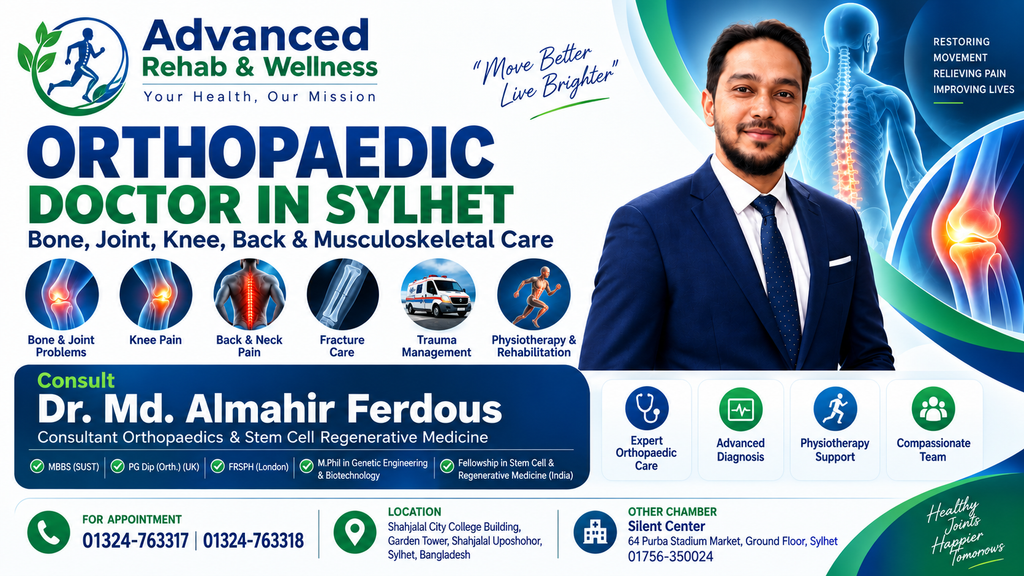
Orthopaedic Doctor in Sylhet – Dr. Md. Almahir Ferdous

For patients searching for an Orthopaedic Doctor in Sylhet, Dr. Md. Almahir Ferdous currently provides orthopaedic consultation through Advanced Rehab & Wellness.

ARAW lists him as a Consultant in Orthopaedics and Stem Cell Regenerative Medicine and Chairman of Advanced Rehab & Wellness.

Listed Academic Qualifications

According to his current ARAW profile, his qualifications include:

  • MBBS – Shahjalal University of Science and Technology
  • PG Diploma in Orthopaedics – UK
  • FRSPH – London
  • M.Phil in Genetic Engineering and Biotechnology
  • Fellowship in Stem Cell & Regenerative Medicine – India

Orthopaedic Doctor in Sylhet, His profile also lists specialised training in orthopaedics, trauma, and hand surgery.

What Conditions Can an Orthopaedic Doctor Assess?

1. Knee Pain

Knee pain is one of the most common reasons patients seek orthopaedic care.

It may be associated with:

  • Osteoarthritis
  • Previous injury
  • Ligament problems
  • Meniscus injuries
  • Sports injuries
  • Fractures
  • Repetitive strain
  • Joint inflammation
  • Age-related changes

Orthopaedic Doctor in Sylhet, The knee is the most frequently affected joint in osteoarthritis. WHO estimates that around 365 million people worldwide have knee osteoarthritis.

An orthopaedic assessment may be especially useful when knee pain:

  • Continues for several weeks
  • Keeps returning
  • Causes swelling
  • Makes walking difficult
  • Interferes with stairs
  • Causes the knee to give way
  • Follows an injury
  • Limits normal activity

Orthopaedic Doctor in Sylhet, Treatment should depend on the underlying cause rather than simply the location of the pain.

2. Knee Osteoarthritis

Knee osteoarthritis can cause:

  • Pain
  • Swelling
  • Stiffness
  • Reduced movement
  • Weakness
  • Difficulty walking
  • Difficulty climbing stairs

WHO describes osteoarthritis as a condition affecting the entire joint and surrounding tissues rather than simply “wear and tear.”

Many patients worry that an osteoarthritis diagnosis automatically means knee replacement.

It does not.

Depending on severity, management may involve:

  • Exercise
  • Muscle strengthening
  • Weight management where appropriate
  • Physiotherapy
  • Medication
  • Activity modification
  • Assistive devices

Joint replacement may be considered when disease is severe and pain or loss of function significantly affects daily life.

3. Back Pain

Back pain can affect people of almost any age.

Possible contributors include:

  • Muscle strain
  • Heavy lifting
  • Reduced physical conditioning
  • Repetitive work
  • Previous injury
  • Degenerative changes
  • Disc-related problems
  • Nerve irritation

Orthopaedic Doctor in Sylhet, Persistent back pain may require an assessment to determine whether the problem is likely musculoskeletal or whether additional investigation is necessary.

Patients should mention symptoms such as:

  • Pain spreading into the leg
  • Numbness
  • Tingling
  • Weakness
  • Significant trauma

Orthopaedic Doctor in Sylhet, because these details may influence the clinical assessment.

4. Neck Pain

Neck pain can affect:

  • Computer work
  • Driving
  • Sleeping
  • Reading
  • Head movement

Possible causes include muscle and joint problems, previous trauma and degenerative cervical changes.

Orthopaedic Doctor in Sylhet, An orthopaedic evaluation may be appropriate when neck pain is persistent or associated with:

  • Arm pain
  • Numbness
  • Tingling
  • Weakness
  • Restricted movement

Progressive neurological symptoms should be evaluated promptly.

5. Shoulder Pain

Shoulder problems can make simple activities difficult.

Patients may struggle to:

  • Raise an arm
  • Dress
  • Reach overhead
  • Carry objects
  • Sleep on the affected side

Possible causes include:

  • Frozen shoulder
  • Rotator cuff disorders
  • Tendon problems
  • Sports injuries
  • Arthritis
  • Previous fractures
  • Trauma

An orthopaedic assessment can help determine whether treatment should involve rehabilitation, medication, further investigation or another approach.

6. Bone Fractures

A fracture can result from:

  • Road accidents
  • Falls
  • Sports injuries
  • Workplace injuries
  • Direct trauma
  • Fragile bones in older adults

Symptoms may include:

  • Severe pain
  • Swelling
  • Bruising
  • Difficulty moving the limb
  • Inability to bear weight
  • Visible deformity

Fractures require appropriate diagnosis because treatment varies depending on:

  • Which bone is affected
  • Fracture pattern
  • Displacement
  • Joint involvement
  • Age
  • Overall health

Treatment may involve immobilisation, casting, fixation or surgery depending on the injury.

Dr. Md. Almahir Ferdous’s published profile includes training and professional interests related to trauma and fracture management.

7. Fracture Healing Problems

Most fractures gradually heal, but some take longer than expected.

Possible problems include:

  • Delayed healing
  • Persistent pain
  • Reduced function
  • Abnormal movement
  • Difficulty returning to normal activity

An orthopaedic doctor may review:

  • Previous X-rays
  • Treatment history
  • Current symptoms
  • Limb alignment
  • Functional ability

Further investigations may be required when healing is delayed.

ARAW’s current orthopaedic information specifically includes bone-healing and union-related problems among the areas evaluated in orthopaedic care.

8. Sports Injuries

Football, cricket, badminton, running and gym activities can lead to injuries involving:

  • Ligaments
  • Muscles
  • Tendons
  • Joints
  • Bones

Common symptoms include:

  • Swelling
  • Pain
  • Instability
  • Weakness
  • Reduced movement

Returning to sport should ideally depend on recovery of function rather than simply waiting until pain decreases.

Treatment may involve orthopaedic assessment followed by physiotherapy and progressive sports rehabilitation.

9. Hand and Wrist Problems

The hand and wrist contain many small bones, joints, tendons, nerves and ligaments.

Problems may affect:

  • Grip
  • Writing
  • Lifting
  • Finger movement
  • Work activities

Dr. Md. Almahir Ferdous’s current professional profile lists specialised training related to hand surgery, supporting his professional interest in relevant hand and upper-limb problems.

10. Trauma-Related Orthopaedic Problems

Road traffic accidents and falls may cause more than a single fracture.

Patients may experience combinations of:

  • Bone injury
  • Joint injury
  • Soft-tissue injury
  • Restricted mobility
  • Muscle weakness
  • Post-traumatic pain

Orthopaedic trauma care may therefore involve both initial treatment and subsequent rehabilitation.

ARAW’s current orthopaedic page highlights trauma assessment and rehabilitation needs as part of Dr. Ferdous’s professional area of interest.

When Should You See an Orthopaedic Doctor?

Consider an orthopaedic consultation when:

  • Pain persists
  • Symptoms repeatedly return
  • A joint remains swollen
  • Movement is restricted
  • Walking becomes difficult
  • Pain affects sleep
  • You cannot return to sport
  • An old fracture remains painful
  • A joint repeatedly gives way
  • Pain follows significant trauma
  • Daily activities are increasingly difficult

Earlier assessment may help determine whether the problem requires simple rehabilitation, investigation or specialist treatment.

When Should You Seek Emergency Care?

Some injuries should not wait for a routine orthopaedic appointment.

Seek urgent medical attention after serious trauma if:

  • A limb looks deformed
  • Bone may be exposed
  • You cannot bear weight
  • There is severe uncontrolled pain
  • The affected limb becomes cold or numb
  • Significant bleeding is present
  • There is sudden major weakness

A very hot, swollen joint accompanied by fever can also require urgent assessment because joint infection must be considered.

What Happens During an Orthopaedic Consultation?

A consultation usually begins with a detailed history.

The doctor may ask:

  • When did the symptoms start?
  • Was there an injury?
  • Where exactly is the pain?
  • What makes it worse?
  • Does the joint swell?
  • Is there numbness?
  • Do you experience weakness?
  • Have you had surgery before?
  • What medication are you taking?
  • What treatment have you already received?

Physical examination may include:

  • Joint movement
  • Strength
  • Tenderness
  • Stability
  • Swelling
  • Walking
  • Neurological examination when relevant

The findings help determine the next step.

Do You Need an X-Ray?

Not every orthopaedic condition requires an X-ray.

An X-ray may be useful when there is concern about:

  • Fracture
  • Joint alignment
  • Degenerative changes
  • Bone abnormalities

The need should be determined according to the clinical situation.

When Is an MRI Useful?

MRI can provide detailed information about soft tissues.

It may be considered for selected:

  • Ligament injuries
  • Meniscus problems
  • Tendon injuries
  • Disc-related conditions
  • Other soft-tissue problems

An MRI should be interpreted alongside the patient’s symptoms and examination findings rather than being treated as the diagnosis by itself.

Orthopaedics and Physiotherapy

Orthopaedic care and physiotherapy often work together.

WHO identifies musculoskeletal conditions as the largest overall contributor to rehabilitation needs worldwide.

After an appropriate diagnosis, physiotherapy may help patients improve:

  • Strength
  • Joint movement
  • Balance
  • Walking
  • Physical endurance
  • Function after surgery
  • Return to work
  • Return to sport

At Advanced Rehab & Wellness, orthopaedic assessment can be connected with broader physiotherapy and rehabilitation services when clinically appropriate. ARAW currently describes itself as providing coordinated musculoskeletal assessment and rehabilitation-related care in Sylhet.

Rehabilitation After a Fracture

Even after the bone has healed, a patient may experience:

  • Joint stiffness
  • Muscle weakness
  • Reduced balance
  • Difficulty walking
  • Reduced confidence

Rehabilitation may therefore include:

  • Joint mobility
  • Strengthening
  • Walking practice
  • Balance training
  • Functional exercises

The rehabilitation plan should respect healing status and orthopaedic precautions.

Rehabilitation After Orthopaedic Surgery

Patients may require physiotherapy following:

  • Knee surgery
  • Hip surgery
  • Shoulder surgery
  • Fracture fixation
  • Ligament reconstruction
  • Joint replacement

Goals may include:

  • Restoring movement
  • Increasing muscle strength
  • Improving walking
  • Returning to daily activities

The exact programme should follow surgical precautions and individual recovery.

Orthopaedic Care Is Not Always Surgery

A common misconception is:

“If I visit an orthopaedic doctor, I will be advised to have surgery.”

This is not necessarily true.

Treatment depends on the diagnosis.

Many conditions can be managed initially with:

  • Education
  • Activity modification
  • Exercise
  • Physiotherapy
  • Medication
  • Weight management
  • Appropriate follow-up

Surgery becomes relevant when there is a clear indication based on severity, structural damage, functional limitation or failure of suitable conservative treatment.

A Note About Regenerative Medicine

Dr. Md. Almahir Ferdous’s listed qualifications include a fellowship in Stem Cell & Regenerative Medicine, and regenerative medicine is included among his professional interests.

However, regenerative treatment is not automatically appropriate for every bone or joint problem.

For example, WHO currently states that there is insufficient evidence to establish stem-cell therapy as beneficial for osteoarthritis.

Patients considering any regenerative procedure should therefore discuss:

  • The exact diagnosis
  • Evidence for the proposed treatment
  • Potential benefits
  • Risks
  • Alternatives
  • Expected outcomes
  • Cost
  • Uncertainties

with an appropriately qualified clinician before deciding.

Why Consider ARAW When Looking for an Orthopaedic Doctor in Sylhet?

Orthopaedic Consultation

ARAW currently lists Dr. Md. Almahir Ferdous as a Consultant in Orthopaedics and Stem Cell Regenerative Medicine.

Bone, Joint and Trauma Assessment

His listed professional interests include bone and joint disorders, fractures, trauma, knee and shoulder pain, hand problems and musculoskeletal rehabilitation.

Physiotherapy and Rehabilitation Support

ARAW provides rehabilitation-oriented services, which may support patients requiring physical recovery after orthopaedic injury or treatment.

Local Sylhet Location

ARAW is located in Shahjalal Uposhahar, Sylhet, with appointment contact information currently published on its website.

About Dr. Md. Almahir Ferdous

Dr. Md. Almahir Ferdous

Consultant: Orthopaedics & Stem Cell Regenerative Medicine

Listed qualifications:

  • MBBS (SUST)
  • PG Dip (Orth.) (UK)
  • FRSPH (London)
  • M.Phil in Genetic Engineering & Biotechnology
  • Fellowship in Stem Cell & Regenerative Medicine (India)

He currently serves as Chairman of Advanced Rehab & Wellness, Sylhet.

Book an Orthopaedic Consultation at ARAW

Advanced Rehab & Wellness—ARAW

Address:
Shahjalal City College Building / Garden Tower
Shahjalal Uposhahar
Sylhet, Bangladesh

Appointment:
01324-763317
01324-763318

General Email:
arawsylhet@gmail.com

Patients should call before visiting to confirm the latest consultation day and time.

Additional Chamber

Dr. Md. Almahir Ferdous is also currently listed as consulting at:

Silent Center
64, Purba Stadium Market
Ground Floor
Sylhet

Appointment:
01756-350024

Professional Contact

ARAW’s current doctor profile also lists:

Mobile:
01711-042145

Email:
roktokorobi@hotmail.com

Office:
209 Excel Tower, 1st Floor
Subid Bazar, Sylhet-3100
Bangladesh

Frequently Asked Questions About Orthopaedic Doctor in Sylhet

Where can I consult an Orthopaedic Doctor in Sylhet?

Dr. Md. Almahir Ferdous currently provides orthopaedic consultation through Advanced Rehab & Wellness in Shahjalal Uposhahar, Sylhet. He is also listed as consulting at Silent Center, Purba Stadium Market.

Who is Dr. Md. Almahir Ferdous?

He is currently listed by ARAW as a Consultant in Orthopaedics and Stem Cell Regenerative Medicine and Chairman of Advanced Rehab & Wellness.

Can an orthopaedic doctor treat knee pain?

Yes. Orthopaedic specialists assess knee problems including injury, arthritis and other joint conditions. Treatment depends on the diagnosis.

Can I see an orthopaedic doctor for back pain?

Yes, particularly for persistent musculoskeletal back pain, injury or symptoms that may require specialist assessment. Depending on findings, another speciality may sometimes be more appropriate.

Does every fracture need surgery?

No. Some fractures can be managed without surgery, while others require operative treatment. The decision depends on fracture type, alignment, location and patient factors.

Can an orthopaedic doctor treat sports injuries?

Yes. Sports-related bone, joint, ligament and tendon injuries are commonly assessed in orthopaedic care.

Is physiotherapy useful after an orthopaedic injury?

Yes, for many conditions. Rehabilitation may help restore strength, movement and everyday function after injury or surgery. WHO identifies musculoskeletal disorders as a major source of rehabilitation need worldwide.

Does arthritis always require surgery?

No. Many people with osteoarthritis are managed initially through exercise, healthy weight management, rehabilitation and appropriate medical treatment. Joint replacement is generally reserved for more severely affected joints.

Does stem-cell treatment cure knee arthritis?

Current evidence does not support a guarantee of cure. WHO states that evidence is insufficient to conclude that stem-cell therapy is beneficial for osteoarthritis. Patients should discuss evidence, risks and alternatives before considering such treatment.

Should I take my previous reports to the appointment?

Yes. If available, take relevant:

  • X-rays
  • MRI reports
  • CT reports
  • Previous prescriptions
  • Surgical documents
  • Physiotherapy records
  • Current medication list

This can help the doctor understand your previous investigations and treatment.

Choosing an Orthopaedic Doctor in Sylhet

When selecting an orthopaedic doctor, consider more than advertising.

Look for:

  • Appropriate medical qualifications
  • Relevant orthopaedic training
  • Clear assessment
  • Explanation of diagnosis
  • Appropriate use of investigations
  • Realistic treatment expectations
  • Access to rehabilitation where required
  • Referral when another specialist is more appropriate

A good consultation should help you understand:

What may be causing the problem, what options are available and what the next step should be.

Conclusion

Bone, joint and musculoskeletal problems can significantly affect mobility, work, exercise and quality of life.

An appropriate Orthopaedic Doctor in Sylhet can assess conditions involving:

  • Knee pain
  • Joint pain
  • Back and neck pain
  • Shoulder problems
  • Fractures
  • Trauma
  • Sports injuries
  • Hand problems
  • Restricted movement
  • Bone-healing concerns

For patients seeking orthopaedic consultation in Sylhet, Dr. Md. Almahir Ferdous is currently listed as Consultant Orthopaedics & Stem Cell Regenerative Medicine at Advanced Rehab & Wellness—ARAW, with professional interests covering orthopaedics, trauma, musculoskeletal care and rehabilitation.

Good orthopaedic care should not focus only on reducing pain. The aim is to understand the underlying problem, protect or restore physical function and help patients return safely to meaningful daily activities.

If persistent bone, joint or injury-related symptoms are affecting your movement or everyday life, a specialist assessment may help identify the appropriate next step.

Medical Disclaimer

This article is intended for general health education and website information. It does not provide an individual diagnosis, prescription or guarantee of treatment outcomes. Bone, joint and musculoskeletal symptoms can have many causes, and management should be based on an appropriate clinical assessment. Seek urgent medical attention for major trauma, severe deformity, inability to bear weight, significant bleeding, a cold or numb injured limb, or a hot swollen joint accompanied by fever.

প্যারালাইসিস রোগীর ফিজিওথেরাপি: হাত-পা সচল করা, হাঁটার প্রশিক্ষণ ও পুনর্বাসনের পূর্ণাঙ্গ গাইড, প্যারালাইসিস রোগীর ফিজিওথেরাপি কীভাবে করা হয়? স্ট্রোক বা স্নায়বিক সমস্যার পর হাত-পা দুর্বলতা, ভারসাম্য, দাঁড়ানো, হাঁটা, পেশির শক্তভাব ও দৈনন্দিন কাজের পুনর্বাসন সম্পর্কে বিস্তারিত জানুন।

প্যারালাইসিস রোগীর ফিজিওথেরাপি

প্যারালাইসিস রোগীর ফিজিওথেরাপি কেন গুরুত্বপূর্ণ?

প্যারালাইসিস রোগীর ফিজিওথেরাপি, প্যারালাইসিসের পর একজন রোগীর জীবন হঠাৎ করেই বদলে যেতে পারে। কেউ নিজের হাত তুলতে পারেন না, কেউ পায়ে ভর দিয়ে দাঁড়াতে পারেন না, আবার কারও বসা, ভারসাম্য রাখা, হাঁটা বা দৈনন্দিন কাজ করাও কঠিন হয়ে পড়ে।

অনেক পরিবারের প্রথম প্রশ্ন হয়—

ফিজিওথেরাপি করলে কি প্যারালাইসিস রোগীর হাত-পা আবার সচল হবে?”

এর উত্তর প্রত্যেক রোগীর ক্ষেত্রে আলাদা।

প্যারালাইসিস রোগীর ফিজিওথেরাপি, কারণ প্যারালাইসিস নিজে একটি একক রোগের নাম নয়। স্ট্রোক, মস্তিষ্কে আঘাত, স্পাইনাল কর্ডের আঘাত, মাল্টিপল স্ক্লেরোসিসসহ বিভিন্ন স্নায়বিক সমস্যার কারণে শরীরের কোনো অংশে দুর্বলতা বা নড়াচড়ার ক্ষমতা হারিয়ে যেতে পারে। এনএইচএসের তথ্য অনুযায়ী স্ট্রোক, মাথার আঘাত ও স্পাইনাল কর্ডের আঘাত প্যারালাইসিসের পরিচিত কারণগুলোর মধ্যে রয়েছে।

প্যারালাইসিস রোগীর ফিজিওথেরাপি, ফিজিওথেরাপির মূল লক্ষ্য সবসময় “সম্পূর্ণ প্যারালাইসিস সারিয়ে দেওয়া” নয়। বরং রোগীর বর্তমান সক্ষমতা অনুযায়ী পেশিশক্তি, নড়াচড়া, ভারসাম্য, বসা, দাঁড়ানো, হাঁটা এবং দৈনন্দিন কাজে স্বাধীনতা যতটা সম্ভব বাড়ানো।

বিশ্ব স্বাস্থ্য সংস্থা পুনর্বাসনকে এমন একটি স্বাস্থ্যসেবা হিসেবে বর্ণনা করে যা রোগীর কার্যক্ষমতা উন্নত করে এবং দৈনন্দিন জীবনে যতটা সম্ভব স্বাধীন থাকতে সাহায্য করে।

প্যারালাইসিস কী?

প্যারালাইসিস বলতে শরীরের কোনো অংশের স্বেচ্ছামূলক নড়াচড়ার ক্ষমতা আংশিক বা সম্পূর্ণ হারিয়ে যাওয়াকে বোঝায়।

এটি হতে পারে:

  • একটি হাত বা পায়ে
  • শরীরের এক পাশে
  • দুই পায়ে
  • চার হাত-পায়ে
  • মুখের এক পাশে

প্যারালাইসিসের সঙ্গে অনেক সময় দেখা দিতে পারে:

  • পেশির দুর্বলতা
  • অসাড়তা
  • ঝিনঝিনি
  • ভারসাম্যের সমস্যা
  • পেশি শক্ত হয়ে যাওয়া
  • হাঁটতে অসুবিধা
  • হাতের সূক্ষ্ম কাজ করতে না পারা
  • দৈনন্দিন কাজে অন্যের সাহায্যের প্রয়োজন

প্যারালাইসিসের চিকিৎসা নির্ভর করে এর কারণের ওপর। এনএইচএসও স্পষ্টভাবে উল্লেখ করে যে প্যারালাইসিসের চিকিৎসা মূল কারণ অনুযায়ী ভিন্ন হয় এবং ফিজিওথেরাপি শক্তি ও পেশির সক্ষমতা ধরে রাখতে সাহায্য করতে পারে।

প্যারালাইসিসের সাধারণ কারণ

১. স্ট্রোক

স্ট্রোক প্যারালাইসিসের অন্যতম গুরুত্বপূর্ণ কারণ।

মস্তিষ্কের কোনো অংশে রক্ত চলাচল বন্ধ হয়ে গেলে অথবা রক্তক্ষরণ হলে সেই অংশের নিয়ন্ত্রণাধীন শরীরের অংশ দুর্বল বা অবশ হয়ে যেতে পারে।

স্ট্রোকের পর প্রায়ই শরীরের এক পাশ আক্রান্ত হয়।

রোগীর হতে পারে:

  • হাত দুর্বল
  • পা দুর্বল
  • মুখ বেঁকে যাওয়া
  • কথা জড়িয়ে যাওয়া
  • হাঁটার সমস্যা
  • ভারসাম্য কমে যাওয়া
  • হাতের ব্যবহার কমে যাওয়া

বিশ্ব স্বাস্থ্য সংস্থার মতে, রোগী চিকিৎসাগতভাবে স্থিতিশীল হওয়ার পর যত দ্রুত সম্ভব স্ট্রোক পুনর্বাসন শুরু করা উচিত। ফিজিওথেরাপি স্ট্রোকের পর নড়াচড়া, পেশিশক্তি, ভারসাম্য ও সমন্বয় উন্নত করার গুরুত্বপূর্ণ অংশ।

২. স্পাইনাল কর্ডের আঘাত

সড়ক দুর্ঘটনা, উচ্চতা থেকে পড়ে যাওয়া বা অন্য কোনো কারণে স্পাইনাল কর্ড ক্ষতিগ্রস্ত হলে শরীরের নিচের অংশ বা কখনো চার হাত-পা পর্যন্ত আক্রান্ত হতে পারে।

বিশ্ব স্বাস্থ্য সংস্থা স্পাইনাল কর্ডের আঘাতের ক্ষেত্রে জরুরি চিকিৎসার পাশাপাশি সময়মতো পুনর্বাসন এবং দীর্ঘমেয়াদি ব্যবস্থাপনার ওপর গুরুত্ব দেয়।

এ ধরনের রোগীর পুনর্বাসনের লক্ষ্য হতে পারে:

  • বিছানায় নড়াচড়া
  • বসার ভারসাম্য
  • হুইলচেয়ার ব্যবহার
  • স্থানান্তর
  • পেশিশক্তি
  • প্রয়োজন অনুযায়ী দাঁড়ানো বা হাঁটার প্রশিক্ষণ
  • দৈনন্দিন কাজে স্বাধীনতা

৩. মস্তিষ্কে আঘাত

প্যারালাইসিস রোগীর ফিজিওথেরাপি, মাথায় গুরুতর আঘাতের পর মস্তিষ্কের ক্ষতির কারণে রোগীর পেশিশক্তি, ভারসাম্য, সমন্বয় ও চলাচল কমে যেতে পারে।

এ ক্ষেত্রে শুধু ফিজিওথেরাপি নয়; প্রয়োজনে কথা বলা, স্মৃতি, দৈনন্দিন কাজ ও মানসিক পুনর্বাসনও প্রয়োজন হতে পারে।

প্যারালাইসিস রোগীর ফিজিওথেরাপির প্রধান লক্ষ্য

রোগীর অবস্থা অনুযায়ী লক্ষ্য ভিন্ন হবে।

একজন রোগীর জন্য লক্ষ্য হতে পারে নিজে বিছানায় পাশ ফেরা।

আরেকজনের লক্ষ্য হতে পারে:

  • নিজে বসা
  • বিছানা থেকে চেয়ারে যাওয়া
  • দাঁড়ানো
  • ওয়াকার নিয়ে হাঁটা
  • সিঁড়ি ব্যবহার
  • দুর্বল হাত দিয়ে গ্লাস ধরা

প্যারালাইসিস রোগীর ফিজিওথেরাপি, বিশ্ব স্বাস্থ্য সংস্থা জোর দেয় যে পুনর্বাসন অত্যন্ত ব্যক্তিকেন্দ্রিক হওয়া উচিত এবং রোগীর প্রয়োজন, সক্ষমতা ও লক্ষ্য অনুযায়ী পরিকল্পনা করা উচিত।

ফিজিওথেরাপি শুরু করার আগে মূল্যায়ন

প্যারালাইসিস রোগীকে শুধু দেখে কয়েকটি সাধারণ ব্যায়াম দিয়ে দেওয়া যথেষ্ট নয়।

প্রথমে মূল্যায়ন করা প্রয়োজন।

ফিজিওথেরাপিস্ট দেখতে পারেন:

  • রোগী নিজে বিছানায় পাশ ফিরতে পারেন কি না
  • মাথা ও শরীরের নিয়ন্ত্রণ কেমন
  • বসার ভারসাম্য আছে কি না
  • আক্রান্ত হাত-পায়ে কতটুকু শক্তি আছে
  • জয়েন্টের নড়াচড়া কতটুকু
  • পেশি অতিরিক্ত শক্ত কি না
  • অনুভূতি স্বাভাবিক কি না
  • দাঁড়াতে পারেন কি না
  • হাঁটার সক্ষমতা কেমন
  • হাত দিয়ে জিনিস ধরতে পারেন কি না
  • দৈনন্দিন কাজে কতটা সাহায্য প্রয়োজন

এর ওপর ভিত্তি করেই থেরাপির পরিকল্পনা করা উচিত।

বিছানায় সঠিক অবস্থান

প্যারালাইসিস রোগী দীর্ঘ সময় একই অবস্থায় শুয়ে থাকলে সমস্যা হতে পারে।

যেমন:

  • জয়েন্ট শক্ত হয়ে যাওয়া
  • পেশি ছোট হয়ে যাওয়া
  • ব্যথা
  • ত্বকে চাপজনিত ক্ষত
  • দুর্বল হাত বা কাঁধে অস্বস্তি

তাই রোগীকে সঠিক অবস্থায় শোয়ানো এবং নিয়মিত অবস্থান পরিবর্তন শেখানো গুরুত্বপূর্ণ।

প্যারালাইসিস রোগীর ফিজিওথেরাপি, তবে রোগীর হাত-পা ইচ্ছেমতো টেনে অবস্থান পরিবর্তন না করে থেরাপিস্টের নির্দেশনা অনুসরণ করা উচিত।

বিছানায় পাশ ফেরার প্রশিক্ষণ

পুনর্বাসনের প্রথম দিকের গুরুত্বপূর্ণ কাজগুলোর একটি হলো নিজে পাশ ফিরতে শেখা।

রোগীকে শেখানো হতে পারে:

  • সুস্থ হাতের সাহায্য ব্যবহার
  • পায়ের অবস্থান পরিবর্তন
  • শরীরের ওজন একদিকে নেওয়া
  • ধীরে পাশ ফেরা
  • পাশ থেকে বসার অবস্থায় আসা

এটি ছোট কাজ মনে হলেও রোগীর স্বাধীনতার জন্য অত্যন্ত গুরুত্বপূর্ণ।

বসার প্রশিক্ষণ

অনেক প্যারালাইসিস রোগী প্রথমদিকে সমর্থন ছাড়া বসতে পারেন না।

তারা সামনে বা এক পাশে পড়ে যেতে পারেন।

এ অবস্থায় বসার ভারসাম্যের অনুশীলন করা হয়।

প্রথমে:

  • সমর্থন দিয়ে বসানো
  • সোজা অবস্থায় থাকা
  • মাথা ও শরীর নিয়ন্ত্রণ

এরপর ধীরে ধীরে:

  • সামনে হাত বাড়ানো
  • পাশে হাত বাড়ানো
  • শরীরের ওজন স্থানান্তর
  • বসে দৈনন্দিন কাজের অনুশীলন

করানো যেতে পারে।

বিছানা থেকে চেয়ারে স্থানান্তর

প্যারালাইসিস রোগীর দৈনন্দিন স্বাধীনতার জন্য বিছানা থেকে চেয়ার বা হুইলচেয়ারে যেতে পারা অত্যন্ত গুরুত্বপূর্ণ।

ভুলভাবে রোগীকে টেনে তুললে:

  • পড়ে যেতে পারেন
  • কাঁধে আঘাত লাগতে পারে
  • পরিবারের সদস্যের কোমরেও আঘাত হতে পারে

তাই রোগী ও পরিবারের সদস্যদের নিরাপদ স্থানান্তরের কৌশল শেখানো প্রয়োজন।

দাঁড়ানোর প্রশিক্ষণ

যখন রোগীর শারীরিক অবস্থা নিরাপদ হয় এবং থেরাপিস্ট মনে করেন তিনি দাঁড়ানোর উপযোগী, তখন ধীরে ধীরে দাঁড়ানোর প্রশিক্ষণ শুরু হতে পারে।

ব্যবহার করা যেতে পারে:

  • সমান্তরাল বার
  • ওয়াকার
  • থেরাপিস্টের সহায়তা
  • প্রয়োজন অনুযায়ী অন্য সহায়ক যন্ত্র

দাঁড়ানোর সময় দেখা হয়:

  • শরীরের ওজন দুই পায়ে যাচ্ছে কি না
  • হাঁটু নিয়ন্ত্রণ করতে পারছেন কি না
  • শরীর সোজা রাখতে পারছেন কি না
  • মাথা ঘোরে কি না
  • ভারসাম্য ঠিক আছে কি না

প্যারালাইসিস রোগীর হাঁটার ফিজিওথেরাপি

অনেক পরিবার রোগীকে যত দ্রুত সম্ভব হাঁটাতে চান।

কিন্তু শুধু ধরে ধরে হাঁটানোই হাঁটার ফিজিওথেরাপি নয়।

হাঁটার প্রশিক্ষণে বিবেচনা করা হয়:

  • শরীরের ভারসাম্য
  • আক্রান্ত পায়ে ওজন নেওয়া
  • হাঁটুর নিয়ন্ত্রণ
  • পায়ের অবস্থান
  • পদক্ষেপের দৈর্ঘ্য
  • পা টেনে হাঁটছেন কি না
  • পড়ে যাওয়ার ঝুঁকি
  • সহায়ক যন্ত্রের প্রয়োজন

রোগীর সক্ষমতা অনুযায়ী ব্যবহার করা যেতে পারে:

  • লাঠি
  • ওয়াকার
  • সমান্তরাল বার
  • অন্য সহায়ক ব্যবস্থা

প্যারালাইসিস রোগীর ফিজিওথেরাপি, এআরএডব্লিউ-এর নিউরো পুনর্বাসন সেবায় ভারসাম্য ও হাঁটার অভিযোজনমূলক প্রশিক্ষণকে পুনর্বাসনের অংশ হিসেবে উল্লেখ করা হয়েছে।

আক্রান্ত হাত সচল করার ফিজিওথেরাপি

প্যারালাইসিসের পর হাতের নড়াচড়া ফিরে আসতে অনেক সময় পায়ের তুলনায় বেশি সময় লাগতে পারে, বিশেষ করে স্ট্রোকের ক্ষেত্রে।

হাতের পুনর্বাসনের লক্ষ্য হতে পারে:

  • কাঁধ নড়ানো
  • কনুই বাঁকানো ও সোজা করা
  • কবজি নিয়ন্ত্রণ
  • আঙুল খোলা ও বন্ধ করা
  • জিনিস ধরা
  • জিনিস এক জায়গা থেকে অন্য জায়গায় নেওয়া
  • দৈনন্দিন কাজে হাত ব্যবহার

প্রথম দিকে বড় বস্তুর সাহায্যে অনুশীলন শুরু হতে পারে।

পরবর্তীতে:

  • গ্লাস ধরা
  • চামচ ব্যবহার
  • কলম ধরা
  • বোতাম লাগানো
  • মোবাইল ব্যবহার

এর মতো সূক্ষ্ম কাজ অনুশীলন করা যেতে পারে।

দুর্বল হাত ধরে রোগীকে টানা কেন উচিত নয়?

স্ট্রোক বা এক পাশের প্যারালাইসিসে আক্রান্ত কাঁধ দুর্বল থাকতে পারে।

দুর্বল হাত ধরে রোগীকে বিছানা থেকে টেনে তুললে কাঁধে ব্যথা বা আঘাতের ঝুঁকি তৈরি হতে পারে।

রোগীকে ওঠানো বা বসানোর সময় শরীরের সঠিক অংশে সমর্থন দিতে হবে।

পরিবারের সদস্যদের এই কৌশল প্রশিক্ষিত থেরাপিস্টের কাছ থেকে শেখা ভালো।

পেশি শক্ত হয়ে গেলে কী করবেন?

কিছু প্যারালাইসিস রোগীর হাত বা পায়ের পেশি অস্বাভাবিকভাবে শক্ত হয়ে যেতে পারে।

এ অবস্থায় দেখা যায়:

  • হাত কনুইয়ের দিকে বাঁকা
  • মুঠো বন্ধ
  • কবজি বাঁকা
  • হাঁটু শক্ত
  • পায়ের গোড়ালি নিচের দিকে টানা

স্ট্রোকের পর পেশির এই অস্বাভাবিক শক্তভাব বা স্প্যাস্টিসিটি হতে পারে। বিশ্ব স্বাস্থ্য সংস্থা স্ট্রোক-পরবর্তী দীর্ঘমেয়াদি সমস্যার মধ্যে স্প্যাস্টিসিটিকে উল্লেখ করেছে।

চিকিৎসায় থাকতে পারে:

  • সঠিক অবস্থান
  • ধীরে প্রসারণ
  • কার্যকর নড়াচড়া
  • প্রয়োজন অনুযায়ী স্প্লিন্ট
  • চিকিৎসকের ওষুধ

জোর করে হাত-পা সোজা করার চেষ্টা করা উচিত নয়।

পায়ের শক্তি বাড়ানোর অনুশীলন

রোগীর অবশিষ্ট ক্ষমতা অনুযায়ী পায়ের অনুশীলন হতে পারে:

  • হাঁটু সোজা করার চেষ্টা
  • পা বিছানায় সরানো
  • বসা অবস্থায় পা তোলা
  • দাঁড়িয়ে ওজন নেওয়া
  • বসা থেকে দাঁড়ানোর অনুশীলন
  • ধাপে ওঠার প্রস্তুতি

তবে কোন ব্যায়াম কতবার করবেন তা রোগীর অবস্থা অনুযায়ী নির্ধারণ করা প্রয়োজন।

ভারসাম্যের প্রশিক্ষণ

প্যারালাইসিস রোগীর পড়ে যাওয়ার ঝুঁকি থাকতে পারে।

ভারসাম্যের প্রশিক্ষণ শুরু হতে পারে:

  • বসা অবস্থায়
  • দাঁড়ানো অবস্থায়
  • শরীরের ওজন এক পাশ থেকে অন্য পাশে নেওয়া
  • সামনে-পেছনে নড়াচড়া
  • ধীরে ধীরে পদক্ষেপ নেওয়া

বিশ্ব স্বাস্থ্য সংস্থা স্ট্রোকসহ বিভিন্ন স্নায়বিক সমস্যায় পেশিশক্তি, স্বেচ্ছামূলক নড়াচড়া ও ভারসাম্য উন্নত করার জন্য শারীরিক অনুশীলনকে পুনর্বাসনের অংশ হিসেবে উল্লেখ করেছে।

নিউরোপ্লাস্টিসিটি ও পুনরাবৃত্ত অনুশীলন

মস্তিষ্ক ও স্নায়ুতন্ত্রের কিছু অংশ আঘাতের পর নতুনভাবে কাজ শেখার বা অবশিষ্ট স্নায়ুপথ ব্যবহার করার ক্ষমতা রাখে।

এই অভিযোজন ক্ষমতাকে নিউরোপ্লাস্টিসিটি বলা হয়।

তাই নিউরো পুনর্বাসনে একটি কাজ সঠিকভাবে বারবার অনুশীলন করানো গুরুত্বপূর্ণ হতে পারে।

যেমন:

  • হাত বাড়িয়ে জিনিস ধরা
  • বারবার চেয়ার থেকে দাঁড়ানো
  • নির্দিষ্টভাবে পদক্ষেপ নেওয়া
  • দুর্বল হাত দৈনন্দিন কাজে ব্যবহার করা

এআরএডব্লিউ-এর বর্তমান নিউরো পুনর্বাসন সেবায় ব্যক্তিকেন্দ্রিক মোটর ও কার্যকর পুনরুদ্ধারের জন্য নিউরোপ্লাস্টিসিটি-ভিত্তিক প্রশিক্ষণের কথা উল্লেখ করা হয়েছে।

দৈনন্দিন কাজের প্রশিক্ষণ

পুনর্বাসনের শেষ লক্ষ্য শুধু ব্যায়াম ভালো করা নয়।

রোগীকে বাস্তব জীবনের কাজে যতটা সম্ভব স্বাধীন করা গুরুত্বপূর্ণ।

অনুশীলনে থাকতে পারে:

  • নিজে খাওয়া
  • পোশাক পরা
  • মুখ ধোয়া
  • বিছানা থেকে ওঠা
  • চেয়ার ব্যবহার
  • টয়লেটে যাওয়া
  • হাঁটা
  • ঘরের মধ্যে নিরাপদে চলাচল

বিশ্ব স্বাস্থ্য সংস্থা পুনর্বাসনের মূল উদ্দেশ্য হিসেবে দৈনন্দিন কাজ ও অর্থপূর্ণ জীবনে স্বাধীনতা বাড়ানোর কথা উল্লেখ করে।

অকুপেশনাল থেরাপির প্রয়োজন হতে পারে

শুধু ফিজিওথেরাপি সব সমস্যার সমাধান করে না।

যদি রোগীর:

  • পোশাক পরা
  • খাবার খাওয়া
  • গোসল
  • হাত দিয়ে সূক্ষ্ম কাজ
  • ঘরের কাজ

প্যারালাইসিস রোগীর ফিজিওথেরাপি, করতে সমস্যা হয়, তাহলে অকুপেশনাল থেরাপির প্রয়োজন হতে পারে।

এনএইচএসও প্যারালাইসিস রোগীর ক্ষেত্রে দৈনন্দিন কাজের সঙ্গে মানিয়ে নেওয়ার জন্য অকুপেশনাল থেরাপির ভূমিকার কথা উল্লেখ করে।

কথা ও খাবার গিলতে সমস্যা থাকলে

বিশেষ করে স্ট্রোকের পর প্যারালাইসিসের সঙ্গে কথা বলা ও খাবার গিলতে সমস্যা থাকতে পারে।

এ অবস্থায় স্পিচ ও ল্যাঙ্গুয়েজ থেরাপির প্রয়োজন হতে পারে।

বিশ্ব স্বাস্থ্য সংস্থার স্ট্রোক নির্দেশনায় কথা বলা, যোগাযোগ ও গিলতে সমস্যার পুনর্বাসনকে বহুবিষয়ক স্ট্রোক পুনর্বাসনের গুরুত্বপূর্ণ অংশ হিসেবে উল্লেখ করা হয়েছে।

খাবার খাওয়ার সময় বারবার কাশি, শ্বাসরোধের মতো সমস্যা বা পানি গিলতে অসুবিধা হলে বিষয়টি অবহেলা করা উচিত নয়।

বাড়িতে প্যারালাইসিস রোগীর ফিজিওথেরাপি

প্যারালাইসিস রোগীর ফিজিওথেরাপি, হাসপাতাল বা সেন্টারের বাইরে বাড়িতেও নিয়মিত অনুশীলনের প্রয়োজন হতে পারে।

তবে রোগীর জন্য নির্ধারিত অনুশীলনই করা উচিত।

বাড়িতে সাধারণভাবে গুরুত্ব পেতে পারে:

  • সঠিকভাবে শোয়া
  • নিয়মিত অবস্থান পরিবর্তন
  • নির্ধারিত নড়াচড়ার অনুশীলন
  • বসার প্রশিক্ষণ
  • নিরাপদ স্থানান্তর
  • চিকিৎসক ও থেরাপিস্ট অনুমোদিত হাঁটার অনুশীলন
  • দৈনন্দিন কাজে রোগীর অংশগ্রহণ

প্যারালাইসিস রোগীর ফিজিওথেরাপি, বিশ্ব স্বাস্থ্য সংস্থা পুনর্বাসন হাসপাতাল, ক্লিনিকের পাশাপাশি রোগীর বাড়িতেও দেওয়া যেতে পারে বলে উল্লেখ করে।

পরিবারের সদস্যদের ভূমিকা

পরিবারের সহযোগিতা প্যারালাইসিস রোগীর পুনর্বাসনে অত্যন্ত গুরুত্বপূর্ণ।

তবে রোগীর সব কাজ করে দেওয়া পুনর্বাসনের লক্ষ্য নয়।

পরিবারের উচিত:

  • রোগীকে সময় দেওয়া
  • নিজে কাজ করতে উৎসাহ দেওয়া
  • নিরাপদ পরিবেশ তৈরি করা
  • ব্যায়ামে সহযোগিতা করা
  • পড়ে যাওয়ার ঝুঁকি কমানো
  • ছোট উন্নতিকেও উৎসাহ দেওয়া

প্যারালাইসিস রোগীর ফিজিওথেরাপি, রোগী যে কাজ নিরাপদে নিজে করতে পারেন, সেটি তাকে করতে দেওয়াই ভালো।

পরিবার কোন ভুলগুলো এড়িয়ে চলবে?

এড়িয়ে চলুন:

  • দুর্বল হাত ধরে টেনে তোলা
  • জোর করে হাঁটানো
  • ব্যথা হলেও হাত-পা টানা
  • প্রশিক্ষণ ছাড়া ম্যাসাজ বা শক্তভাবে ঘষা
  • অতিরিক্ত ব্যায়াম
  • ইন্টারনেট দেখে কঠিন ব্যায়াম শুরু করা
  • রোগীকে সারাদিন বিছানায় শুইয়ে রাখা
  • নিজের সিদ্ধান্তে ওষুধ বন্ধ করা

প্যারালাইসিস রোগীর কি ম্যাসাজ প্রয়োজন?

শুধু ম্যাসাজ করে প্যারালাইসিসের মূল স্নায়বিক সমস্যা ঠিক করা যায় না।

প্যারালাইসিস রোগীর ফিজিওথেরাপি, কিছু ক্ষেত্রে নরম টিস্যু ব্যবস্থাপনা আরামের জন্য ব্যবহার করা হতে পারে, কিন্তু ফিজিওথেরাপির মূল গুরুত্ব থাকে:

  • উদ্দেশ্যমূলক নড়াচড়া
  • পেশিশক্তি
  • ভারসাম্য
  • হাঁটা
  • দৈনন্দিন কাজ

এনএইচএসও প্যারালাইসিসে শক্তি ও পেশির সক্ষমতা ধরে রাখার জন্য ফিজিওথেরাপির কথা উল্লেখ করে।

প্যারালাইসিস রোগী কি আবার হাঁটতে পারেন?

কিছু রোগী উল্লেখযোগ্যভাবে হাঁটার সক্ষমতা ফিরে পান।

আবার কিছু রোগীর প্রয়োজন হতে পারে:

  • লাঠি
  • ওয়াকার
  • ব্রেস
  • হুইলচেয়ার

কতটুকু উন্নতি হবে তা নির্ভর করে:

  • প্যারালাইসিসের কারণ
  • স্নায়ুর ক্ষতির মাত্রা
  • স্ট্রোক বা আঘাতের তীব্রতা
  • রোগীর বয়স
  • অন্যান্য রোগ
  • পুনর্বাসনের ধারাবাহিকতা

নির্দিষ্ট মূল্যায়ন ছাড়া “অবশ্যই হাঁটবেন” বলা দায়িত্বশীল নয়।

বিশ্ব স্বাস্থ্য সংস্থার মতে, সব রোগী সম্পূর্ণ কার্যক্ষমতা ফিরে পাবেন এমন নয়; অনেক ক্ষেত্রে লক্ষ্য হলো যতটা সম্ভব কার্যক্ষমতা ও স্বাধীনতা সর্বোচ্চ পর্যায়ে নেওয়া।

পুরোনো প্যারালাইসিসেও ফিজিওথেরাপি করা যায়?

হ্যাঁ, অনেক ক্ষেত্রে পুরোনো প্যারালাইসিস রোগীরও নতুন পুনর্বাসন লক্ষ্য থাকতে পারে।

যেমন:

  • বসার ভারসাম্য উন্নত করা
  • স্থানান্তর সহজ করা
  • হাঁটার কৌশল উন্নত করা
  • হুইলচেয়ার ব্যবহারে দক্ষ হওয়া
  • শক্ত হয়ে যাওয়া জয়েন্টের যত্ন
  • হাতের ব্যবহার বাড়ানো
  • শারীরিক সক্ষমতা ধরে রাখা

তবে প্রত্যাশিত ফল রোগীভেদে ভিন্ন।

কতদিন ফিজিওথেরাপি লাগবে?

এর কোনো নির্দিষ্ট সংখ্যা নেই।

পুনর্বাসনের সময় নির্ভর করে:

  • রোগের কারণ
  • স্নায়বিক ক্ষতির তীব্রতা
  • রোগীর বয়স
  • পেশিশক্তি
  • ভারসাম্য
  • চিকিৎসাগত জটিলতা
  • ব্যক্তিগত লক্ষ্য

প্যারালাইসিস রোগীর ফিজিওথেরাপি, বিশ্ব স্বাস্থ্য সংস্থাও উল্লেখ করে যে পুনর্বাসনের সেশনের সংখ্যা ও সময় প্রত্যেক ব্যক্তির প্রয়োজন অনুযায়ী ভিন্ন হয়।

নতুন করে প্যারালাইসিস হলে কী করবেন?

এটি সবচেয়ে গুরুত্বপূর্ণ অংশ।

কেউ হঠাৎ:

  • মুখ বেঁকে গেলে
  • হাত দুর্বল হলে
  • পা দুর্বল হলে
  • কথা জড়িয়ে গেলে
  • হাঁটতে না পারলে

প্রথমে ফিজিওথেরাপি সেন্টারে নয়—জরুরি হাসপাতালে যেতে হবে।

এগুলো স্ট্রোকের লক্ষণ হতে পারে।

প্যারালাইসিস রোগীর ফিজিওথেরাপি, স্ট্রোকের ক্ষেত্রে জরুরি চিকিৎসার পর রোগী চিকিৎসাগতভাবে স্থিতিশীল হলে পুনর্বাসন শুরু করা হয়।

দুর্ঘটনার পর হাত-পা নাড়াতে না পারলে

প্যারালাইসিস রোগীর ফিজিওথেরাপি, সড়ক দুর্ঘটনা বা উচ্চতা থেকে পড়ে যাওয়ার পর রোগী হাত বা পা নাড়াতে না পারলে স্পাইনাল কর্ডের আঘাতের সম্ভাবনা থাকতে পারে।

এ অবস্থায় নিজের মতো করে রোগীকে দাঁড়ানো বা হাঁটানোর চেষ্টা করবেন না।

প্যারালাইসিস রোগীর ফিজিওথেরাপি, বিশ্ব স্বাস্থ্য সংস্থা সন্দেহজনক স্পাইনাল কর্ডের আঘাতের ক্ষেত্রে দ্রুত মূল্যায়ন, প্রয়োজন অনুযায়ী মেরুদণ্ড স্থির রাখা এবং জরুরি চিকিৎসার ওপর গুরুত্ব দেয়।

সিলেটে প্যারালাইসিস রোগীর ফিজিওথেরাপি ও নিউরো পুনর্বাসন

Advanced Rehab & Wellness—ARAW সিলেটে নিউরো পুনর্বাসন, স্ট্রোক পুনর্বাসন এবং ফিজিওথেরাপি ও ব্যথা ব্যবস্থাপনা সেবা প্রদান করে।

প্যারালাইসিস রোগীর ফিজিওথেরাপি, ARAW-এর নিউরো পুনর্বাসন সেবায় রোগীর স্নায়বিক সমস্যা অনুযায়ী ব্যক্তিকেন্দ্রিক মোটর ও কার্যকর সক্ষমতা উন্নয়ন, ভারসাম্য এবং হাঁটার পুনর্বাসনের কথা উল্লেখ করা হয়েছে।

স্ট্রোক পুনর্বাসন সেবায় পেশির শক্তভাব, শরীরের এক পাশের দুর্বল অঙ্গের নড়াচড়া এবং দৈনন্দিন কাজে স্বাধীনতা পুনরুদ্ধারের ওপর গুরুত্ব দেওয়া হয়েছে।

ARAW-এর স্ট্রোক পুনর্বাসন সেবা

বর্তমান ওয়েবসাইট অনুযায়ী ARAW-এর স্ট্রোক পুনর্বাসনের সময়সূচি:

শনিবার–সোমবার:
সকাল ৮টা–দুপুর ১২টা

মঙ্গলবার–বৃহস্পতিবার:
দুপুর ২টা–সন্ধ্যা ৬টা।

ARAW-এর নিউরো পুনর্বাসন সেবা

বর্তমান নিউরো পুনর্বাসন সময়সূচি:

রবিবার–মঙ্গলবার:
সকাল ৯টা–দুপুর ১টা

বুধবার–বৃহস্পতিবার:
দুপুর ৩টা–সন্ধ্যা ৭টা।

রোগীর সমস্যার কারণ অনুযায়ী কোন সেবাটি বেশি উপযোগী তা আগে যোগাযোগ করে নিশ্চিত করা ভালো।

প্যারালাইসিস রোগীর ফিজিওথেরাপি নিয়ে সাধারণ প্রশ্ন

প্যারালাইসিস রোগীর কি প্রতিদিন ফিজিওথেরাপি দরকার?

রোগীর অবস্থা অনুযায়ী নিয়মিত অনুশীলন প্রয়োজন হতে পারে। কিন্তু সেশন কতদিন বা কতক্ষণ হবে তা সবার জন্য একই নয়।

হাত-পা একেবারেই নড়ে না—তবুও কি থেরাপি দরকার?

প্যারালাইসিস রোগীর ফিজিওথেরাপি, অনেক ক্ষেত্রে প্রয়োজন হতে পারে। লক্ষ্য হতে পারে জয়েন্টের নড়াচড়া বজায় রাখা, সঠিক অবস্থান, বসার সক্ষমতা, ত্বকের যত্ন এবং ভবিষ্যৎ কার্যকর পুনর্বাসনের প্রস্তুতি।

প্যারালাইসিস কি ফিজিওথেরাপিতে পুরোপুরি সেরে যায়?

সব ক্ষেত্রে নয়। ফিজিওথেরাপি রোগীর শক্তি, নড়াচড়া, ভারসাম্য ও কার্যক্ষমতা উন্নত করতে সাহায্য করতে পারে, কিন্তু স্নায়বিক ক্ষতি কতটা পুনরুদ্ধার হবে তা মূল রোগ ও ক্ষতির মাত্রার ওপর নির্ভর করে।

প্যারালাইসিস রোগীকে জোর করে হাঁটানো যাবে?

না। রোগীর শক্তি ও ভারসাম্য মূল্যায়ন না করে জোর করে হাঁটানো পড়ে যাওয়ার ঝুঁকি বাড়ায়।

হাত মুঠো হয়ে থাকলে কি জোর করে খুলব?

না। এটি পেশির অস্বাভাবিক শক্তভাবের সঙ্গে সম্পর্কিত হতে পারে। থেরাপিস্টের নির্দেশনা অনুযায়ী ধীরে ব্যবস্থাপনা করা উচিত।

পুরোনো স্ট্রোক বা প্যারালাইসিসে কি থেরাপি নেওয়া যায়?

প্যারালাইসিস রোগীর ফিজিওথেরাপি, অনেক ক্ষেত্রে যায়। লক্ষ্য হতে পারে বর্তমান সক্ষমতা উন্নত করা বা ধরে রাখা এবং দৈনন্দিন কাজে স্বাধীনতা বাড়ানো।

কতদিনে হাঁটতে পারবেন?

নির্দিষ্ট সময় বলা যায় না। রোগীর কারণ, ক্ষতির মাত্রা এবং পুনর্বাসনের অগ্রগতির ওপর নির্ভর করে।

ARAW-এ যোগাযোগ

Advanced Rehab & Wellness—ARAW

ঠিকানা:
শাহজালাল সিটি কলেজ বিল্ডিং
গার্ডেন টাওয়ার
শাহজালাল উপশহর, সিলেট

অ্যাপয়েন্টমেন্ট:
০১৩২৪-৭৬৩৩১৭
০১৩২৪-৭৬৩৩১৮

ই-মেইল:
arawsylhet@gmail.com

ARAW-এর বর্তমান যোগাযোগ পাতায় এই ঠিকানা, ফোন নম্বর ও ই-মেইল প্রকাশ করা হয়েছে।

প্যারালাইসিস রোগীর ফিজিওথেরাপি, রোগীর স্ট্রোক, স্পাইনাল কর্ডের আঘাত বা অন্য নিউরোলজিক্যাল সমস্যার ইতিহাস থাকলে ফোন করার সময় তা জানিয়ে উপযুক্ত পুনর্বাসন সেবা সম্পর্কে নিশ্চিত হওয়া ভালো।

উপসংহার

প্যারালাইসিস রোগীর ফিজিওথেরাপি শুধু হাত-পা নাড়ানোর কয়েকটি ব্যায়ামের নাম নয়।

এটি একটি দীর্ঘমেয়াদি, লক্ষ্যভিত্তিক এবং ব্যক্তিকেন্দ্রিক পুনর্বাসন প্রক্রিয়া।

রোগীর প্রয়োজন অনুযায়ী এর মধ্যে থাকতে পারে:

  • বিছানায় নড়াচড়া
  • বসার ভারসাম্য
  • হাত-পায়ের নড়াচড়া
  • পেশিশক্তি বৃদ্ধি
  • পেশির শক্তভাব নিয়ন্ত্রণ
  • দাঁড়ানোর প্রশিক্ষণ
  • হাঁটার অনুশীলন
  • দৈনন্দিন কাজে স্বাধীনতা
  • সহায়ক যন্ত্রের ব্যবহার
  • পরিবারের প্রশিক্ষণ

বিশ্ব স্বাস্থ্য সংস্থা পুনর্বাসনের মূল লক্ষ্য হিসেবে রোগীর কার্যক্ষমতা সর্বোচ্চ পর্যায়ে নেওয়া, অক্ষমতার প্রভাব কমানো এবং দৈনন্দিন জীবনে যতটা সম্ভব স্বাধীনতা অর্জনের ওপর গুরুত্ব দেয়।

সুতরাং প্যারালাইসিসের ক্ষেত্রে লক্ষ্য হওয়া উচিত শুধু “হাত-পা নড়ছে কি না” তা দেখা নয়—বরং রোগী কতটা নিরাপদে বসতে, দাঁড়াতে, চলাচল করতে এবং নিজের দৈনন্দিন কাজ করতে পারছেন সেটিও মূল্যায়ন করা।

সঠিক মূল্যায়ন, নিয়মিত পুনর্বাসন, বাস্তবসম্মত লক্ষ্য এবং পরিবারের সহযোগিতা—এই চারটি বিষয় প্যারালাইসিস রোগীর পুনর্বাসনে অত্যন্ত গুরুত্বপূর্ণ।

চিকিৎসাবিষয়ক সতর্কতা

এই লেখা সাধারণ স্বাস্থ্যশিক্ষা ও ওয়েবসাইটে তথ্য প্রকাশের উদ্দেশ্যে তৈরি। এটি ব্যক্তিগত রোগনির্ণয়, প্রেসক্রিপশন বা সম্পূর্ণ সুস্থ হওয়ার নিশ্চয়তা নয়। নতুন করে হঠাৎ মুখ বেঁকে যাওয়া, হাত-পা দুর্বল হওয়া, কথা জড়িয়ে যাওয়া বা হাঁটার ক্ষমতা হারালে প্রথমে জরুরি হাসপাতালে যান। দুর্ঘটনার পর প্যারালাইসিস হলে স্পাইনাল কর্ডের আঘাতের সম্ভাবনা বিবেচনায় জরুরি চিকিৎসা প্রয়োজন। রোগী চিকিৎসাগতভাবে স্থিতিশীল হওয়ার পর যোগ্য চিকিৎসক ও পুনর্বাসন পেশাজীবীর মূল্যায়ন অনুযায়ী ফিজিওথেরাপি শুরু করুন।

Looking for acupuncture treatment in Sylhet? Learn about acupuncture for back pain, neck pain, knee pain, osteoarthritis, headaches and muscle tension, plus safety, electro-acupuncture, dry needling and integrated physiotherapy at Advanced Rehab & Wellness—ARAW.

Acupuncture Treatment in Sylhet

Acupuncture Treatment Sylhet: What Patients Should Know Before Starting Treatment

Persistent pain can gradually affect almost every area of life.

Back pain may make sitting or bending difficult. Knee pain can interfere with walking and stairs. Neck pain may affect sleep and office work, while recurring headaches or muscle tension can reduce concentration and quality of life.

For these reasons, many people now search for acupuncture treatment in Sylhet as a non-drug or complementary option for managing pain.

Acupuncture is a technique in which very fine needles are inserted into selected points of the body. Depending on the approach, the needles may be stimulated manually or with a mild electrical current known as electro-acupuncture.

The United States National Center for Complementary and Integrative Health states that acupuncture is most commonly used for pain and that research suggests it may help selected people with conditions such as back pain, neck pain and knee pain related to osteoarthritis. However, the size of the benefit varies, and not every condition responds in the same way.

For people seeking acupuncture treatment in Sylhet, Advanced Rehab & Wellness—ARAW currently provides a dedicated acupuncture service at Garden Tower, Shahjalal Uposhahar, Sylhet. ARAW also provides Physiotherapy & Pain Management, Neuro Rehabilitation and Stroke Rehabilitation within the same facility.

This guide explains how acupuncture works, what it may help with, what its limitations are, how to choose a safe clinic and when medical assessment should come before acupuncture.


What Is Acupuncture?

Acupuncture involves inserting very thin needles through the skin at carefully selected points.

The technique originated within traditional Chinese medicine but is now also used in many modern pain-management and rehabilitation settings.

A practitioner may select points based on:

  • Pain location
  • Anatomy
  • Muscle tension
  • Trigger points
  • Nerve pathways
  • Functional symptoms
  • The broader treatment plan

The needles may be:

  • Left in place for a short period
  • Gently manipulated
  • Connected to controlled electrical stimulation
  • Combined with exercise or physiotherapy

NCCIH explains that acupuncture may influence nervous-system function and local tissues, although the exact biological mechanisms are still being studied. It also notes that non-specific factors, including treatment expectations and the patient-practitioner interaction, may contribute to the overall effect.


What Conditions Is Acupuncture Commonly Used For?

Acupuncture is most often used for pain.

Research has examined it for:

  • Lower-back pain
  • Neck pain
  • Knee osteoarthritis
  • Headaches
  • Migraine
  • Post-operative pain
  • Selected muscle-related pain conditions

NCCIH reports evidence of benefit for several chronic pain conditions, while also emphasizing that effectiveness differs by condition and that benefits compared with sham acupuncture are sometimes modest.

For this reason, acupuncture should be considered a possible treatment option rather than a guaranteed cure.


Acupuncture Treatment in Sylhet at ARAW

ARAW currently operates a dedicated acupuncture service in Sylhet.

Its published service page lists the following techniques:

  • Neuroanatomical point stimulation
  • Electro-acupuncture
  • Dry needling for trigger points
  • Auricular point approaches.

ARAW also states that it uses ultra-fine single-use needles within a controlled clinical setting.

The appropriate technique should depend on the patient’s assessment.

A patient with chronic knee pain may need a different plan from someone with local muscular trigger-point pain or recurrent lower-back discomfort.


Acupuncture for Back Pain

Lower-back pain is one of the most common reasons people seek acupuncture.

Symptoms may include:

  • Dull aching
  • Stiffness
  • Muscle tightness
  • Pain during bending
  • Pain after prolonged sitting
  • Reduced walking tolerance
  • Recurrent flare-ups

NCCIH reports that acupuncture has shown benefit for some people with back pain. Large reviews have found greater improvement compared with no treatment, while differences compared with sham acupuncture tend to be smaller.

This means acupuncture may help selected patients with symptom management, but it should not be described as physically “putting the spine back into place” or permanently repairing a slipped disc.

For persistent back pain, rehabilitation may also need to address:

  • Strength
  • Mobility
  • Activity tolerance
  • Exercise
  • Work demands
  • Sleep
  • General physical conditioning

Acupuncture for Neck Pain

Neck pain can interfere with:

  • Driving
  • Sleeping
  • Computer work
  • Reading
  • Turning the head
  • Looking up or down

NCCIH includes neck pain among pain conditions for which acupuncture may be helpful in some patients.

However, acupuncture should not delay further medical assessment if neck pain is associated with:

  • Progressive arm weakness
  • Significant numbness
  • Loss of hand coordination
  • Balance problems
  • Serious trauma

These symptoms may suggest a problem requiring a broader medical or neurological evaluation.


Acupuncture for Knee Pain

Knee pain may be caused by:

  • Osteoarthritis
  • Muscle weakness
  • Repetitive stress
  • Previous injury
  • Sports injury
  • Tendon problems
  • Ligament injury
  • Other joint conditions

Knee osteoarthritis is one of the better-studied areas of acupuncture.

NCCIH reports that acupuncture has shown benefit for osteoarthritis pain, with the strongest body of research involving knee osteoarthritis. However, the effect compared with sham treatment is generally smaller than the effect compared with receiving no acupuncture.

Acupuncture may therefore be considered for symptom management in selected patients.

It cannot reliably:

  • Regrow damaged cartilage
  • Reverse advanced arthritis
  • Guarantee avoidance of knee surgery

For many knee-pain patients, strengthening and rehabilitation remain important.


Acupuncture for Headache and Migraine

Acupuncture has also been studied for migraine and tension-type headaches.

NCCIH reports moderate-quality evidence that acupuncture may help reduce migraine frequency and may also help some people with tension headaches.

However, a new or unusual headache should not automatically be treated with acupuncture.

Urgent medical assessment is important for:

  • Sudden severe headache
  • Headache with weakness
  • Speech difficulty
  • Confusion
  • Loss of consciousness
  • Headache following serious trauma
  • Fever with severe neurological symptoms

Acupuncture for Muscle Tension and Trigger Points

Persistent muscle tightness may occur in the:

  • Neck
  • Shoulder
  • Upper back
  • Lower back
  • Hip region

ARAW currently lists dry needling for trigger points as part of its acupuncture-related service offering.

Dry needling and acupuncture both use thin needles, but they are not necessarily the same treatment.

Dry needling is commonly directed toward anatomical muscle trigger points, while acupuncture may use a broader system of point selection.

Patients should ask:

  • Which technique is being used?
  • Why is it recommended?
  • What is the goal?
  • Is exercise also needed?

What Is Electro-Acupuncture?

Electro-acupuncture involves connecting acupuncture needles to a device that provides controlled, mild electrical stimulation.

ARAW currently lists electro-acupuncture among its acupuncture services.

The stimulation should be adjusted to a comfortable level.

Before electro-acupuncture, tell the practitioner if you have:

  • A pacemaker
  • An implanted electrical device
  • Significant heart problems
  • Reduced sensation
  • Pregnancy
  • Other significant medical conditions

This information can influence whether the treatment is suitable.


Acupuncture and Chronic Pain

Chronic pain can be influenced by many factors.

These may include:

  • Physical deconditioning
  • Poor sleep
  • Stress
  • Reduced confidence in movement
  • Previous injury
  • Work demands
  • Long-term illness

NCCIH notes that acupuncture may help some chronic pain conditions, but complementary approaches should still be considered in the context of the individual patient’s overall health and medical care.

A broader chronic pain plan may include:

  • Acupuncture
  • Physiotherapy
  • Exercise
  • Education
  • Sleep management
  • Medical treatment
  • Psychological support when appropriate

Acupuncture should not automatically become the only treatment for a complex chronic pain condition.


Can Acupuncture Be Combined With Physiotherapy?

Yes, when clinically appropriate.

This can be particularly useful when pain relief alone is not enough.

For example, a patient with painful knee osteoarthritis may also have:

  • Weak thigh muscles
  • Poor balance
  • Difficulty walking
  • Trouble using stairs

Acupuncture may be considered for symptom management, while physiotherapy can address strength, mobility and function.

ARAW currently provides Physiotherapy & Pain Management in addition to acupuncture, allowing selected patients to receive an integrated rehabilitation plan.


Why Active Rehabilitation Still Matters

Pain management is important, but long-term improvement often depends on restoring physical function.

A rehabilitation programme may include:

  • Strengthening
  • Mobility exercises
  • Balance training
  • Walking practice
  • Core exercises
  • Functional movement
  • Home exercise

The goal is not simply to make pain disappear for a few hours.

The goal is to help the person move, work and function better.

For this reason, patients should be cautious about becoming dependent on repeated passive treatment without addressing physical capacity.


Is Acupuncture Safe?

Acupuncture is generally considered safe when performed appropriately by a competent practitioner using sterile needles.

However, it is not risk-free.

NCCIH reports that improper acupuncture can result in serious complications such as:

  • Infection
  • Puncture of internal organs
  • Injury to the nervous system.

Such complications are uncommon, but they explain why appropriate training and sterile technique matter.


Why Single-Use Needles Are Important

Acupuncture needles penetrate the skin.

Therefore, infection control is essential.

A professional clinic should use:

  • Sterile needles
  • Single-use needles
  • Appropriate sharps disposal
  • Clean treatment surfaces
  • Proper hand hygiene

NCCIH notes that acupuncture needles regulated in the United States must be sterile and labeled for single use.

ARAW’s current service page states that it uses medical-grade, pre-sterilized, single-use needles that are discarded after use.


Possible Side Effects of Acupuncture

Minor temporary effects may include:

  • Mild soreness
  • Small bruises
  • Minor bleeding
  • Temporary fatigue
  • Dizziness
  • Feeling faint
  • Temporary increase in discomfort

More serious complications are rare when treatment is performed correctly.

Patients should report severe or unusual symptoms after treatment.


Who Needs Extra Caution?

Acupuncture may require modification or may not be appropriate for everyone.

The NHS advises particular caution in people who:

  • Take blood-thinning medicines
  • Have an increased risk of bleeding
  • Have certain skin conditions
  • Have a skin infection.

Patients should also tell the practitioner if they:

  • Are pregnant
  • Have diabetes
  • Have reduced sensation
  • Have an implanted device
  • Recently had surgery
  • Have a weakened immune system
  • Have significant medical conditions

Do not stop prescribed medication simply because you want acupuncture.


Acupuncture During Pregnancy

Pregnancy should always be disclosed before acupuncture.

Some acupuncture may be used during pregnancy, but appropriate precautions and technique modifications may be necessary.

Acupuncture should never replace:

  • Routine antenatal care
  • Obstetric assessment
  • Emergency medical care

Pregnant patients should discuss treatment with an appropriate healthcare professional when there is uncertainty.


Acupuncture and Blood-Thinning Medication

Patients taking anticoagulants or other medicines that increase bleeding risk should always tell the practitioner.

The NHS specifically identifies blood-thinning medication and increased bleeding risk as reasons acupuncture may not be suitable without additional consideration.

Do not stop blood-thinning medication without instruction from the healthcare professional who prescribed it.


What Happens During an Acupuncture Consultation?

A responsible treatment session should normally begin with assessment rather than immediate needling.

The practitioner may ask about:

  • Main symptoms
  • Pain location
  • How long the problem has been present
  • Previous injuries
  • Medical conditions
  • Current medication
  • Previous treatment
  • Pregnancy
  • Bleeding risk
  • Implanted devices
  • Treatment goals

The practitioner should also consider whether acupuncture is actually appropriate.


What Happens During the Procedure?

The patient is positioned comfortably.

The practitioner identifies the treatment area and inserts fine needles at selected points.

Patients may feel:

  • Mild pinching
  • Dull aching
  • Pressure
  • Tingling
  • Warmth
  • Heaviness

Severe pain should be reported immediately.

Depending on the plan, the needles may remain in place for a limited period and may be stimulated manually or electrically.


Does Acupuncture Hurt?

Most patients do not describe acupuncture as severely painful.

ARAW’s current service page states that its ultra-fine needles typically cause only mild sensations such as warmth or heaviness.

Individual experiences vary.

A patient should feel comfortable telling the practitioner if a needle produces sharp or severe pain.


How Many Acupuncture Sessions Are Needed?

There is no universal number.

Treatment duration may depend on:

  • Diagnosis
  • Symptom duration
  • Severity
  • Treatment response
  • General health
  • Whether physiotherapy is also being used
  • Functional goals

A responsible clinic should periodically review whether treatment is helping.

Patients should be cautious of guaranteed statements such as:

  • “One session cures every pain.”
  • “Six sessions permanently cure arthritis.”
  • “Acupuncture permanently fixes every slipped disc.”

Reliable medical evidence does not support such universal guarantees.


How Should Progress Be Measured?

Improvement should not be judged only by pain intensity.

Patients may also monitor:

  • Walking tolerance
  • Sleep
  • Ability to work
  • Joint movement
  • Stair climbing
  • Exercise tolerance
  • Daily activity
  • Medication requirements when medically appropriate

If repeated acupuncture provides no meaningful benefit, the treatment plan should be reconsidered.


Can Acupuncture Cure Arthritis?

Acupuncture may help with pain in selected people with osteoarthritis.

However, it does not reliably reverse the structural changes of advanced arthritis.

Patients with arthritis may also need:

  • Exercise
  • Strengthening
  • Weight management
  • Medical treatment
  • Physiotherapy
  • Assistive devices
  • Orthopaedic assessment

Acupuncture is best presented as a possible symptom-management option rather than a cure.


Can Acupuncture Cure a Slipped Disc?

Acupuncture cannot be claimed to physically “put a disc back into place.”

Some people with back pain may experience symptom improvement, but disc-related conditions vary considerably.

A patient with significant weakness, progressive numbness or bladder and bowel changes requires medical evaluation rather than routine acupuncture.


Is Acupuncture a Replacement for Medicine?

Not necessarily.

Acupuncture can sometimes be used alongside conventional treatment.

Patients should not stop:

  • Pain medication
  • Blood-pressure medication
  • Diabetes medicine
  • Anticoagulants
  • Other prescribed treatment

without advice from the prescribing healthcare professional.

NCCIH specifically advises people not to use acupuncture as a reason to postpone appropriate medical care.


When Acupuncture Should Not Be the First Treatment

Seek urgent medical care instead of routine acupuncture when symptoms include:

  • Sudden weakness
  • Facial drooping
  • Speech difficulty
  • Loss of consciousness
  • Severe chest pain
  • Significant breathing difficulty
  • Major trauma
  • Suspected fracture
  • Rapidly worsening neurological symptoms
  • Severe infection
  • A hot, swollen joint with fever

Acupuncture is not emergency treatment.


How to Choose an Acupuncture Center in Sylhet

When searching for acupuncture treatment Sylhet, do not judge a clinic only by advertisements.

Consider the following.

Proper Assessment

Treatment should begin after the practitioner understands your symptoms and medical history.

Sterile Single-Use Needles

Needle hygiene is essential.

Clear Explanation

You should know:

  • Why acupuncture is recommended
  • Which technique will be used
  • What sensations to expect
  • What the risks are
  • What alternatives exist

Realistic Expectations

Avoid clinics claiming guaranteed permanent cures.

Appropriate Referral

A responsible service should recognise conditions requiring medical, orthopaedic or neurological assessment.

Access to Rehabilitation

Many pain conditions also need strengthening, mobility or functional exercise.

Progress Monitoring

Treatment should continue because it is producing meaningful improvement, not simply because a package was purchased.


Why Consider ARAW for Acupuncture Treatment in Sylhet?

Advanced Rehab & Wellness currently provides a dedicated Acupuncture service at Shahjalal Uposhahar, Sylhet.

ARAW’s published service lists:

  • Single-use acupuncture needles
  • Neuroanatomical point stimulation
  • Electro-acupuncture
  • Trigger-point dry needling
  • Auricular techniques.

The center also provides:

  • Physiotherapy & Pain Management
  • Neuro Rehabilitation
  • Stroke Rehabilitation
  • Regenerative Wellness.

This can be useful when the patient requires more than pain relief alone.

For example, acupuncture may be considered for symptoms while physiotherapy focuses on movement, strength and everyday function.


Frequently Asked Questions About Acupuncture Treatment Sylhet

Where can I get acupuncture treatment in Sylhet?

Advanced Rehab & Wellness—ARAW currently provides acupuncture at Garden Tower, Shahjalal Uposhahar, Sylhet.

Is acupuncture scientifically proven?

Evidence varies by condition. NCCIH reports that acupuncture may help some people with back pain, neck pain, knee osteoarthritis and certain headache disorders. Benefits can be modest, and it is not effective for every condition or every patient.

Can acupuncture help back pain?

Yes, some research suggests acupuncture may help selected people with back pain, particularly chronic lower-back pain. However, it should not be considered a guaranteed cure.

Can acupuncture help knee pain?

Evidence suggests acupuncture may provide some pain relief for people with knee osteoarthritis.

Can acupuncture help neck pain?

Acupuncture may help some patients with neck pain. Significant weakness, numbness or balance problems should receive medical evaluation.

Is acupuncture safe?

It is generally considered safe when performed by a competent practitioner using sterile needles. Serious complications are uncommon but can include infections and organ injury when treatment is performed improperly.

Are acupuncture needles reused?

They should not be. ARAW states that it uses single-use, pre-sterilized needles.

Can I receive acupuncture while taking blood thinners?

Extra caution is needed. The NHS advises that acupuncture may not be suitable for people taking blood-thinning medication or those with increased bleeding risk without appropriate professional consideration.

Can acupuncture be combined with physiotherapy?

Yes, when appropriate. ARAW currently provides both acupuncture and Physiotherapy & Pain Management.

What is electro-acupuncture?

Electro-acupuncture uses mild electrical stimulation through selected acupuncture needles. ARAW currently lists this among its acupuncture services.

Is dry needling the same as acupuncture?

Not exactly. Both use thin needles, but dry needling commonly focuses on anatomical muscle trigger points, while acupuncture may use different point-selection approaches.

How many sessions will I need?

There is no fixed number. Treatment should be determined by the condition and reviewed according to response.

Does acupuncture permanently cure pain?

No responsible clinic should guarantee permanent pain relief for every patient. Acupuncture may help manage symptoms for some conditions, but outcomes vary.


Book Acupuncture Treatment in Sylhet at ARAW

If pain, stiffness or recurring muscle discomfort is affecting your work, sleep, exercise or daily activity, an appropriate assessment can help determine whether acupuncture is a reasonable option.

For people searching for acupuncture treatment Sylhet, Advanced Rehab & Wellness—ARAW currently offers a dedicated acupuncture service alongside Physiotherapy & Pain Management and other rehabilitation services.

Advanced Rehab & Wellness—ARAW

Address:
Shahjalal City College Building
Garden Tower
Shahjalal Uposhahar, Sylhet
Bangladesh

Appointment Numbers:
+880 13 2476 3317
+880 13 2476 3318

Email:
arawsylhet@gmail.com

Current Acupuncture Schedule

ARAW’s current acupuncture service page lists:

Monday & Wednesday:
10:00 AM–03:00 PM

Tuesday & Thursday:
01:00 PM–06:00 PM.

Patients should call before visiting to confirm the latest schedule and practitioner availability.


Conclusion

Acupuncture is a widely used complementary treatment, particularly for pain.

Current research suggests it may help some people with:

  • Back pain
  • Neck pain
  • Knee osteoarthritis
  • Headaches
  • Selected chronic pain conditions.

However, acupuncture should not be presented as a guaranteed cure.

Good acupuncture treatment in Sylhet should involve:

  • Proper assessment
  • Sterile single-use needles
  • Appropriate practitioner training
  • Realistic expectations
  • Medical referral when necessary
  • Progress monitoring
  • Physiotherapy or exercise when needed

ARAW currently provides acupuncture in Sylhet within a wider rehabilitation setting that also includes Physiotherapy & Pain Management, Neuro Rehabilitation and Stroke Rehabilitation.

The most useful treatment plan is one that focuses not only on reducing symptoms but also on helping the patient return to meaningful movement, work and everyday life.

Medical Disclaimer

This article is intended for general health education and website information. It does not provide an individual diagnosis, prescription or guarantee of treatment results. Evidence for acupuncture varies by condition and patient. Acupuncture should be performed using appropriate sterile techniques by a suitably trained practitioner. Do not delay emergency or medically necessary treatment in order to receive acupuncture. Patients taking blood thinners, those with skin infection, pregnancy, implanted electrical devices or significant medical conditions should discuss these issues with the practitioner before treatment.

Acupuncture for Knee Pain Sylhet: Pain Management, Physiotherapy and Rehabilitation at ARA

Looking for acupuncture for knee pain in Sylhet? Learn how acupuncture may help selected patients with knee osteoarthritis and chronic knee pain, what the evidence says, safety precautions, physiotherapy, exercise and rehabilitation at Advanced Rehab & Wellness—ARAW.


Acupuncture for Knee Pain Sylhet: A Complete Guide to Pain Relief and Functional Recovery

Knee pain can gradually make everyday activities difficult. Walking, climbing stairs, standing from a chair, praying, shopping, exercising or standing for long periods may become uncomfortable when the knee is painful, stiff or weak.

For some people, knee pain begins after an injury. For others, it develops gradually because of osteoarthritis, muscle weakness, repetitive physical stress, previous trauma or another joint condition.

One treatment people increasingly search for is acupuncture for knee pain.

Acupuncture involves inserting very fine needles into selected points of the body. Research suggests that it may provide pain relief for some people with osteoarthritis, particularly knee osteoarthritis, although the size of the benefit varies and guideline recommendations are not completely consistent.

For people searching for “acupuncture for knee pain Sylhet,” Advanced Rehab & Wellness—ARAW provides a dedicated acupuncture service in Shahjalal Uposhahar, Sylhet. ARAW’s current service page also lists Physiotherapy & Pain Management, meaning acupuncture may be combined with strengthening, mobility and functional rehabilitation where appropriate.

This guide explains the common causes of knee pain, how acupuncture may help selected patients, what current research says, when physiotherapy is important, safety precautions and when knee pain requires urgent medical assessment.


Why Does Knee Pain Happen?

The knee is a major weight-bearing joint.

It is made up of bones, cartilage, ligaments, tendons, muscles and other supporting tissues.

Knee pain may develop because of:

  • Osteoarthritis
  • Previous injury
  • Ligament damage
  • Meniscus injury
  • Tendon-related pain
  • Muscle weakness
  • Sports injuries
  • Repetitive physical stress
  • Previous fractures
  • Reduced physical conditioning
  • Post-operative weakness
  • Inflammatory joint disease
  • Other musculoskeletal conditions

Because many different problems can produce similar symptoms, treatment should begin with appropriate assessment rather than assuming that all knee pain is simply “arthritis.”


Knee Osteoarthritis: One of the Most Common Causes of Knee Pain

Osteoarthritis is a degenerative joint condition that can cause pain, stiffness, swelling and reduced movement.

According to the World Health Organization, around 528 million people worldwide were living with osteoarthritis in 2019, and the knee is the most frequently affected joint, with an estimated 365 million people affected.

Common symptoms of knee osteoarthritis include:

  • Pain when walking
  • Pain on stairs
  • Morning stiffness
  • Difficulty standing from a chair
  • Reduced knee movement
  • Swelling
  • Weakness around the knee
  • Reduced walking distance
  • Difficulty bending or squatting

When pain leads to reduced activity, the surrounding muscles may become weaker and physical function may decline further. WHO specifically notes that reduced movement can lead to loss of muscle strength.


Does Knee Osteoarthritis Mean the Joint Is “Worn Out”?

Not exactly.

Osteoarthritis is often described as simple “wear and tear,” but the condition affects the whole joint and surrounding tissues.

Risk factors include:

  • Previous joint injury
  • Repeated physical stress
  • Older age
  • Obesity
  • Genetics
  • Other joint disease.

Having osteoarthritis does not automatically mean the patient should stop exercising or will need surgery.

WHO recommends activity, muscle strengthening, healthy weight management and a rehabilitation plan tailored to the patient’s needs.


What Is Acupuncture?

Acupuncture is a treatment technique in which thin needles are inserted through the skin at selected points.

Traditional acupuncture developed from Chinese medicine, while modern clinical approaches may select points based on:

  • Anatomy
  • Pain location
  • Muscle tension
  • Trigger points
  • Nervous-system pathways

ARAW describes its current acupuncture service as combining traditional acupuncture concepts with modern neuroanatomical understanding and using sterile, ultra-fine single-use needles.

Depending on the treatment plan, the practitioner may also use:

  • Manual needle stimulation
  • Electro-acupuncture
  • Trigger-point needling
  • Auricular approaches.

How Might Acupuncture Help Knee Pain?

The exact mechanisms of acupuncture are still being studied.

Possible effects may involve:

  • Stimulation of sensory nerves
  • Changes in pain-processing pathways
  • Release of naturally occurring pain-modulating chemicals
  • Local muscle effects
  • Reduced pain sensitivity

NCCIH notes that acupuncture appears to influence nervous-system function and pain processing, although non-specific treatment effects may also contribute.

Acupuncture should not be described as rebuilding cartilage or permanently reversing arthritis.


Does Acupuncture Work for Knee Osteoarthritis?

Evidence suggests acupuncture may help some people, but the degree of benefit varies.

NCCIH reports that a 2018 review involving more than 2,400 people found acupuncture more effective than no treatment for osteoarthritis pain, and more effective than sham acupuncture, although the difference compared with sham was smaller. Most participants had knee osteoarthritis.

Another NCCIH review notes that acupuncture may help relieve osteoarthritis pain and that evidence is strongest for knee osteoarthritis.

A 2023 evidence summary also reported that acupuncture used alongside oral medication was associated with short-term improvements in knee pain and function.

However, clinical guidance is not completely uniform. NCCIH notes that some professional guidelines conditionally support acupuncture for knee osteoarthritis, while others recommend against routine use. This reflects uncertainty about how large and clinically meaningful the benefit is.

For patients, the practical message is:

Acupuncture may be worth considering as an optional adjunct for selected knee-pain patients, but it should not replace exercise, rehabilitation or necessary medical care.


Acupuncture for Chronic Knee Pain

Chronic knee pain can persist for months or years.

Patients may experience:

  • Constant aching
  • Pain during walking
  • Pain on stairs
  • Morning stiffness
  • Reduced activity
  • Sleep disturbance
  • Fear of movement

Acupuncture may be considered when the patient wants an additional non-drug approach to pain management.

NCCIH notes that acupuncture has shown promise for chronic pain conditions, including osteoarthritis.

However, long-term improvement usually requires more than passive pain-relief treatment alone.

A broader plan may include:

  • Strengthening
  • Physical activity
  • Physiotherapy
  • Weight management if relevant
  • Activity modification
  • Medical treatment
  • Acupuncture as an optional adjunct

Acupuncture for Knee Pain After Overuse

Knee pain can also occur after:

  • Running
  • Gym training
  • Repetitive stairs
  • Long periods of standing
  • Increased sports activity
  • Sudden training-load changes

In these cases, acupuncture may help some patients manage discomfort, but treatment should also identify whether the real problem involves:

  • Training load
  • Muscle weakness
  • Poor recovery
  • Tendon irritation
  • Previous injury
  • Inadequate conditioning

Pain relief alone does not necessarily prepare a person to return safely to exercise.


Acupuncture for Sports-Related Knee Pain

Sports involving running, jumping, turning or rapid changes of direction can place high demands on the knee.

Examples include:

  • Football
  • Cricket
  • Badminton
  • Running
  • Gym training

An athlete may ask for acupuncture because pain is preventing return to sport.

Acupuncture may be used for symptom management in selected cases, but sports rehabilitation should also assess:

  • Strength
  • Balance
  • Joint stability
  • Running ability
  • Jumping
  • Landing control
  • Change of direction

Treatment should not simply suppress pain so an athlete can return before an injury has recovered adequately.


Acupuncture for Knee Pain at ARAW in Sylhet

Advanced Rehab & Wellness currently offers a dedicated Acupuncture service.

According to ARAW’s current service page, available approaches include:

  • Neuroanatomical Point Stimulation
  • Electro-Acupuncture Loops
  • Dry Needling for Trigger Points
  • Auricular Protocol Mapping.

The clinic states that it uses ultra-fine, single-use needles.

Which technique is appropriate should depend on assessment rather than automatically using the same protocol for every patient.


What Is Electro-Acupuncture?

Electro-acupuncture involves connecting selected acupuncture needles to a device that provides mild electrical stimulation.

ARAW currently lists electro-acupuncture among its acupuncture approaches.

The stimulation should be controlled and adjusted to the patient’s tolerance.

Tell the practitioner if you have:

  • A pacemaker
  • An implanted electrical device
  • Significant heart problems
  • Pregnancy
  • Reduced sensation

Electro-acupuncture may not be suitable for every patient.


Dry Needling and Knee Pain

ARAW also lists dry needling for trigger points.

Dry needling and acupuncture both use thin needles, but they are not necessarily the same technique.

Dry needling typically focuses on:

  • Muscle trigger points
  • Myofascial pain
  • Local muscle tightness

Patients should ask:

  • Which method is being recommended?
  • Why?
  • What problem is being targeted?

Why Physiotherapy Is Important for Knee Pain

Acupuncture may help manage pain, but physiotherapy addresses other important physical problems.

WHO emphasises that exercise can strengthen muscles and improve mobility in osteoarthritis.

Physiotherapy for knee pain may focus on:

  • Knee movement
  • Quadriceps strength
  • Hip strength
  • Balance
  • Walking
  • Stair climbing
  • Functional activities

ARAW currently provides Physiotherapy & Pain Management alongside acupuncture. Its listed physiotherapy approaches include joint mobilisation, electrotherapy, ultrasound, core-stability work and mobility assessment.


Acupuncture Plus Physiotherapy

For selected patients, combining acupuncture with active rehabilitation may be more useful than relying on repeated acupuncture sessions alone.

For example:

Acupuncture may help with:

  • Pain modulation
  • Short-term symptom relief
  • Muscle tension

Physiotherapy may help with:

  • Strength
  • Mobility
  • Balance
  • Walking
  • Stair climbing
  • Functional recovery

This combination can help move treatment from temporary pain relief toward improved everyday function.


Strengthening for Knee Osteoarthritis

Muscle weakness is common in knee osteoarthritis.

When pain causes patients to become less active, quadriceps strength may decline.

WHO specifically recommends exercise to strengthen affected muscles and support mobility.

A 2026 randomized trial also reinforced the importance of strengthening in knee osteoarthritis rehabilitation, showing improvement in pain, quadriceps strength and disability with structured exercise, with additional early benefit when mobilisation was combined with exercise.

Exercises may include:

  • Isometric quadriceps work
  • Sit-to-stand
  • Controlled step exercises
  • Hip strengthening
  • Calf strengthening

The programme should be progressed according to the patient’s condition.


Should You Exercise If the Knee Hurts?

Appropriate exercise is usually important for osteoarthritis.

WHO states that regular physical activity and muscle strengthening can help manage symptoms and maintain mobility.

Exercise does not mean forcing through severe pain.

The correct programme should consider:

  • Pain level
  • Swelling
  • Strength
  • Balance
  • Age
  • General health
  • Previous injury

Patients with severe acute injury may need medical assessment before beginning exercises.


Weight Management and Knee Pain

Body weight can influence the load placed on the knee.

WHO identifies obesity as a significant risk factor for knee and hip osteoarthritis and recommends maintaining a healthy weight as part of management.

For patients who are overweight, gradual weight management may support:

  • Reduced joint loading
  • Easier walking
  • Better overall health
  • Improved exercise tolerance

Weight should never be treated as the only explanation for pain, and recommendations should remain respectful and individualised.


Does Acupuncture Regrow Knee Cartilage?

There is no good evidence that routine acupuncture regrows damaged cartilage or reverses advanced knee osteoarthritis.

Acupuncture should be viewed primarily as a possible method for managing symptoms.

WHO notes that osteoarthritis treatment may involve exercise, medicines, assistive devices and, in severe disease, joint replacement surgery.

Patients should be cautious about claims that acupuncture can permanently rebuild a severely damaged joint.


Can Acupuncture Prevent Knee Replacement?

It cannot be guaranteed.

Some patients with knee osteoarthritis can manage symptoms successfully for long periods without surgery.

Others eventually need knee replacement because pain and mobility loss become severe.

Acupuncture may help selected patients manage pain, but it cannot reliably prevent surgery when the joint is severely affected.

WHO notes that joint replacement can reduce pain and restore mobility in people with severe joint disease.


Is Acupuncture Safe?

Acupuncture is generally considered safe when performed by an experienced practitioner using sterile needles.

However, NCCIH warns that improperly performed acupuncture can cause:

  • Infection
  • Organ injury
  • Other serious complications.

This is why needle hygiene and practitioner training matter.


Needle Safety at ARAW

ARAW states that it uses single-use, medical-grade, pre-sterilized needles that are discarded immediately after use.

Patients should never accept acupuncture with reused needles.

A professional clinic should also maintain:

  • Clean treatment surfaces
  • Appropriate hand hygiene
  • Safe sharps disposal
  • Proper skin preparation

Possible Side Effects

Temporary side effects may include:

  • Mild soreness
  • Small bruises
  • Minor bleeding
  • Dizziness
  • Feeling tired
  • Temporary discomfort
  • Feeling faint

Severe or unexpected symptoms should be reported immediately.


Who Needs Extra Caution?

Before acupuncture, tell the practitioner if you:

  • Take blood-thinning medicine
  • Have a bleeding disorder
  • Have diabetes
  • Have reduced sensation
  • Have a skin infection
  • Are pregnant
  • Have a pacemaker
  • Recently had surgery
  • Have a weakened immune system
  • Have severe osteoporosis
  • Frequently faint during needle procedures

Do not stop prescribed medicines simply to receive acupuncture.


What Happens During an Acupuncture Consultation?

Before treatment, the practitioner should ask about:

  • Where your knee hurts
  • How long the pain has been present
  • Whether there was an injury
  • Swelling
  • Locking
  • Instability
  • Medical conditions
  • Medication
  • Previous treatment
  • Treatment goals

A knee that locks repeatedly or becomes unstable after trauma may require orthopaedic assessment before routine acupuncture.


What Happens During Treatment?

The patient is positioned comfortably.

Fine needles are inserted into selected points.

You may feel:

  • Brief pinching
  • Mild aching
  • Pressure
  • Warmth
  • Tingling

The needles may remain for a limited period.

Where appropriate, mild electrical stimulation may be applied.

Severe pain should be reported immediately.


How Many Acupuncture Sessions Are Needed?

There is no fixed number.

Treatment duration depends on:

  • Cause of knee pain
  • Severity
  • Duration
  • Response to treatment
  • General health
  • Whether physiotherapy is being used
  • Functional goals

The treatment plan should be reviewed according to progress.

Do not assume that a large prepaid package is automatically necessary.


How Should Improvement Be Measured?

Treatment success should not be measured only by pain.

Useful signs of improvement include:

  • Walking further
  • Easier stair climbing
  • Better sleep
  • Improved knee movement
  • Greater strength
  • Easier sit-to-stand
  • Return to exercise
  • Improved confidence

If acupuncture is not producing meaningful improvement after an appropriate trial, the treatment approach should be reconsidered.


Does Every Knee Pain Patient Need an X-Ray or MRI?

No.

Imaging may be considered when there is:

  • Major trauma
  • Suspected fracture
  • Significant instability
  • Persistent locking
  • Severe unexplained swelling
  • Suspected structural injury
  • Consideration of surgery

Many common knee-pain problems can first be evaluated through medical history and physical examination.


When Is Knee Pain an Emergency?

Acupuncture should never delay urgent medical assessment.

Seek prompt medical care if:

  • The knee becomes very hot, red and swollen
  • You have fever with knee swelling
  • You cannot bear weight after an injury
  • The knee appears deformed
  • There was a major accident
  • Pain becomes suddenly severe
  • The leg becomes numb or unusually cold
  • There is significant calf swelling or sudden breathlessness

A hot swollen joint with fever can indicate infection and requires urgent evaluation.


Knee Pain After Injury

If the knee became painful immediately after:

  • Twisting
  • Falling
  • Sports injury
  • Road accident

and you experience:

  • Rapid swelling
  • Locking
  • Giving way
  • Inability to bear weight

do not begin acupuncture simply because the knee hurts.

An orthopaedic or appropriate medical assessment may be needed first.


Acupuncture for Older Adults With Knee Pain

Knee osteoarthritis is common in older adults.

WHO reports that around 73% of people with osteoarthritis are over age 55.

Older adults may also have:

  • Muscle weakness
  • Reduced balance
  • Diabetes
  • Cardiovascular conditions
  • Medication-related considerations

Treatment should therefore include broader health screening.

Acupuncture may be considered for pain, while physiotherapy can help address strength and mobility.


Acupuncture and Pain Medication

Acupuncture may be used alongside conventional care in some cases.

It should not automatically replace medication prescribed by a doctor.

Do not stop:

  • Anti-inflammatory medication
  • Blood-pressure medicine
  • Diabetes medicine
  • Anticoagulants
  • Other prescribed treatment

without discussing it with the prescribing healthcare professional.


How to Choose Acupuncture for Knee Pain in Sylhet

Look beyond advertising claims.

Proper Assessment

The practitioner should understand why your knee hurts.

Safe Needles

Sterile, single-use needles are essential.

Realistic Expectations

Avoid claims such as:

  • “Permanent cure in one session”
  • “Cartilage regrows immediately”
  • “No knee replacement will ever be needed”

Integration With Rehabilitation

Patients with weakness or reduced mobility may also need exercise.

Referral When Necessary

A reputable clinic should recognise when orthopaedic or emergency care is required.

Progress Monitoring

Treatment should continue because it provides measurable benefit.


Why Consider ARAW for Acupuncture for Knee Pain in Sylhet?

Advanced Rehab & Wellness currently provides a dedicated acupuncture service in Shahjalal Uposhahar, Sylhet.

ARAW’s acupuncture service currently lists:

  • Single-use sterile needles
  • Neuroanatomical point stimulation
  • Electro-acupuncture
  • Trigger-point dry needling.

The same centre also provides Physiotherapy & Pain Management, allowing selected patients to receive active rehabilitation alongside pain-management strategies.

This may be particularly relevant for knee pain because muscle strength and mobility are important components of long-term function.


Frequently Asked Questions About Acupuncture for Knee Pain Sylhet

Where can I get acupuncture for knee pain in Sylhet?

Advanced Rehab & Wellness—ARAW provides acupuncture at Garden Tower, Shahjalal Uposhahar, Sylhet.

Does acupuncture work for knee arthritis?

Research suggests acupuncture may provide pain relief for some people with knee osteoarthritis, although the degree of benefit varies.

Is acupuncture recommended for every knee arthritis patient?

No. Guideline recommendations differ, and treatment should be individualised.

Can acupuncture cure osteoarthritis?

No. It may help manage symptoms, but it does not reverse all structural joint changes.

Can acupuncture regrow cartilage?

There is no reliable evidence that routine acupuncture regrows damaged knee cartilage.

Can acupuncture replace physiotherapy?

Not always. Physiotherapy may be important for strength, mobility, balance and functional recovery.

Can I exercise while receiving acupuncture?

Often yes, if the exercise is appropriate for your condition. Exercise is an important part of knee osteoarthritis management.

Is acupuncture painful?

Most people experience mild pinching, pressure, aching or tingling rather than severe pain.

Are acupuncture needles reused?

They should not be. ARAW states that it uses single-use, pre-sterilized needles.

Can I have acupuncture while taking blood thinners?

Extra caution is needed. Inform the practitioner and do not stop medication without medical advice.

Can acupuncture help after knee replacement?

Acupuncture may be considered for selected pain problems after appropriate medical clearance, but post-operative rehabilitation should primarily follow the surgeon’s recovery plan.

How many sessions will I need?

There is no fixed number. Progress should be reviewed according to your response.


Book Acupuncture for Knee Pain in Sylhet at ARAW

If knee pain is affecting your walking, stairs, exercise or daily activities, proper assessment is the first step.

For selected patients, acupuncture may be considered as part of a broader pain-management programme.

For people searching for acupuncture for knee pain Sylhet, Advanced Rehab & Wellness—ARAW provides acupuncture alongside Physiotherapy & Pain Management.

Advanced Rehab & Wellness—ARAW

Address:
Shahjalal City College Building
Garden Tower
Shahjalal Uposhahar, Sylhet
Bangladesh

Appointment Numbers:
+880 13 2476 3317
+880 13 2476 3318

Email:
arawsylhet@gmail.com

Current Acupuncture Schedule

ARAW’s current acupuncture page lists:

Monday & Wednesday:
10:00 AM–03:00 PM

Tuesday & Thursday:
01:00 PM–06:00 PM.

Patients should contact the centre before visiting to confirm the latest practitioner availability and whether acupuncture is suitable for their condition.


Conclusion

Knee pain can have many causes, and no single treatment is appropriate for everyone.

For knee osteoarthritis, current evidence suggests acupuncture may help some patients with pain, but benefits are generally modest and guidelines do not completely agree on routine use.

At the same time, exercise, muscle strengthening, healthy weight management and personalised rehabilitation remain important parts of knee osteoarthritis care.

For effective acupuncture for knee pain in Sylhet, treatment should therefore include:

  • Proper assessment
  • Safe single-use needles
  • Realistic expectations
  • Appropriate medical referral
  • Progress monitoring
  • Exercise and physiotherapy when indicated

Advanced Rehab & Wellness—ARAW provides acupuncture and Physiotherapy & Pain Management within the same rehabilitation setting in Sylhet.

The goal should not simply be temporary pain reduction. Whenever possible, treatment should help the patient improve movement, strength, walking and everyday function.

Medical Disclaimer

This article is intended for general health education and website information. It does not provide an individual diagnosis, medical prescription or guarantee of recovery. Scientific evidence for acupuncture varies by condition and patient. Acupuncture should be performed by an appropriately trained practitioner using sterile techniques after suitable assessment. Seek urgent medical care for severe knee pain after major trauma, inability to bear weight, obvious deformity, a hot swollen knee with fever, significant neurological symptoms or sudden unexplained swelling.

স্ট্রোকের পর হাত-পা সচল করার থেরাপি কেন গুরুত্বপূর্ণ?

স্ট্রোকের পর একজন মানুষের শরীরের এক পাশ দুর্বল হয়ে যেতে পারে। কারও হাত তুলতে সমস্যা হয়, কারও পা ঠিকমতো চলে না, কেউ দাঁড়াতে পারেন না, আবার অনেক রোগীর হাঁটা, ভারসাম্য, কথা বলা, খাবার গেলা কিংবা দৈনন্দিন কাজ করার ক্ষমতাও কমে যেতে পারে।

স্ট্রোকের পর হাত-পা সচল করার ফিজিওথেরাপি

এই অবস্থায় পরিবারের সবচেয়ে সাধারণ প্রশ্ন হয়—“স্ট্রোকের পর হাত-পা কি আবার সচল হবে?”

এর উত্তর সবার জন্য এক নয়।

স্ট্রোকের ধরন, মস্তিষ্কের কোন অংশ আক্রান্ত হয়েছে, ক্ষতির মাত্রা, রোগীর বয়স, অন্যান্য রোগ, চিকিৎসা কত দ্রুত শুরু হয়েছে এবং পুনর্বাসনে রোগীর অংশগ্রহণ—এসব বিষয়ের ওপর সুস্থতার অগ্রগতি নির্ভর করে।

তবে স্ট্রোকের পর চিকিৎসকের অনুমতি অনুযায়ী পরিকল্পিত পুনর্বাসন শুরু করা অত্যন্ত গুরুত্বপূর্ণ। বিশ্ব স্বাস্থ্য সংস্থার মতে, রোগী চিকিৎসাগতভাবে স্থিতিশীল হওয়ার পর যত দ্রুত সম্ভব স্ট্রোক পুনর্বাসন শুরু করা উচিত। পুনর্বাসনের মাধ্যমে চলাফেরা, পেশিশক্তি, ভারসাম্য, সমন্বয় এবং দৈনন্দিন কাজ করার সক্ষমতা উন্নত করার চেষ্টা করা হয়। (World Health Organization)

স্ট্রোকের পর হাত-পা কেন দুর্বল হয়ে যায়?

স্ট্রোক হলে মস্তিষ্কের কোনো অংশে রক্ত চলাচল বন্ধ হয়ে যেতে পারে অথবা রক্তক্ষরণ হতে পারে। মস্তিষ্কের যে অংশ শরীরের হাত-পা, ভারসাম্য বা অন্যান্য কাজ নিয়ন্ত্রণ করে, সেই অংশ ক্ষতিগ্রস্ত হলে শরীরের বিপরীত পাশ দুর্বল বা অবশ হতে পারে।

কিছু রোগীর ক্ষেত্রে হাত-পা পুরোপুরি নাড়ানো সম্ভব হয় না। আবার কারও ক্ষেত্রে কিছুটা নড়াচড়া থাকে, কিন্তু স্বাভাবিক শক্তি থাকে না।

শরীরের এক পাশের এই দুর্বলতার সঙ্গে আরও থাকতে পারে পেশির অস্বাভাবিক শক্তভাব, হাত মুঠো হয়ে থাকা, পা টেনে হাঁটা, ভারসাম্য হারানো এবং সূক্ষ্ম কাজ করতে অসুবিধা।

স্ট্রোকের পর থেরাপি কখন শুরু করা উচিত?

স্ট্রোক হওয়ার সঙ্গে সঙ্গে প্রথম দায়িত্ব হলো রোগীকে হাসপাতালে নিয়ে যাওয়া এবং জরুরি চিকিৎসা নিশ্চিত করা।

মুখের এক পাশ হঠাৎ বেঁকে যাওয়া, একটি হাত বা পা হঠাৎ দুর্বল হয়ে যাওয়া, কথা জড়িয়ে যাওয়া, হঠাৎ ভারসাম্য হারানো বা দৃষ্টিতে পরিবর্তন—এসব স্ট্রোকের গুরুত্বপূর্ণ লক্ষণ। এমন পরিস্থিতিতে থেরাপি সেন্টারে না গিয়ে দ্রুত হাসপাতালে যেতে হবে। (World Health Organization)

রোগী চিকিৎসাগতভাবে স্থিতিশীল হওয়ার পর পুনর্বাসন শুরু করা যায়।

বিশ্ব স্বাস্থ্য সংস্থার বর্তমান নির্দেশনা অনুযায়ী, স্ট্রোকের পর প্রথম কয়েক দিনের মধ্যেই উপযুক্ত পুনর্বাসন শুরু করা ভালো, যদি রোগীর শারীরিক অবস্থা তা অনুমোদন করে। (World Health Organization)

তবে সব রোগীকে একই দিনে বা একই মাত্রার ব্যায়াম শুরু করানো উচিত নয়। রক্তচাপ, হৃদ্‌যন্ত্রের অবস্থা, স্ট্রোকের ধরন, সচেতনতার মাত্রা এবং অন্যান্য জটিলতা বিবেচনা করে চিকিৎসক ও পুনর্বাসন দলের সিদ্ধান্ত অনুযায়ী থেরাপি শুরু করতে হয়।

স্ট্রোকের পর ফিজিওথেরাপির মূল লক্ষ্য কী?

স্ট্রোকের পর ফিজিওথেরাপির লক্ষ্য শুধু রোগীর হাত-পা নড়ানো নয়।

মূল উদ্দেশ্য হলো রোগীকে যতটা সম্ভব স্বাভাবিক ও স্বাধীন জীবনে ফিরিয়ে আনা।

একজন রোগীর প্রথম লক্ষ্য হতে পারে বিছানায় নিজে পাশ পরিবর্তন করা। অন্য একজনের লক্ষ্য হতে পারে সাহায্য নিয়ে বসা। আরেকজনের লক্ষ্য হতে পারে দাঁড়ানো, হাঁটা বা সিঁড়ি ব্যবহার করা।

বিশ্ব স্বাস্থ্য সংস্থা স্ট্রোক পুনর্বাসনের ক্ষেত্রে পেশিশক্তি, স্বেচ্ছামূলক নড়াচড়া, ভারসাম্য এবং সমন্বয় উন্নত করতে শারীরিক ব্যায়াম ও পুনর্বাসনের গুরুত্ব উল্লেখ করেছে। (World Health Organization)

প্রথমে রোগীর কী কী মূল্যায়ন করা হয়?

থেরাপি শুরু করার আগে রোগীর বর্তমান সক্ষমতা বোঝা অত্যন্ত গুরুত্বপূর্ণ।

ফিজিওথেরাপিস্ট বা পুনর্বাসন বিশেষজ্ঞ সাধারণত দেখেন রোগী বিছানায় নিজে নড়তে পারেন কি না, বসতে পারেন কি না, মাথা ও শরীরের নিয়ন্ত্রণ কেমন, আক্রান্ত হাত-পায়ে কতটুকু শক্তি আছে, পেশি অতিরিক্ত শক্ত হয়ে আছে কি না, দাঁড়াতে পারেন কি না এবং ভারসাম্য কেমন।

এর সঙ্গে হাতের আঙুল, কবজি, কনুই, কাঁধ, হাঁটু ও পায়ের নড়াচড়াও মূল্যায়ন করা হতে পারে।

রোগী কতটুকু সাহায্য নিয়ে দৈনন্দিন কাজ করতে পারেন—এটিও পুনর্বাসনের গুরুত্বপূর্ণ অংশ।

বিছানায় নড়াচড়ার প্রশিক্ষণ

স্ট্রোকের পর অনেক রোগী প্রথমদিকে নিজে পাশ ফিরতে পারেন না।

এ অবস্থায় বিছানায় সঠিকভাবে শোয়া, আক্রান্ত হাত-পা নিরাপদ অবস্থায় রাখা এবং ধীরে ধীরে নিজে পাশ পরিবর্তনের অনুশীলন গুরুত্বপূর্ণ।

রোগীকে শুধু সারাদিন একই ভঙ্গিতে শুইয়ে রাখা উচিত নয়। দীর্ঘ সময় একই অবস্থায় থাকলে জয়েন্ট শক্ত হয়ে যাওয়া, ত্বকে চাপের ক্ষত এবং অন্যান্য সমস্যা দেখা দিতে পারে।

সঠিকভাবে পাশ পরিবর্তন, বসার প্রস্তুতি এবং বিছানার কিনারায় আসার অনুশীলন পরবর্তী পুনর্বাসনের ভিত্তি তৈরি করে।

বসার ভারসাম্য উন্নত করার থেরাপি

অনেক স্ট্রোক রোগী প্রথমদিকে সোজা হয়ে বসতে পারেন না। তারা একদিকে হেলে পড়তে পারেন অথবা সমর্থন ছাড়া বসে থাকতে পারেন না।

এ অবস্থায় বসার ভারসাম্য প্রশিক্ষণ করা হয়।

প্রথমে রোগীকে সমর্থন দিয়ে সোজা বসানো হতে পারে। এরপর ধীরে ধীরে সামনে, পাশে বা বিভিন্ন দিকে শরীরের ওজন স্থানান্তর করার অনুশীলন করানো হয়।

বসার নিয়ন্ত্রণ ভালো হলে রোগীর পোশাক পরা, খাওয়া, বিছানা থেকে চেয়ারে যাওয়া এবং পরবর্তীতে দাঁড়ানোর প্রস্তুতি সহজ হয়।

বিছানা থেকে চেয়ারে যাওয়ার প্রশিক্ষণ

স্ট্রোক রোগীর স্বাধীনতার ক্ষেত্রে বিছানা থেকে চেয়ার বা হুইলচেয়ারে যাওয়ার সক্ষমতা খুব গুরুত্বপূর্ণ।

ভুলভাবে রোগীকে টেনে তুললে পড়ে যাওয়া কিংবা কাঁধে আঘাত লাগতে পারে।

বিশেষ করে দুর্বল হাত ধরে রোগীকে টেনে ওঠানো উচিত নয়।

থেরাপিস্ট রোগী ও পরিবারের সদস্যদের শেখাতে পারেন কীভাবে শরীরের ওজন নিয়ন্ত্রণ করে, প্রয়োজনীয় সমর্থন দিয়ে এবং নিরাপদ কৌশলে রোগীকে স্থানান্তর করতে হয়।

আক্রান্ত পা সচল করার থেরাপি

স্ট্রোকের পর আক্রান্ত পায়ে শক্তি কমে গেলে দাঁড়ানো এবং হাঁটা কঠিন হয়।

প্রথমদিকে রোগীকে বিছানায় বা বসা অবস্থায় পায়ের নড়াচড়া অনুশীলন করানো হতে পারে। এরপর ধীরে ধীরে পায়ে ওজন নেওয়া, হাঁটু নিয়ন্ত্রণ, দাঁড়ানো এবং পদক্ষেপ নেওয়ার প্রশিক্ষণ দেওয়া হয়।

রোগীর সক্ষমতা অনুযায়ী প্রশিক্ষণে সমান্তরাল বার, লাঠি, ওয়াকার বা অন্য সহায়ক যন্ত্র ব্যবহার করা যেতে পারে।

মূল লক্ষ্য হলো শুধু রোগীকে ধরে হাঁটানো নয়; বরং শরীরের ভারসাম্য, পায়ের নিয়ন্ত্রণ এবং নিরাপদ পদক্ষেপ নেওয়ার দক্ষতা তৈরি করা।

স্ট্রোকের পর হাঁটার প্রশিক্ষণ

অনেক স্ট্রোক রোগীর একটি পা টেনে হাঁটার প্রবণতা দেখা যায়। কারও পায়ের সামনের অংশ মাটি থেকে ঠিকমতো উঠতে চায় না। কারও হাঁটু নিয়ন্ত্রণ কম থাকে।

হাঁটার প্রশিক্ষণের সময় রোগীর শরীরের ওজন দুই পাশে কীভাবে যাচ্ছে, পা কোথায় পড়ছে, হাঁটু কেমন নিয়ন্ত্রিত হচ্ছে এবং ভারসাম্য ঠিক আছে কি না—এসব দেখা হয়।

এআরএডব্লিউ-এর প্রকাশিত স্ট্রোক পুনর্বাসন সেবায় আক্রান্ত অঙ্গের নড়াচড়া পুনরুদ্ধার, পেশির শক্তভাব নিয়ন্ত্রণ এবং দৈনন্দিন স্বাধীনতা পুনরায় শেখানোর ওপর গুরুত্ব দেওয়া হয়েছে। (Advanced Rehab & Wellness)

এআরএডব্লিউ-এর নিউরো পুনর্বাসন সেবাতেও ভারসাম্য ও হাঁটার প্রশিক্ষণকে গুরুত্বপূর্ণ অংশ হিসেবে উল্লেখ করা হয়েছে। (Advanced Rehab & Wellness)

স্ট্রোকের পর হাত সচল করার থেরাপি

অনেক রোগীর ক্ষেত্রে পায়ের তুলনায় আক্রান্ত হাত ও আঙুলের কার্যক্ষমতা ফিরে পেতে বেশি সময় লাগতে পারে।

হাতের থেরাপির লক্ষ্য হতে পারে কাঁধ নড়ানো, কনুই সোজা ও বাঁকা করা, কবজি নিয়ন্ত্রণ, আঙুল খোলা ও বন্ধ করা এবং বিভিন্ন জিনিস ধরার ক্ষমতা বাড়ানো।

শুধু সুস্থ হাত দিয়ে সব কাজ করলে আক্রান্ত হাত ব্যবহারের সুযোগ কমে যায়। তাই রোগীর সক্ষমতা অনুযায়ী দৈনন্দিন কাজে দুর্বল হাতকে ধীরে ধীরে যুক্ত করার চেষ্টা করা হয়।

প্রথমদিকে বড় জিনিস ধরার প্রশিক্ষণ দেওয়া হতে পারে। পরে ছোট বস্তু ধরা, গ্লাস ধরে রাখা, চামচ ব্যবহার, বোতাম লাগানো বা কলম ধরার মতো সূক্ষ্ম কাজের অনুশীলন করা যেতে পারে।

দুর্বল কাঁধের যত্ন কেন গুরুত্বপূর্ণ?

স্ট্রোকের পর আক্রান্ত হাতের কাঁধ সঠিকভাবে নিয়ন্ত্রণ করতে না পারলে ব্যথা বা আঘাতের ঝুঁকি বাড়তে পারে।

পরিবারের সদস্যরা প্রায়ই রোগীকে দুর্বল হাত ধরে টেনে বিছানা থেকে ওঠানোর চেষ্টা করেন। এটি করা উচিত নয়।

বসা বা শোয়ার সময় আক্রান্ত হাতকে যথাযথ সমর্থন দেওয়া প্রয়োজন।

কাঁধে তীব্র ব্যথা, ফোলা বা নড়াচড়ায় নতুন সমস্যা দেখা দিলে থেরাপিস্ট বা চিকিৎসককে জানাতে হবে।

পেশি অতিরিক্ত শক্ত হয়ে গেলে কী করবেন?

স্ট্রোকের পর কিছু রোগীর আক্রান্ত হাত বা পায়ের পেশি অস্বাভাবিকভাবে শক্ত হয়ে যায়।

হাত কনুইয়ের দিকে বাঁকা থাকতে পারে, মুঠো বন্ধ হয়ে যেতে পারে অথবা পায়ের গোড়ালি ও আঙুল শক্ত হয়ে হাঁটায় বাধা সৃষ্টি করতে পারে।

এ অবস্থাকে পেশির অস্বাভাবিক শক্তভাব বলা হয়।

এআরএডব্লিউ-এর বর্তমান স্ট্রোক পুনর্বাসন সেবায় স্ট্রোক-পরবর্তী পেশির শক্তভাব নিয়ন্ত্রণকে পুনর্বাসনের গুরুত্বপূর্ণ অংশ হিসেবে উল্লেখ করা হয়েছে। (Advanced Rehab & Wellness)

চিকিৎসায় সঠিক অবস্থান, ধীরে প্রসারণ, কার্যকর নড়াচড়া এবং প্রয়োজন হলে চিকিৎসকের ওষুধভিত্তিক ব্যবস্থাপনা বিবেচনা করা হতে পারে।

জোর করে হাত বা পা টেনে সোজা করা উচিত নয়।

বারবার একই কাজ অনুশীলন কেন প্রয়োজন?

মস্তিষ্কের একটি গুরুত্বপূর্ণ বৈশিষ্ট্য হলো নতুনভাবে শেখা এবং অবশিষ্ট স্নায়ুপথ ব্যবহার করে কাজের সঙ্গে মানিয়ে নেওয়ার ক্ষমতা।

তাই পুনর্বাসনে উদ্দেশ্যমূলক এবং বারবার অনুশীলনের গুরুত্ব রয়েছে।

রোগী শুধু ব্যায়াম করবেন এমন নয়; বাস্তব কাজও অনুশীলন করবেন।

যেমন গ্লাস ধরা, বিছানা থেকে ওঠা, চেয়ার থেকে দাঁড়ানো, কয়েক ধাপ হাঁটা বা পোশাক পরার মতো কাজ পুনরাবৃত্তির মাধ্যমে শেখানো যেতে পারে।

এআরএডব্লিউ-এর নিউরো পুনর্বাসন সেবায় ব্যক্তিকেন্দ্রিক স্নায়বিক পুনরুদ্ধার ও লক্ষ্যভিত্তিক নড়াচড়ার প্রশিক্ষণের কথা উল্লেখ করা হয়েছে। (Advanced Rehab & Wellness)

প্রতিদিন কতক্ষণ থেরাপি করা উচিত?

সব রোগীর জন্য একই সময় উপযুক্ত নয়।

একজন রোগী কয়েক মিনিটের অনুশীলনেই ক্লান্ত হয়ে যেতে পারেন। অন্যজন দীর্ঘ সময় পুনর্বাসন করতে সক্ষম হতে পারেন।

সময় ও ব্যায়ামের মাত্রা নির্ধারণে বিবেচনা করতে হয় রোগীর স্ট্রোকের তীব্রতা, বয়স, রক্তচাপ, হৃদ্‌যন্ত্রের অবস্থা, ক্লান্তি, ভারসাম্য এবং অন্যান্য শারীরিক সমস্যা।

দীর্ঘ সময় একবারে খুব বেশি ব্যায়ামের পরিবর্তে কিছু রোগীর জন্য অল্প অল্প করে নিয়মিত অনুশীলন বেশি উপযোগী হতে পারে।

রোগীর ব্যক্তিগত পুনর্বাসন পরিকল্পনা অনুসরণ করা উচিত।

বাড়িতে কি থেরাপি করা যায়?

হ্যাঁ, হাসপাতাল বা পুনর্বাসন কেন্দ্র থেকে বাড়ি ফেরার পরও পুনর্বাসন চালিয়ে যাওয়া প্রয়োজন হতে পারে।

এনএইচএস-এর তথ্য অনুযায়ী, স্ট্রোক রোগীর বাড়ির পুনরুদ্ধার পরিকল্পনায় চলাফেরা ও দুর্বলতা উন্নত করার ব্যায়াম, কথা ও গিলতে সমস্যা উন্নত করার অনুশীলন এবং অন্যান্য প্রয়োজনীয় পুনর্বাসন অন্তর্ভুক্ত থাকতে পারে। (nhs.uk)

তবে বাড়িতে ইন্টারনেট বা ভিডিও দেখে নিজের মতো কঠিন ব্যায়াম শুরু করা ঠিক নয়।

থেরাপিস্ট যে ব্যায়াম দিয়েছেন এবং যেভাবে করতে বলেছেন, সেভাবেই করা নিরাপদ।

পরিবারের ভূমিকা

পরিবারের সদস্যরা স্ট্রোক রোগীর পুনর্বাসনের গুরুত্বপূর্ণ অংশ।

এনএইচএস-এর তথ্য অনুযায়ী, পরিবার ও বন্ধুদের অংশগ্রহণ রোগীর পুনরুদ্ধার পরিকল্পনায় সহায়ক হতে পারে। (nhs.uk)

পরিবারের সদস্যদের রোগীকে উৎসাহ দিতে হবে, কিন্তু সব কাজ নিজেরা করে দেওয়া উচিত নয়।

রোগী যদি নিরাপদে একটি কাজের কিছু অংশ নিজে করতে পারেন, তাকে সময় দিয়ে সেই কাজটি করার সুযোগ দেওয়া ভালো।

এতে আত্মবিশ্বাস এবং স্বাধীনতা বাড়তে পারে।

পরিবারের সদস্যদের কোন ভুলগুলো এড়িয়ে চলা উচিত?

সবচেয়ে গুরুত্বপূর্ণ হলো রোগীকে জোর করে হাঁটানো বা দুর্বল হাত ধরে টেনে তোলা থেকে বিরত থাকা।

এছাড়া ব্যথা হলেও জোর করে জয়েন্ট বাঁকানো, চিকিৎসকের নির্দেশনা ছাড়া ম্যাসাজ বা বিভিন্ন ধরনের তেল ব্যবহার করে শক্তভাবে ঘষা, অনলাইনে দেখা কঠিন ব্যায়াম করানো এবং রোগীর সামর্থ্যের বাইরে কাজ করতে বাধ্য করা উচিত নয়।

স্ট্রোকের পুনর্বাসন ধীরে ধীরে এবং পরিকল্পিতভাবে এগোনো প্রয়োজন।

রোগীর আত্মবিশ্বাস ফিরিয়ে আনা

স্ট্রোকের পর অনেক রোগী মনে করেন তিনি আর কোনো কাজ করতে পারবেন না।

দীর্ঘদিন অন্যের ওপর নির্ভরশীল থাকা, কথা বলতে সমস্যা, হাঁটতে না পারা এবং স্বাভাবিক জীবন বদলে যাওয়ার কারণে হতাশা, উদ্বেগ ও আত্মবিশ্বাসের অভাব দেখা দিতে পারে।

বিশ্ব স্বাস্থ্য সংস্থা স্ট্রোক-পরবর্তী মানসিক ও আবেগজনিত সমস্যাকে গুরুত্বপূর্ণ বলে উল্লেখ করে এবং প্রয়োজনে মনস্তাত্ত্বিক ও মানসিক সহায়তাকে পুনর্বাসনের অংশ হিসেবে বিবেচনা করে। (World Health Organization)

রোগীর ছোট উন্নতিগুলোকেও গুরুত্ব দেওয়া উচিত।

আজ যদি নিজে পাঁচ মিনিট বসতে পারেন, সেটিও অগ্রগতি। আগামীতে হয়তো দাঁড়ানোর সক্ষমতা তৈরি হবে

কথা বলা ও খাবার গিলতে সমস্যা হলে কী করবেন?

স্ট্রোক শুধু হাত-পা দুর্বল করে না। অনেক রোগীর কথা বলা, অন্যের কথা বোঝা অথবা খাবার গিলতে সমস্যা হতে পারে।

বিশ্ব স্বাস্থ্য সংস্থা স্ট্রোক পুনর্বাসনের ক্ষেত্রে বাক্‌ ও ভাষা চিকিৎসা এবং গিলতে সমস্যার চিকিৎসাকে বহুবিষয়ক পুনর্বাসনের গুরুত্বপূর্ণ অংশ হিসেবে উল্লেখ করেছে। (World Health Organization)

রোগী খাবার খাওয়ার সময় বারবার কাশি দিলে, পানি খেয়ে দম বন্ধ হওয়ার মতো হলে অথবা খাবার মুখের মধ্যে জমে থাকলে বিষয়টি অবহেলা করা উচিত নয়।

উপযুক্ত মূল্যায়ন ছাড়া জোর করে খাবার বা পানি দেওয়া বিপজ্জনক হতে পারে।

স্ট্রোকের পর কতদিন থেরাপি লাগে?

এর নির্দিষ্ট উত্তর নেই।

কিছু রোগীর কয়েক সপ্তাহে উল্লেখযোগ্য উন্নতি হয়। অন্যদের কয়েক মাস বা আরও দীর্ঘ সময় পুনর্বাসন প্রয়োজন হতে পারে।

এনএইচএস উল্লেখ করে যে স্ট্রোকের পুনরুদ্ধারে কারও দিন বা সপ্তাহ লাগতে পারে, আবার কারও মাস বা বছরও লাগতে পারে। অগ্রগতি নির্ভর করে স্ট্রোকের প্রভাব এবং ব্যক্তিগত পুনর্বাসন পরিকল্পনার ওপর। (nhs.uk)

তাই অন্য রোগীর সঙ্গে তুলনা করা উচিত নয়।

ছয় মাস পরে কি আর উন্নতি হয় না?

“স্ট্রোকের ছয় মাস পরে আর কোনো উন্নতি হয় না”—এটি অতিরিক্ত সরলীকৃত ধারণা।

অনেক রোগীর দীর্ঘমেয়াদে নতুন লক্ষ্য থাকতে পারে।

ছয় মাস বা তারও পরে রোগীর হাঁটা, ভারসাম্য, হাতের ব্যবহার, দৈনন্দিন কাজ অথবা শারীরিক সক্ষমতা পুনরায় মূল্যায়ন করা যেতে পারে।

এনএইচএস ছয় মাসের কাছাকাছি সময়ে অগ্রগতি পর্যালোচনার কথা উল্লেখ করে এবং প্রয়োজন অনুযায়ী পুনর্বাসন পরিকল্পনা চালিয়ে যাওয়ার পরামর্শ দেয়। (nhs.uk)

বয়স্ক রোগীর হাত-পা কি সচল হতে পারে?

বয়স বেশি হলেই পুনর্বাসন বন্ধ করে দেওয়ার কারণ নেই।

বয়স্ক রোগীর ক্ষেত্রে হয়তো ব্যায়ামের গতি ধীর রাখতে হবে এবং উচ্চ রক্তচাপ, ডায়াবেটিস, হৃদ্‌রোগ, জয়েন্টের ব্যথা বা অন্যান্য অসুস্থতা বিবেচনা করতে হবে।

লক্ষ্য হতে পারে সম্পূর্ণ স্বাভাবিক হাঁটার পরিবর্তে নিরাপদে চেয়ার থেকে ওঠা, অল্প দূরত্ব হাঁটা অথবা অন্যের সাহায্য কমিয়ে আনা।


রোগী যদি একেবারেই হাঁটতে না পারেন?

হাঁটা সম্ভব না হলেও পুনর্বাসনের অনেক গুরুত্বপূর্ণ লক্ষ্য থাকে।

রোগীর বসার ভারসাম্য, বিছানায় নড়াচড়া, চেয়ারে স্থানান্তর, হাত ব্যবহার এবং দৈনন্দিন কাজের সক্ষমতা উন্নত করা যেতে পারে।

প্রয়োজনে হুইলচেয়ার বা অন্য সহায়ক যন্ত্র ব্যবহার করে স্বাধীনতা বাড়ানো যায়।

বিশ্ব স্বাস্থ্য সংস্থা পুনর্বাসনের মূল লক্ষ্য হিসেবে রোগীর সর্বোচ্চ সম্ভাব্য কার্যক্ষমতা এবং স্বাধীনতা অর্জনের ওপর গুরুত্ব দেয়। (World Health Organization)


স্ট্রোকের পর আবার স্ট্রোক প্রতিরোধও গুরুত্বপূর্ণ

শুধু হাত-পা সচল করাই চিকিৎসার শেষ লক্ষ্য নয়।

দ্বিতীয়বার স্ট্রোক হওয়ার ঝুঁকি কমানোও অত্যন্ত গুরুত্বপূর্ণ।

বিশ্ব স্বাস্থ্য সংস্থা উচ্চ রক্তচাপ নিয়ন্ত্রণ, ধূমপান এড়িয়ে চলা, স্বাস্থ্যকর খাবার, নিয়মিত শারীরিক কার্যক্রম এবং ডায়াবেটিস, কোলেস্টেরল ও হৃদ্‌যন্ত্রের নির্দিষ্ট সমস্যার যথাযথ চিকিৎসাকে স্ট্রোক প্রতিরোধে গুরুত্বপূর্ণ বলে উল্লেখ করেছে। (World Health Organization)

ডাক্তারের দেওয়া ওষুধ নিজের সিদ্ধান্তে বন্ধ করা উচিত নয়।


কখন নতুন করে জরুরি হাসপাতালে যেতে হবে?

পূর্বে স্ট্রোক হয়েছে বলে নতুন দুর্বলতাকে পুরোনো স্ট্রোকের অংশ ধরে নেওয়া উচিত নয়।

হঠাৎ নতুন করে মুখ বেঁকে যাওয়া, হাত বা পা দুর্বল হওয়া, কথা জড়িয়ে যাওয়া, দৃষ্টিতে পরিবর্তন, ভারসাম্য হারানো, অজ্ঞান হওয়া বা খিঁচুনি হলে দ্রুত হাসপাতালে যেতে হবে।

এগুলো নতুন স্ট্রোক বা অন্য গুরুতর স্নায়বিক সমস্যার লক্ষণ হতে পারে। (World Health Organization)


সিলেটে স্ট্রোক পুনর্বাসন

অ্যাডভান্সড রিহ্যাব অ্যান্ড ওয়েলনেস—এআরএডব্লিউ সিলেটের শাহজালাল উপশহরে স্ট্রোক পুনর্বাসন ও নিউরো পুনর্বাসন সেবা প্রদান করে।

প্রতিষ্ঠানটির প্রকাশিত স্ট্রোক পুনর্বাসন সেবায় শরীরের এক পাশের দুর্বলতা, আক্রান্ত অঙ্গের নড়াচড়া পুনরুদ্ধার, পেশির শক্তভাব, দৈনন্দিন কার্যক্ষমতা, কথা ও গিলতে সমস্যাসহ বিভিন্ন স্ট্রোক-পরবর্তী সমস্যাকে পুনর্বাসনের অংশ হিসেবে উল্লেখ করা হয়েছে। (Advanced Rehab & Wellness)

নিউরো পুনর্বাসন সেবায় ব্যক্তিকেন্দ্রিক স্নায়বিক পুনরুদ্ধার, ভারসাম্য, হাঁটা ও নড়াচড়ার প্রশিক্ষণের কথাও উল্লেখ রয়েছে। (Advanced Rehab & Wellness)

এআরএডব্লিউ-এ স্ট্রোক পুনর্বাসনের জন্য যোগাযোগ

অ্যাডভান্সড রিহ্যাব অ্যান্ড ওয়েলনেস—এআরএডব্লিউ

ঠিকানা:
শাহজালাল সিটি কলেজ বিল্ডিং
গার্ডেন টাওয়ার
শাহজালাল উপশহর, সিলেট

অ্যাপয়েন্টমেন্ট নম্বর:
০১৩২৪-৭৬৩৩১৭
০১৩২৪-৭৬৩৩১৮

ই-মেইল:
আরওসিলেট অ্যাট জিমেইল ডট কম

এআরএডব্লিউ-এর বর্তমান স্ট্রোক পুনর্বাসন পাতায় শনিবার থেকে সোমবার সকাল ৮টা থেকে দুপুর ১২টা এবং মঙ্গলবার থেকে বৃহস্পতিবার দুপুর ২টা থেকে সন্ধ্যা ৬টা পর্যন্ত সময়সূচি দেওয়া রয়েছে। যাওয়ার আগে ফোন করে সর্বশেষ সময়সূচি ও রোগীর অবস্থার জন্য উপযুক্ত সেবা নিশ্চিত করা ভালো। (Advanced Rehab & Wellness)

সাধারণ জিজ্ঞাসা

স্ট্রোকের পর হাত-পা সচল হতে কতদিন লাগে?

নির্দিষ্ট সময় বলা যায় না। স্ট্রোকের তীব্রতা ও অবস্থান, রোগীর বয়স, অন্যান্য রোগ এবং পুনর্বাসনের অগ্রগতির ওপর সময় নির্ভর করে। কারও কয়েক সপ্তাহে উন্নতি হয়, কারও কয়েক মাস বা আরও বেশি সময় প্রয়োজন হয়। (nhs.uk)

স্ট্রোকের পর প্রতিদিন ফিজিওথেরাপি করা যায়?

রোগীর অবস্থা অনুযায়ী নিয়মিত থেরাপি প্রয়োজন হতে পারে। তবে কতক্ষণ এবং কী মাত্রায় করবেন তা পুনর্বাসন দলের পরামর্শ অনুযায়ী হওয়া উচিত।

দুর্বল হাত কি শুধু ম্যাসাজ করলে ভালো হয়?

না। শুধু ম্যাসাজ স্ট্রোকের পর হাতের কার্যক্ষমতা ফিরিয়ে আনার সম্পূর্ণ চিকিৎসা নয়। উদ্দেশ্যমূলক নড়াচড়া, হাত ব্যবহার, শক্তি, সমন্বয় ও দৈনন্দিন কাজের অনুশীলন গুরুত্বপূর্ণ।

  • দুর্বল পা ধরে জোর করে হাঁটানো কি ভালো?

না। রোগীর ভারসাম্য ও শক্তি মূল্যায়ন ছাড়া জোর করে হাঁটানো পড়ে যাওয়া বা অন্য আঘাতের ঝুঁকি বাড়াতে পারে।

  • পুরোনো স্ট্রোকেও কি থেরাপি নেওয়া যায়?

হ্যাঁ, অনেক রোগীর পুরোনো স্ট্রোকের পরও নতুন কার্যকর লক্ষ্য থাকতে পারে। বর্তমান সক্ষমতা মূল্যায়ন করে বাস্তবসম্মত পুনর্বাসন পরিকল্পনা করা যেতে পারে।

  • স্ট্রোকের পর হাত মুঠো হয়ে গেলে কী করবেন?

এটি পেশির অস্বাভাবিক শক্তভাবের সঙ্গে সম্পর্কিত হতে পারে। জোর করে আঙুল টেনে খোলা উচিত নয়। সঠিক অবস্থান, প্রসারণ, কার্যকর নড়াচড়া ও প্রয়োজনে চিকিৎসকের পরামর্শ প্রয়োজন।

  • উপসংহার

স্ট্রোকের পর হাত-পা সচল করার থেরাপি শুধু হাত-পা নড়ানোর কয়েকটি ব্যায়ামের নাম নয়। এটি একটি পরিকল্পিত পুনর্বাসন প্রক্রিয়া।

এই প্রক্রিয়ায় রোগীর বিছানায় নড়াচড়া, বসা, ভারসাম্য, দাঁড়ানো, হাঁটা, হাত ব্যবহার, দৈনন্দিন কাজ, কথা বলা এবং খাবার গিলতে পারার মতো বিভিন্ন সক্ষমতা বিবেচনা করা হয়।

বিশ্ব স্বাস্থ্য সংস্থা স্ট্রোক পুনর্বাসনকে চিকিৎসার অত্যন্ত গুরুত্বপূর্ণ অংশ হিসেবে বিবেচনা করে এবং রোগী চিকিৎসাগতভাবে স্থিতিশীল হওয়ার পর দ্রুত পুনর্বাসন শুরুর ওপর গুরুত্ব দেয়। (World Health Organization)

তবে প্রতিটি রোগীর অগ্রগতি আলাদা। তাই “নির্দিষ্ট কয়েক দিনে হাত-পা সম্পূর্ণ ভালো হবে” বা “শতভাগ সচল হয়ে যাবে”—এমন নিশ্চয়তা দায়িত্বশীলভাবে দেওয়া যায় না।

সঠিক লক্ষ্য হলো রোগীর সম্ভাব্য সর্বোচ্চ কার্যক্ষমতা, নিরাপদ চলাফেরা এবং দৈনন্দিন জীবনে যতটা সম্ভব স্বাধীনতা অর্জন করা।

চিকিৎসাবিষয়ক সতর্কতা

এই লেখাটি সাধারণ স্বাস্থ্যশিক্ষা ও ওয়েবসাইটে তথ্য প্রকাশের উদ্দেশ্যে প্রস্তুত করা হয়েছে। এটি ব্যক্তিগত রোগনির্ণয়, প্রেসক্রিপশন বা সুস্থতার নিশ্চয়তা নয়। নতুন করে মুখ বেঁকে যাওয়া, হাত-পা দুর্বল হওয়া, কথা জড়িয়ে যাওয়া, দৃষ্টিতে পরিবর্তন, অজ্ঞান হওয়া বা খিঁচুনি হলে থেরাপি শুরু না করে দ্রুত হাসপাতালে জরুরি চিকিৎসা নিন। রোগী চিকিৎসাগতভাবে স্থিতিশীল হওয়ার পর যোগ্য চিকিৎসক ও পুনর্বাসন পেশাজীবীর মূল্যায়ন অনুযায়ী থেরাপি শুরু করুন।

এই লেখাটি “স্ট্রোকের পর হাত-পা সচল করার থেরাপি” মূল শব্দগুচ্ছকে কেন্দ্র করে এআরএডব্লিউ-এর ওয়েবসাইটে প্রকাশের উপযোগী করে সাজানো হয়েছে।

সিলেটে অর্থোপেডিক্স বিশেষজ্ঞ ডাক্তার খুঁজছেন? হাঁটু, কোমর, ঘাড়, কাঁধ ও জয়েন্টের ব্যথা, ফ্র্যাকচার, ট্রমা, খেলাধুলার আঘাত এবং হাড়-মাংসপেশির সমস্যার মূল্যায়ন ও চিকিৎসা সম্পর্কে বিস্তারিত জানুন Advanced Rehab & Wellness—ARAW-এ।

অর্থোপেডিক্স বিশেষজ্ঞ ডাক্তার সিলেট: কখন দেখাবেন এবং কী ধরনের চিকিৎসা পাওয়া যায়?

হাঁটুতে ব্যথা, কোমরে দীর্ঘদিনের সমস্যা, ঘাড় শক্ত হয়ে থাকা, কাঁধ নাড়াতে কষ্ট, হাড় ভেঙে যাওয়া, খেলাধুলার সময় আঘাত কিংবা কোনো দুর্ঘটনার পর জয়েন্টে সমস্যা—এসব অসুবিধা একজন মানুষের স্বাভাবিক জীবনকে উল্লেখযোগ্যভাবে প্রভাবিত করতে পারে।

শুরুতে ব্যথা সামান্য মনে হলেও সময়ের সঙ্গে হাঁটা, সিঁড়ি দিয়ে ওঠানামা, অফিসে বসে কাজ করা, ভারী জিনিস বহন করা, গাড়ি চালানো, ব্যায়াম করা কিংবা ঘুমানো পর্যন্ত কঠিন হয়ে উঠতে পারে।

এ ধরনের সমস্যায় উপযুক্ত অর্থোপেডিক্স বিশেষজ্ঞ ডাক্তার রোগীর হাড়, জয়েন্ট, পেশি, লিগামেন্ট, টেন্ডন এবং সংশ্লিষ্ট অঙ্গের সমস্যা মূল্যায়ন করে সম্ভাব্য কারণ চিহ্নিত করতে সাহায্য করেন।

বিশ্ব স্বাস্থ্য সংস্থার তথ্য অনুযায়ী, বিশ্বে প্রায় ১৭১ কোটি মানুষ কোনো না কোনো পেশি-হাড়-জয়েন্ট বা মাসকিউলোস্কেলেটাল সমস্যায় ভুগছেন। এসব সমস্যার মধ্যে কোমর ব্যথা, ঘাড় ব্যথা, অস্টিওআর্থ্রাইটিস, ফ্র্যাকচার এবং বিভিন্ন ধরনের আঘাত অন্তর্ভুক্ত। এগুলো বিশ্বব্যাপী অক্ষমতার অন্যতম প্রধান কারণ।

যারা “অর্থোপেডিক্স বিশেষজ্ঞ ডাক্তার সিলেট” লিখে চিকিৎসক খুঁজছেন, তারা Advanced Rehab & Wellness—ARAW-এ ডা. মো. আলমাহির ফেরদৌসের অর্থোপেডিক্স পরামর্শ সম্পর্কে জানতে পারেন। ARAW-এর বর্তমান ওয়েবসাইট অনুযায়ী তিনি অর্থোপেডিক্স ও স্টেম সেল রিজেনারেটিভ মেডিসিন বিষয়ে কনসালট্যান্ট হিসেবে সিলেটে চিকিৎসা প্রদান করেন এবং প্রতিষ্ঠানটির চেয়ারম্যান হিসেবেও দায়িত্ব পালন করছেন।


অর্থোপেডিক্স কী?

অর্থোপেডিক্স চিকিৎসাবিজ্ঞানের এমন একটি শাখা, যেখানে মূলত শরীরের চলাচল ব্যবস্থার বিভিন্ন সমস্যা মূল্যায়ন ও চিকিৎসা করা হয়।

এই ব্যবস্থার মধ্যে রয়েছে:

  • হাড়
  • জয়েন্ট
  • পেশি
  • লিগামেন্ট
  • টেন্ডন
  • হাত-পায়ের বিভিন্ন গঠন
  • আঘাতজনিত সমস্যা
  • কিছু ক্ষেত্রে মেরুদণ্ডের পেশি-হাড়-জয়েন্ট সম্পর্কিত সমস্যা

বিশ্ব স্বাস্থ্য সংস্থার মতে, মাসকিউলোস্কেলেটাল সমস্যা ১৫০টিরও বেশি ধরনের রোগ ও অবস্থাকে অন্তর্ভুক্ত করে। এগুলো হাড়, পেশি, জয়েন্ট ও সংশ্লিষ্ট সংযোজক টিস্যুকে প্রভাবিত করতে পারে এবং সাময়িক বা দীর্ঘমেয়াদি চলাফেরার সীমাবদ্ধতা তৈরি করতে পারে।

অর্থোপেডিক্স বিশেষজ্ঞ ডাক্তার কী করেন?

অর্থোপেডিক্স বিশেষজ্ঞ ডাক্তার রোগীর সমস্যার ইতিহাস, শারীরিক পরীক্ষা এবং প্রয়োজন হলে এক্স-রে, এমআরআই, সিটি স্ক্যান বা অন্যান্য পরীক্ষার তথ্য বিবেচনা করে সমস্যার সম্ভাব্য কারণ নির্ণয় করেন।

রোগীর অবস্থা অনুযায়ী চিকিৎসায় থাকতে পারে:

  • প্রয়োজনীয় ওষুধ
  • দৈনন্দিন কাজের পরিবর্তন
  • বিশ্রাম বা নির্দিষ্ট সময় কার্যক্রম সীমিত রাখা
  • ফিজিওথেরাপি
  • পুনর্বাসন
  • নির্দিষ্ট ব্যায়াম
  • সহায়ক যন্ত্র
  • প্রয়োজন অনুযায়ী ইনজেকশনভিত্তিক চিকিৎসা
  • অস্ত্রোপচার প্রয়োজন কি না মূল্যায়ন
  • অন্য বিশেষজ্ঞের কাছে রেফার

সব রোগীর চিকিৎসা একই নয়। একই হাঁটু ব্যথার পেছনে অস্টিওআর্থ্রাইটিস, লিগামেন্টের আঘাত, মেনিসকাসের সমস্যা, পুরোনো আঘাত বা অন্য কারণ থাকতে পারে।

তাই শুধু ব্যথার স্থান দেখে চিকিৎসা না করে সঠিক মূল্যায়ন জরুরি।

কোন কোন সমস্যায় অর্থোপেডিক্স বিশেষজ্ঞ দেখাবেন?

১. হাঁটু ব্যথা

হাঁটু ব্যথা অত্যন্ত সাধারণ একটি সমস্যা। এটি তরুণ, মধ্যবয়সী ও বয়স্ক—সব বয়সী মানুষেরই হতে পারে।

সম্ভাব্য কারণের মধ্যে রয়েছে:

  • হাঁটুর অস্টিওআর্থ্রাইটিস
  • লিগামেন্টের আঘাত
  • মেনিসকাসের সমস্যা
  • খেলাধুলাজনিত আঘাত
  • অতিরিক্ত ব্যবহার
  • পুরোনো দুর্ঘটনা
  • হাড় বা জয়েন্টের সমস্যা
  • অস্ত্রোপচারের পর জটিলতা

হাঁটুর অস্টিওআর্থ্রাইটিসে ব্যথা, ফোলা, শক্তভাব এবং নড়াচড়ায় সমস্যা হতে পারে। বিশ্ব স্বাস্থ্য সংস্থার তথ্য অনুযায়ী, অস্টিওআর্থ্রাইটিসে হাঁটু সবচেয়ে বেশি আক্রান্ত হওয়া জয়েন্ট।

যদি হাঁটু ব্যথার কারণে হাঁটা, সিঁড়ি ব্যবহার, চেয়ার থেকে ওঠা বা দৈনন্দিন কাজ কঠিন হয়ে যায়, তাহলে অর্থোপেডিক্স মূল্যায়ন উপকারী হতে পারে।

২. কোমর ব্যথা

কোমর ব্যথা পৃথিবীতে অক্ষমতার অন্যতম প্রধান কারণ। বিশ্ব স্বাস্থ্য সংস্থার হিসাবে প্রায় ৬১৯ মিলিয়ন মানুষ কোমর ব্যথায় আক্রান্ত এবং এটি বিশ্বব্যাপী অক্ষমতার প্রধান কারণ।

কোমর ব্যথার সম্ভাব্য কারণের মধ্যে থাকতে পারে:

  • পেশিতে টান
  • দীর্ঘ সময় বসে থাকা
  • ভারী জিনিস তোলা
  • অতিরিক্ত শারীরিক চাপ
  • বয়সজনিত পরিবর্তন
  • ডিস্ক-সম্পর্কিত সমস্যা
  • স্নায়ুতে চাপ
  • পূর্বের আঘাত

সব কোমর ব্যথার কারণ এক নয়। WHO-এর তথ্য অনুযায়ী প্রায় ৯০ শতাংশ কোমর ব্যথার ক্ষেত্রে নির্দিষ্ট কোনো একক রোগ বা গঠনগত কারণ চিহ্নিত করা যায় না।

তাই এক্স-রে বা এমআরআই দেখেই সবসময় পুরো সমস্যার ব্যাখ্যা পাওয়া যায় না। রোগীর ইতিহাস ও শারীরিক পরীক্ষাও গুরুত্বপূর্ণ।


৩. ঘাড় ব্যথা

ঘাড় ব্যথার সঙ্গে থাকতে পারে:

  • ঘাড় শক্ত হয়ে যাওয়া
  • মাথা ঘোরাতে সমস্যা
  • কাঁধে ব্যথা
  • হাতের দিকে ব্যথা ছড়িয়ে যাওয়া
  • ঝিনঝিন
  • অসাড়তা
  • হাতের শক্তি কমে যাওয়া

দীর্ঘ সময় ডেস্কে কাজ, মেরুদণ্ডের বয়সজনিত পরিবর্তন, আঘাত কিংবা অন্য সমস্যা ঘাড়ের ব্যথার সঙ্গে সম্পর্কিত হতে পারে।

যদি হাতের শক্তি কমতে থাকে, হাঁটার ভারসাম্যে পরিবর্তন আসে বা অন্য স্নায়বিক সমস্যা দেখা দেয়, তাহলে দ্রুত চিকিৎসা মূল্যায়ন জরুরি।

৪. কাঁধের ব্যথা

কাঁধের সমস্যা হলে রোগী প্রায়ই বলেন:

  • হাত ওপরে তুলতে পারছি না
  • জামা পরতে কষ্ট হচ্ছে
  • আক্রান্ত পাশে ঘুমাতে পারছি না
  • ভারী জিনিস ধরলে ব্যথা
  • হাত পেছনে নিতে পারছি না

কাঁধের ব্যথার সম্ভাব্য কারণের মধ্যে থাকতে পারে:

  • রোটেটর কাফ-সম্পর্কিত সমস্যা
  • ফ্রোজেন শোল্ডার
  • টেন্ডন বা পেশির সমস্যা
  • খেলাধুলার আঘাত
  • জয়েন্টের সমস্যা
  • দুর্ঘটনা
  • পূর্বের ফ্র্যাকচার

সঠিক কারণ অনুযায়ী চিকিৎসা নির্বাচন করা প্রয়োজন।

৫. ফ্র্যাকচার বা হাড় ভাঙা

দুর্ঘটনা, পড়ে যাওয়া, খেলাধুলার আঘাত কিংবা বয়স্ক ব্যক্তিদের ক্ষেত্রে হাড়ের দুর্বলতার কারণে ফ্র্যাকচার হতে পারে।

ফ্র্যাকচারের লক্ষণ হতে পারে:

  • তীব্র ব্যথা
  • ফোলা
  • কালশিটে
  • অঙ্গ নাড়াতে সমস্যা
  • ওজন নিতে না পারা
  • অঙ্গের স্বাভাবিক আকৃতি বদলে যাওয়া

ফ্র্যাকচারের ক্ষেত্রে সঠিক অবস্থান, হাড়ের ধরন, আঘাতের মাত্রা এবং রোগীর সামগ্রিক অবস্থা বিবেচনা করে চিকিৎসা নির্ধারণ করা হয়।

কিছু ফ্র্যাকচার প্লাস্টার বা অন্যভাবে স্থির রাখার মাধ্যমে চিকিৎসা করা যায়, আবার কিছু ক্ষেত্রে অস্ত্রোপচার প্রয়োজন হতে পারে।

৬. ফ্র্যাকচার সেরে উঠতে দেরি হলে

বেশিরভাগ ফ্র্যাকচার সময়ের সঙ্গে সেরে ওঠে। কিন্তু কিছু ক্ষেত্রে প্রত্যাশিত সময়ে হাড় জোড়া না লাগতে পারে বা ধীরে জোড়া লাগতে পারে।

রোগীর যদি:

  • দীর্ঘদিন ব্যথা থাকে
  • ফ্র্যাকচারের জায়গায় অস্বাভাবিক নড়াচড়া থাকে
  • স্বাভাবিক কাজে ফিরতে না পারেন
  • চিকিৎসক মনে করেন হাড়ের জোড়া লাগায় সমস্যা হচ্ছে

তাহলে পুনরায় অর্থোপেডিক্স মূল্যায়ন প্রয়োজন হতে পারে।

ARAW-এর বর্তমান চিকিৎসক প্রোফাইলে ডা. মো. আলমাহির ফেরদৌসের পেশাগত আগ্রহের মধ্যে হাড়ের জোড়া লাগার সমস্যা এবং ট্রমা-পরবর্তী অর্থোপেডিক্স মূল্যায়নের কথাও উল্লেখ আছে।

৭. খেলাধুলাজনিত আঘাত

ফুটবল, ক্রিকেট, ব্যাডমিন্টন, দৌড়, জিম কিংবা অন্যান্য খেলাধুলার সময় আঘাত লাগতে পারে:

  • হাঁটুতে
  • গোড়ালিতে
  • কাঁধে
  • হাতে
  • পেশিতে
  • লিগামেন্টে
  • টেন্ডনে
  • হাড়ে

আঘাতের পর ব্যথা কমে গেছে বলেই খেলাধুলায় সঙ্গে সঙ্গে ফিরে যাওয়া নিরাপদ নাও হতে পারে।

প্রথমে বোঝা প্রয়োজন:

  • কোনো গুরুত্বপূর্ণ গঠন ক্ষতিগ্রস্ত হয়েছে কি না
  • জয়েন্ট স্থিতিশীল কি না
  • পেশির শক্তি ঠিক আছে কি না
  • নড়াচড়া স্বাভাবিক হয়েছে কি না

এরপর প্রয়োজন অনুযায়ী পুনর্বাসনের মাধ্যমে ধীরে ধীরে খেলাধুলায় ফেরা নিরাপদ।

৮. হাত ও কবজির সমস্যা

হাত ও কবজিতে অসংখ্য ছোট হাড়, জয়েন্ট, টেন্ডন, লিগামেন্ট ও স্নায়ু রয়েছে।

আঘাত বা রোগের কারণে রোগীর সমস্যা হতে পারে:

  • হাত দিয়ে শক্ত করে ধরতে
  • লিখতে
  • জিনিস বহন করতে
  • আঙুল বাঁকাতে
  • কবজি নাড়াতে

ডা. মো. আলমাহির ফেরদৌসের ARAW প্রোফাইলে হাতের অস্ত্রোপচার-সম্পর্কিত বিশেষ প্রশিক্ষণের কথা উল্লেখ রয়েছে।

৯. জয়েন্টের ব্যথা

হাঁটু ছাড়াও ব্যথা হতে পারে:

  • কাঁধ
  • কোমর বা হিপ
  • কনুই
  • কবজি
  • আঙুল
  • গোড়ালি
  • পায়ের বিভিন্ন জয়েন্টে

জয়েন্টের ব্যথার অনেক কারণ থাকতে পারে। NHS-এর বর্তমান নির্দেশনা অনুযায়ী আঘাত, অস্টিওআর্থ্রাইটিস, রিউমাটয়েড আর্থ্রাইটিস, গাউট এবং জয়েন্টের সংক্রমণ—সবই জয়েন্ট ব্যথার সম্ভাব্য কারণ।

তাই দীর্ঘদিনের জয়েন্ট ব্যথাকে শুধু “বাত” ধরে চিকিৎসা করা ঠিক নয়।

১০. অস্টিওআর্থ্রাইটিস বা জয়েন্ট ক্ষয়জনিত সমস্যা

অস্টিওআর্থ্রাইটিসে সাধারণত দেখা যায়:

  • জয়েন্টে ব্যথা
  • ফোলা
  • শক্তভাব
  • নড়াচড়ায় সমস্যা
  • দৈনন্দিন কাজে সীমাবদ্ধতা

এটি সবচেয়ে বেশি হাঁটু, হিপ, মেরুদণ্ড ও হাতের জয়েন্টে দেখা যায়।

অস্টিওআর্থ্রাইটিস মানেই সঙ্গে সঙ্গে অস্ত্রোপচার নয়।

রোগীর অবস্থার ওপর ভিত্তি করে চিকিৎসায় থাকতে পারে:

  • ব্যায়াম
  • পেশি শক্তিশালী করা
  • ওজন নিয়ন্ত্রণ
  • দৈনন্দিন কাজের পরিবর্তন
  • ফিজিওথেরাপি ও পুনর্বাসন
  • প্রয়োজনীয় ওষুধ
  • নির্বাচিত ক্ষেত্রে অন্যান্য চিকিৎসা
  • গুরুতর ক্ষেত্রে জয়েন্ট প্রতিস্থাপন

WHO-এর মতে, ব্যায়াম ও স্বাস্থ্যকর জীবনযাপন পেশি শক্তিশালী করতে এবং অস্টিওআর্থ্রাইটিসের উপসর্গ নিয়ন্ত্রণে সহায়তা করতে পারে। গুরুতর ক্ষেত্রে জয়েন্ট প্রতিস্থাপন বিবেচিত হতে পারে।

কোন লক্ষণে অর্থোপেডিক্স বিশেষজ্ঞের পরামর্শ নেওয়া উচিত?

নিচের ক্ষেত্রে অর্থোপেডিক্স মূল্যায়ন বিবেচনা করতে পারেন:

  • ব্যথা দীর্ঘদিন ধরে চলছে
  • ব্যথা বারবার ফিরে আসছে
  • ব্যথার কারণে রাতে ঘুম হয় না
  • হাঁটা কমে গেছে
  • সিঁড়ি ব্যবহার করতে পারছেন না
  • জয়েন্টের নড়াচড়া কমে গেছে
  • ফোলা বারবার হচ্ছে
  • পুরোনো ফ্র্যাকচারের সমস্যা আছে
  • আঘাতের পর স্বাভাবিক কাজে ফিরতে পারছেন না
  • হাঁটু বারবার বেঁকে যাচ্ছে বা অস্থিতিশীল লাগছে
  • কোনো জয়েন্ট আটকে যাচ্ছে
  • খেলাধুলায় ফিরতে পারছেন না

NHS-এর বর্তমান পরামর্শ অনুযায়ী জয়েন্টের ব্যথা যদি স্বাভাবিক কাজ বা ঘুমে বাধা দেয়, বারবার ফিরে আসে, ফোলা বাড়ে বা ঘরোয়া ব্যবস্থাপনায় দুই সপ্তাহেও উন্নতি না হয়, তাহলে চিকিৎসা পরামর্শ নেওয়া উচিত।

কখন জরুরি চিকিৎসা প্রয়োজন?

সব অর্থোপেডিক্স সমস্যা রুটিন অ্যাপয়েন্টমেন্টের জন্য অপেক্ষা করা উচিত নয়।

দ্রুত জরুরি চিকিৎসা নিন যদি:

  • বড় দুর্ঘটনার পর তীব্র জয়েন্ট বা হাড়ের ব্যথা হয়
  • আহত পায়ে একেবারেই ভর দিতে না পারেন
  • জয়েন্ট বা অঙ্গের আকৃতি বদলে যায়
  • দুর্ঘটনার পর আক্রান্ত অংশ অসাড় হয়ে যায়
  • জয়েন্ট খুব গরম ও ফুলে যায় এবং সঙ্গে জ্বর থাকে
  • হঠাৎ গুরুতর দুর্বলতা দেখা দেয়

NHS-এর নির্দেশনা অনুযায়ী আঘাতের পর অত্যন্ত তীব্র জয়েন্ট ব্যথা, হাঁটতে বা ওজন নিতে না পারা, জয়েন্ট স্থানচ্যুত হওয়া বা আক্রান্ত অংশে অনুভূতি হারানো জরুরি মূল্যায়নের কারণ। গরম ও ফুলে যাওয়া জয়েন্টের সঙ্গে জ্বর থাকলে সংক্রমণের সম্ভাবনাও বিবেচনা করতে হয়।

অর্থোপেডিক্স চিকিৎসায় এক্স-রে কখন প্রয়োজন?

হাড় ও জয়েন্টের অনেক সমস্যায় এক্স-রে প্রয়োজন হতে পারে।

বিশেষ করে সন্দেহ করা হলে:

  • ফ্র্যাকচার
  • জয়েন্টের স্থানচ্যুতি
  • অস্টিওআর্থ্রাইটিসের পরিবর্তন
  • হাড়ের গঠনগত সমস্যা
  • পুরোনো আঘাত

তবে সব ব্যথায় এক্স-রে করার প্রয়োজন নেই।

চিকিৎসক রোগীর উপসর্গ ও শারীরিক পরীক্ষা দেখে সিদ্ধান্ত নেবেন।

এমআরআই কখন প্রয়োজন হতে পারে?

এমআরআই সাধারণত নরম টিস্যু, ডিস্ক, লিগামেন্ট, মেনিসকাস, টেন্ডন বা অন্যান্য গঠন সম্পর্কে বিস্তারিত তথ্য দিতে পারে।

কিন্তু হাঁটু, কোমর বা কাঁধের প্রতিটি ব্যথায় এমআরআই করা আবশ্যক নয়।

অর্থোপেডিক্স বিশেষজ্ঞ প্রয়োজনীয়তা মূল্যায়ন করে পরীক্ষা পরামর্শ দিতে পারেন।

ইতিমধ্যে এমআরআই করা থাকলে রিপোর্টের সঙ্গে সম্ভব হলে মূল ছবি বা ডিস্কও চিকিৎসকের কাছে নিয়ে যাওয়া ভালো।

অর্থোপেডিক্স চিকিৎসায় ফিজিওথেরাপির ভূমিকা

অনেক অর্থোপেডিক্স সমস্যার চিকিৎসায় শুধু ওষুধ নয়, পুনর্বাসনও গুরুত্বপূর্ণ।

বিশ্ব স্বাস্থ্য সংস্থার মতে, মাসকিউলোস্কেলেটাল সমস্যাগুলো বিশ্বব্যাপী পুনর্বাসন প্রয়োজনের সবচেয়ে বড় উৎসগুলোর একটি।

ফিজিওথেরাপি রোগীর অবস্থার ওপর ভিত্তি করে সাহায্য করতে পারে:

  • জয়েন্ট সচল করতে
  • পেশির শক্তি বাড়াতে
  • ভারসাম্য উন্নত করতে
  • হাঁটার সক্ষমতা বাড়াতে
  • অস্ত্রোপচারের পর কাজে ফিরতে
  • আঘাতের পর খেলাধুলায় ফিরতে
  • দৈনন্দিন কাজের সক্ষমতা বাড়াতে

এ কারণেই অর্থোপেডিক্স চিকিৎসা ও ফিজিওথেরাপি অনেক ক্ষেত্রে পরস্পর সম্পর্কিত।

অর্থোপেডিক্স ও পুনর্বাসনের সমন্বিত চিকিৎসা কেন গুরুত্বপূর্ণ?

ধরা যাক একজন রোগীর হাঁটু ব্যথা রয়েছে।

অর্থোপেডিক্স বিশেষজ্ঞ প্রথমে বুঝতে চেষ্টা করবেন সমস্যাটি:

  • অস্টিওআর্থ্রাইটিস
  • আঘাত
  • লিগামেন্ট
  • মেনিসকাস
  • অন্য কোনো জয়েন্ট সমস্যা

এর কোনটির সঙ্গে সম্পর্কিত।

এরপর প্রয়োজন অনুযায়ী ফিজিওথেরাপির মাধ্যমে:

  • পেশি শক্তিশালী করা
  • হাঁটার ধরন উন্নত করা
  • ভারসাম্য বৃদ্ধি
  • সিঁড়ির অনুশীলন
  • দৈনন্দিন কাজে ফেরা

লক্ষ্য হতে পারে।

ফ্র্যাকচারের ক্ষেত্রেও হাড় সেরে ওঠার পর রোগীর জয়েন্ট শক্ত, পেশি দুর্বল বা হাঁটার সমস্যা থাকতে পারে। তখন পুনর্বাসন গুরুত্বপূর্ণ হয়ে ওঠে।

ARAW-এর বর্তমান অর্থোপেডিক্স বিষয়ক তথ্যেও অর্থোপেডিক্স মূল্যায়ন, ফিজিওথেরাপি ও পুনর্বাসনের সমন্বিত পদ্ধতির কথা বলা হয়েছে।

সিলেটে অর্থোপেডিক্স বিশেষজ্ঞ—ডা. মো. আলমাহির ফেরদৌস

Advanced Rehab & Wellness—ARAW-এর প্রকাশিত তথ্য অনুযায়ী ডা. মো. আলমাহির ফেরদৌস সিলেটে অর্থোপেডিক্স ও স্টেম সেল রিজেনারেটিভ মেডিসিন বিষয়ে কনসালট্যান্ট হিসেবে কাজ করছেন। তিনি ARAW-এর চেয়ারম্যানও।

প্রকাশিত শিক্ষাগত যোগ্যতা

ARAW-এর বর্তমান প্রোফাইল অনুযায়ী তাঁর যোগ্যতার মধ্যে রয়েছে:

  • এমবিবিএস — শাহজালাল বিজ্ঞান ও প্রযুক্তি বিশ্ববিদ্যালয়
  • অর্থোপেডিক্সে পোস্টগ্র্যাজুয়েট ডিপ্লোমা — যুক্তরাজ্য
  • এফআরএসপিএইচ — লন্ডন
  • জেনেটিক ইঞ্জিনিয়ারিং ও বায়োটেকনোলজিতে এমফিল
  • স্টেম সেল ও রিজেনারেটিভ মেডিসিনে ফেলোশিপ — ভারত

বিশেষ প্রশিক্ষণ

প্রকাশিত প্রোফাইল অনুযায়ী তাঁর প্রশিক্ষণের মধ্যে রয়েছে:

  • এও ট্রমা প্রশিক্ষণ
  • অ্যাডভান্সড ট্রমা লাইফ সাপোর্ট প্রশিক্ষণ
  • হাতের অস্ত্রোপচার-সম্পর্কিত প্রশিক্ষণ
  • স্টেম সেল ও রিজেনারেটিভ মেডিসিন ফেলোশিপ

কোন কোন সমস্যায় ডা. মো. আলমাহির ফেরদৌসের পরামর্শ বিবেচনা করতে পারেন?

ARAW-এর বর্তমান প্রকাশিত তথ্য অনুযায়ী তাঁর পেশাগত আগ্রহের ক্ষেত্রগুলোর মধ্যে রয়েছে:

  • হাড়ের সমস্যা
  • জয়েন্টের ব্যথা
  • হাঁটু ব্যথা
  • কোমর ব্যথা
  • ঘাড় ব্যথা
  • কাঁধের সমস্যা
  • ফ্র্যাকচার
  • দুর্ঘটনাজনিত অর্থোপেডিক্স সমস্যা
  • খেলাধুলাজনিত আঘাত
  • হাতের বিভিন্ন সমস্যা
  • হাড় জোড়া লাগার সমস্যা
  • পেশি-হাড়-জয়েন্টের বিভিন্ন রোগ
  • পুনর্বাসন প্রয়োজন এমন অর্থোপেডিক্স সমস্যা

রিজেনারেটিভ মেডিসিন সম্পর্কে গুরুত্বপূর্ণ কথা

ARAW-এর ওয়েবসাইটে ডা. মো. আলমাহির ফেরদৌসের পেশাগত আগ্রহ ও প্রশিক্ষণের মধ্যে স্টেম সেল ও রিজেনারেটিভ মেডিসিনের উল্লেখ রয়েছে।

তবে সব ধরনের হাঁটু, জয়েন্ট বা মাংসপেশির সমস্যায় এ ধরনের চিকিৎসা প্রয়োজন বা উপযুক্ত—এমন নয়।

কোনো রোগী রিজেনারেটিভ চিকিৎসা বিবেচনা করলে চিকিৎসকের সঙ্গে বিস্তারিতভাবে আলোচনা করা উচিত:

  • তার নির্দিষ্ট রোগে চিকিৎসাটি কেন বিবেচনা করা হচ্ছে
  • সম্ভাব্য উপকার
  • সম্ভাব্য ঝুঁকি
  • বিকল্প চিকিৎসা
  • বর্তমান বৈজ্ঞানিক প্রমাণ
  • খরচ
  • দীর্ঘমেয়াদি ফলাফল সম্পর্কে অনিশ্চয়তা

শুধু “আধুনিক চিকিৎসা” বা “স্টেম সেল” শব্দ শুনে সিদ্ধান্ত না নিয়ে ব্যক্তিকেন্দ্রিক মেডিক্যাল মূল্যায়নের ভিত্তিতে সিদ্ধান্ত নেওয়া গুরুত্বপূর্ণ।

প্রথম অর্থোপেডিক্স পরামর্শে কী হয়?

প্রথম সাক্ষাতে চিকিৎসক জানতে চাইতে পারেন:

  • সমস্যা কবে থেকে
  • ব্যথা কোথায়
  • কী করলে বাড়ে
  • বিশ্রামে ব্যথা হয় কি না
  • কোনো আঘাত ছিল কি না
  • জয়েন্ট ফুলে যায় কি না
  • হাঁটতে সমস্যা কি না
  • অসাড়তা বা দুর্বলতা আছে কি না
  • আগে কোনো অস্ত্রোপচার হয়েছে কি না
  • আগে কী চিকিৎসা নিয়েছেন
  • বর্তমানে কী ওষুধ খাচ্ছেন

এরপর প্রয়োজন অনুযায়ী আক্রান্ত অঙ্গ পরীক্ষা করা হয়।

চিকিৎসকের কাছে কী কী নিয়ে যাবেন?

যদি আগে চিকিৎসা নিয়ে থাকেন, সঙ্গে নিতে পারেন:

  • পুরোনো প্রেসক্রিপশন
  • এক্স-রে
  • এমআরআই
  • সিটি স্ক্যান
  • রক্ত পরীক্ষার রিপোর্ট
  • হাসপাতালের ডিসচার্জ পেপার
  • অস্ত্রোপচারের নথি
  • বর্তমান ওষুধের তালিকা
  • ফিজিওথেরাপির পুরোনো রিপোর্ট

ARAW-এর বর্তমান অর্থোপেডিক্স প্রোফাইলেও রোগীদের পূর্ববর্তী এক্স-রে, এমআরআই বা সিটি রিপোর্ট, প্রেসক্রিপশন এবং চিকিৎসার নথি সঙ্গে আনার পরামর্শ দেওয়া হয়েছে।

অর্থোপেডিক্স রোগীর কি সবসময় অস্ত্রোপচার প্রয়োজন?

না।

অর্থোপেডিক্স চিকিৎসা মানেই অস্ত্রোপচার নয়।

অনেক সমস্যায় প্রথমে বিবেচনা করা হতে পারে:

  • পর্যবেক্ষণ
  • ওষুধ
  • কার্যক্রমে পরিবর্তন
  • ফিজিওথেরাপি
  • পুনর্বাসন
  • ব্যায়াম
  • ওজন নিয়ন্ত্রণ
  • সহায়ক যন্ত্র

রোগ গুরুতর হলে বা অন্য চিকিৎসায় পর্যাপ্ত ফল না এলে অস্ত্রোপচার বিবেচনা করা যেতে পারে।

যেমন, অস্টিওআর্থ্রাইটিসের গুরুতর অবস্থায় জয়েন্ট প্রতিস্থাপন করা হতে পারে, কিন্তু সব অস্টিওআর্থ্রাইটিস রোগীর অস্ত্রোপচার প্রয়োজন হয় না।

কেন ARAW-এ অর্থোপেডিক্স পরামর্শ বিবেচনা করবেন?

অর্থোপেডিক্স বিশেষজ্ঞের পরামর্শ

ARAW-এর বর্তমান ওয়েবসাইট অনুযায়ী ডা. মো. আলমাহির ফেরদৌস অর্থোপেডিক্স ও রিজেনারেটিভ মেডিসিনের কনসালট্যান্ট এবং প্রতিষ্ঠানটির চেয়ারম্যান।

অর্থোপেডিক্স ও পুনর্বাসনের সমন্বয়

হাড় ও জয়েন্টের অনেক রোগীর ক্ষেত্রে চিকিৎসকের মূল্যায়নের পর ফিজিওথেরাপি বা পুনর্বাসন প্রয়োজন হতে পারে। ARAW-এর সামগ্রিক সেবা কাঠামো রোগীর চলাফেরা ও পুনর্বাসনের প্রয়োজনকে গুরুত্ব দেয়।

ব্যক্তিকেন্দ্রিক চিকিৎসা পরিকল্পনা

ARAW-এর বর্তমান ওয়েবসাইটে প্রাথমিক পরামর্শের পর রোগীর প্রয়োজন অনুযায়ী ব্যক্তিকেন্দ্রিক চিকিৎসা বা পুনর্বাসন পরিকল্পনা তৈরির কথা উল্লেখ রয়েছে।

সিলেট শহরের মধ্যে অবস্থান

প্রতিষ্ঠানটি শাহজালাল উপশহর, সিলেটে অবস্থিত।

সাধারণ জিজ্ঞাসা

সিলেটে অর্থোপেডিক্স বিশেষজ্ঞ ডাক্তার কোথায় পাওয়া যাবে?

Advanced Rehab & Wellness—ARAW-এ ডা. মো. আলমাহির ফেরদৌস অর্থোপেডিক্স ও রিজেনারেটিভ মেডিসিন বিষয়ে কনসালট্যান্ট হিসেবে তালিকাভুক্ত আছেন। প্রতিষ্ঠানটি শাহজালাল উপশহর, সিলেটে অবস্থিত।

হাঁটু ব্যথার জন্য অর্থোপেডিক্স ডাক্তার দেখানো যায়?

হ্যাঁ। দীর্ঘস্থায়ী, বারবার হওয়া বা দৈনন্দিন কাজে বাধা দেওয়া হাঁটু ব্যথার কারণ মূল্যায়নে অর্থোপেডিক্স বিশেষজ্ঞের পরামর্শ নেওয়া যেতে পারে।

কোমর ব্যথায় অর্থোপেডিক্স বিশেষজ্ঞ দেখাব কি?

দীর্ঘদিনের কোমর ব্যথা, আঘাত, হাত-পায়ে ব্যথা বা স্নায়বিক উপসর্গ থাকলে উপযুক্ত চিকিৎসা মূল্যায়ন প্রয়োজন। রোগীর অবস্থার ওপর ভিত্তি করে অর্থোপেডিক্স, নিউরোলজি, নিউরোসার্জারি, ফিজিক্যাল মেডিসিন বা ফিজিওথেরাপির প্রয়োজন হতে পারে।

ফ্র্যাকচারের চিকিৎসা কি অর্থোপেডিক্স ডাক্তার করেন?

হ্যাঁ। হাড়ের ফ্র্যাকচার, ট্রমা এবং ফ্র্যাকচার সেরে ওঠার জটিলতা অর্থোপেডিক্স চিকিৎসার গুরুত্বপূর্ণ অংশ।

খেলাধুলার আঘাতে অর্থোপেডিক্স বিশেষজ্ঞ দেখানো যায়?

হ্যাঁ। বিশেষ করে তীব্র ব্যথা, ফোলা, জয়েন্ট অস্থিতিশীল হওয়া, ওজন নিতে না পারা বা বারবার একই injury হলে চিকিৎসা মূল্যায়ন গুরুত্বপূর্ণ।

অর্থোপেডিক্স রোগীর ফিজিওথেরাপি কি প্রয়োজন?

অনেক রোগীর ক্ষেত্রে প্রয়োজন হতে পারে। WHO-এর তথ্য অনুযায়ী পেশি-হাড়-জয়েন্টের সমস্যাগুলো পুনর্বাসন প্রয়োজনের অন্যতম প্রধান কারণ।

সব জয়েন্ট ব্যথা কি বাত?

না। জয়েন্টের ব্যথা আঘাত, অস্টিওআর্থ্রাইটিস, প্রদাহজনিত আর্থ্রাইটিস, গাউট, সংক্রমণ এবং অন্যান্য কারণে হতে পারে।

সব হাঁটু ব্যথায় এমআরআই লাগে?

না। উপসর্গ, আঘাতের ইতিহাস এবং শারীরিক পরীক্ষার ভিত্তিতে চিকিৎসক এমআরআই বা অন্য পরীক্ষা প্রয়োজন কি না নির্ধারণ করেন।

হাড় ভাঙলে কখন জরুরি হাসপাতালে যেতে হবে?

তীব্র আঘাতের পর অঙ্গ বিকৃত হয়ে গেলে, পায়ে ভর দিতে না পারলে, জয়েন্ট স্থানচ্যুত হলে বা আক্রান্ত অংশে অনুভূতি হারালে দ্রুত জরুরি চিকিৎসা প্রয়োজন।


সিলেটে অর্থোপেডিক্স বিশেষজ্ঞের অ্যাপয়েন্টমেন্ট

হাঁটু, কোমর, ঘাড়, কাঁধ, ফ্র্যাকচার, ট্রমা অথবা অন্য কোনো হাড়-জয়েন্টের সমস্যা যদি আপনার স্বাভাবিক চলাফেরা, কাজ, ঘুম বা দৈনন্দিন জীবনকে প্রভাবিত করে, তাহলে উপযুক্ত বিশেষজ্ঞ মূল্যায়ন সমস্যার কারণ বোঝার গুরুত্বপূর্ণ প্রথম ধাপ হতে পারে।

Advanced Rehab & Wellness—ARAW

ঠিকানা:
শাহজালাল সিটি কলেজ বিল্ডিং / গার্ডেন টাওয়ার
শাহজালাল উপশহর
সিলেট, বাংলাদেশ

অ্যাপয়েন্টমেন্ট:
০১৩২৪-৭৬৩৩১৭
০১৩২৪-৭৬৩৩১৮

ই-মেইল:
arawsylhet@gmail.com

ARAW-এর বর্তমান ওয়েবসাইটে এই ঠিকানা ও অ্যাপয়েন্টমেন্ট নম্বর প্রকাশ করা হয়েছে। চিকিৎসকের সর্বশেষ চেম্বারের সময় নিশ্চিত করতে যাওয়ার আগে ফোন করা উচিত।

ডা. মো. আলমাহির ফেরদৌসের চেম্বার

ARAW-এর বর্তমান প্রোফাইল অনুযায়ী ডা. মো. আলমাহির ফেরদৌস আরও রোগী দেখেন:

সাইলেন্ট সেন্টার
৬৪, পূর্ব স্টেডিয়াম মার্কেট, নিচতলা
সিলেট

অ্যাপয়েন্টমেন্ট:
০১৭৫৬-৩৫০০২৪

চেম্বারের দিন ও সময় পরিবর্তিত হতে পারে, তাই যাওয়ার আগে যোগাযোগ করে নিশ্চিত করা ভালো।

উপসংহার

হাড়, জয়েন্ট, পেশি ও আঘাতজনিত সমস্যাকে অবহেলা করলে অনেক সময় ব্যথার পাশাপাশি চলাফেরা, কাজের সক্ষমতা এবং স্বাভাবিক জীবনযাত্রাও প্রভাবিত হতে পারে।

একজন অর্থোপেডিক্স বিশেষজ্ঞ ডাক্তার রোগীর সমস্যার সম্ভাব্য কারণ মূল্যায়ন করে প্রয়োজন অনুযায়ী পরীক্ষা, ওষুধ, পুনর্বাসন, ফিজিওথেরাপি বা অন্য চিকিৎসার পরিকল্পনা করতে সাহায্য করেন।

যারা “অর্থোপেডিক্স বিশেষজ্ঞ ডাক্তার সিলেট” খুঁজছেন, তারা Advanced Rehab & Wellness—ARAW-এ ডা. মো. আলমাহির ফেরদৌসের পরামর্শ সম্পর্কে জানতে যোগাযোগ করতে পারেন। ARAW-এর প্রকাশিত তথ্য অনুযায়ী তাঁর পেশাগত ক্ষেত্রের মধ্যে অর্থোপেডিক্স, ট্রমা, হাড় ও জয়েন্টের সমস্যা, হাতের সমস্যা, পুনর্বাসন এবং রিজেনারেটিভ মেডিসিন অন্তর্ভুক্ত।

সঠিক চিকিৎসার প্রথম ধাপ হলো সঠিক মূল্যায়ন। একই ব্যথার পেছনে একাধিক কারণ থাকতে পারে—তাই নিজে থেকে রোগ নির্ণয় বা দীর্ঘদিন নিজের মতো করে ওষুধ ব্যবহার না করে প্রয়োজন অনুযায়ী উপযুক্ত চিকিৎসা পরামর্শ নেওয়া গুরুত্বপূর্ণ।

সিলেটে অর্থোপেডিক ডাক্তার, হাড়ের ডাক্তার সিলেট, জয়েন্ট ব্যথার ডাক্তার সিলেট, হাঁটু ব্যথার ডাক্তার সিলেট, কোমর ব্যথার ডাক্তার সিলেট, ফ্র্যাকচারের ডাক্তার সিলেট, অর্থোপেডিক্স চিকিৎসা সিলেট, হাড় ও জয়েন্ট বিশেষজ্ঞ সিলেট

চিকিৎসাবিষয়ক সতর্কতা

এই লেখাটি সাধারণ স্বাস্থ্যশিক্ষা এবং ARAW-এর ওয়েবসাইটে তথ্য প্রকাশের উদ্দেশ্যে তৈরি। এটি ব্যক্তিগত রোগনির্ণয়, প্রেসক্রিপশন বা চিকিৎসায় নিশ্চিত ফলাফলের প্রতিশ্রুতি নয়। রোগীর উপসর্গ, বয়স, চিকিৎসা ইতিহাস এবং পরীক্ষার ফলের ভিত্তিতে চিকিৎসা ভিন্ন হতে পারে। বড় দুর্ঘটনা, তীব্র ব্যথা, অঙ্গ বিকৃত হয়ে যাওয়া, হাঁটতে বা ওজন নিতে সম্পূর্ণ অক্ষমতা, আক্রান্ত অংশ অসাড় হওয়া অথবা জ্বরসহ গরম ও ফুলে যাওয়া জয়েন্ট হলে দ্রুত জরুরি চিকিৎসা নিন।

Looking for an Orthopaedics Medicine Specialist in Sylhet? Consult Dr. Md. Almahir Ferdous for bone, joint, knee, back, fracture, trauma and musculoskeletal care at Advanced Rehab & Wellness.

Orthopaedics Medicine Specialist in Sylhet

Finding an experienced Orthopaedics Medicine Specialist in Sylhet is important when you are suffering from persistent joint pain, knee pain, back pain, neck pain, fractures, sports injuries, arthritis, or other musculoskeletal problems. These conditions can gradually reduce mobility, affect daily activities, disturb sleep, and limit work or exercise.

At Advanced Rehab & Wellness, Sylhet, patients can receive specialist assessment for a wide range of orthopaedic and musculoskeletal conditions. Dr. Md. Almahir Ferdous, Consultant Orthopaedics & Stem Cell Regenerative Medicine, provides orthopaedic consultation with professional interests in trauma care, bone and joint disorders, hand conditions, rehabilitation, and regenerative medicine.

What Does an Orthopaedics Medicine Specialist Do?

An orthopaedics specialist focuses on conditions affecting the body’s musculoskeletal system, including bones, joints, muscles, ligaments, tendons, and related structures.

Patients may consult an orthopaedic specialist for problems such as:

  • Knee pain
  • Back pain
  • Neck pain
  • Shoulder pain
  • Joint pain
  • Arthritis
  • Bone fractures
  • Sports injuries
  • Hand injuries
  • Musculoskeletal trauma
  • Degenerative joint disorders
  • Bone healing problems
  • Restricted movement
  • Orthopaedic rehabilitation needs

The purpose of an orthopaedic consultation is not only to control pain but also to identify the underlying cause of the problem and develop an appropriate treatment or rehabilitation plan.

Orthopaedics Medicine Specialist in Sylhet – Dr. Md. Almahir Ferdous

Dr. Md. Almahir Ferdous is a Consultant in Orthopaedics and Stem Cell Regenerative Medicine in Sylhet.

His listed academic qualifications include:

MBBS (SUST), PG Dip (Orth.) (UK), FRSPH (London)
M.Phil in Genetic Engineering and Biotechnology
Fellowship in Stem Cell & Regenerative Medicine (India)

He has also received specialised training in areas related to orthopaedic and trauma care, including AO Trauma, ATLS, and Hand Surgery.

This combination of orthopaedics, trauma management, regenerative medicine, genetic engineering, biotechnology, and rehabilitation provides a multidisciplinary foundation for assessing musculoskeletal conditions.

Why You May Need an Orthopaedics Specialist

Many people initially ignore joint or muscle pain because they expect it to improve on its own. Mild discomfort may sometimes resolve, but persistent or worsening symptoms may require specialist evaluation.

You may consider consulting an orthopaedics specialist if pain continues for several days or weeks, if movement becomes increasingly difficult, if symptoms recur frequently, or if an injury has affected normal function.

Signs that may justify medical assessment include persistent swelling, reduced joint movement, difficulty walking, pain after trauma, suspected fracture, chronic knee or shoulder pain, or pain that interferes with sleep and everyday activities.

Knee Pain Treatment in Sylhet

Knee pain is one of the most common reasons people seek orthopaedic care.

The knee is a complex joint exposed to significant pressure during walking, standing, running, climbing stairs, and exercise. Knee symptoms can develop due to injury, degenerative changes, overuse, inflammation, or other musculoskeletal conditions.

Common symptoms include:

  • Pain during walking
  • Pain while using stairs
  • Knee stiffness
  • Swelling
  • Clicking or locking
  • Reduced movement
  • Difficulty standing from a chair
  • Pain during exercise

Because different knee conditions can produce similar symptoms, proper assessment is important before deciding on treatment.

Arthritis and Joint Pain

Arthritis may cause persistent joint pain, stiffness, swelling, and reduced mobility.

Although arthritis is frequently associated with older adults, joint problems can affect people of different ages depending on the underlying cause.

An orthopaedics specialist may assess the affected joint, review medical history, perform a physical examination, and consider investigations when necessary.

Treatment depends on the specific condition and may involve medication, activity modification, physiotherapy, rehabilitation, or other procedures when clinically appropriate.

Back Pain Treatment in Sylhet

Back pain is another common musculoskeletal complaint.

It can occur due to poor posture, prolonged sitting, physical strain, injuries, degenerative changes, or other conditions.

Some patients experience localised lower-back pain, while others may have pain associated with reduced movement or symptoms extending into another area.

Orthopaedic evaluation can help determine whether further investigation, rehabilitation, physiotherapy, medication, or another form of treatment may be appropriate.

Neck Pain and Cervical Problems

Neck pain can develop from prolonged computer use, poor posture, injury, degenerative changes, or several other causes.

Symptoms may include stiffness, reduced movement, pain around the neck and shoulder region, or discomfort that interferes with work and sleep.

Persistent symptoms should be evaluated, especially when they affect function or are accompanied by other concerning features.

Shoulder Pain

The shoulder provides a large range of movement, making it important for daily activities such as lifting, dressing, reaching, and carrying objects.

Shoulder pain can result from injuries or problems involving muscles, tendons, joints, and other structures.

An orthopaedic assessment helps identify the likely source of symptoms and supports the development of an appropriate management plan.

Fracture and Trauma Care

A fracture requires appropriate diagnosis and management to support bone healing and restoration of function.

Dr. Md. Almahir Ferdous has specialised training related to orthopaedic trauma.

Orthopaedic trauma care may involve assessment of fractures, joint injuries, complications after trauma, and subsequent rehabilitation needs.

Follow-up is often important to monitor healing and determine whether additional treatment or rehabilitation is required.

Bone Healing and Union Problems

Most fractures heal gradually, but some may take longer than expected.

Delayed healing or union-related problems require appropriate medical assessment.

An orthopaedics specialist may review previous imaging, examine the injured area, assess pain and function, and recommend additional investigation or management if required.

Sports Injuries

Sports injuries can occur during football, cricket, running, gym workouts, cycling, recreational activities, or physically demanding work.

They may involve muscles, tendons, ligaments, joints, or bones.

An appropriate diagnosis is important because returning to activity too early can sometimes worsen an injury.

Treatment may involve rest, activity modification, rehabilitation, physiotherapy, and progressive return to exercise depending on the condition.

Hand and Upper Limb Problems

The hand contains many small bones, joints, tendons, ligaments, nerves, and muscles.

Injuries or disorders involving these structures may affect grip, writing, lifting, work, and other everyday activities.

Dr. Md. Almahir Ferdous has listed specialised training in Hand Surgery, supporting his professional interest in relevant hand and upper-limb orthopaedic conditions.

Regenerative Medicine and Orthopaedics

Regenerative medicine is an evolving field that examines methods intended to support tissue repair or biological healing processes.

Dr. Ferdous has Fellowship training in Stem Cell & Regenerative Medicine in India and an academic background in Genetic Engineering and Biotechnology.

However, regenerative interventions are not suitable for every patient or every condition. Their appropriateness depends on diagnosis, evidence, individual circumstances, risks, benefits, alternatives, and applicable medical standards.

A specialist assessment is therefore essential before considering regenerative treatment.

Orthopaedic Rehabilitation

Pain relief alone may not restore normal function after injury or a long-term musculoskeletal condition.

Rehabilitation may help patients improve:

  • Joint movement
  • Muscle strength
  • Flexibility
  • Balance
  • Walking ability
  • Functional independence
  • Confidence in movement

Orthopaedic rehabilitation can be particularly important after fractures, injuries, surgery, prolonged immobilisation, or chronic pain.

Advanced Rehab & Wellness in Sylhet

Advanced Rehab & Wellness provides rehabilitation and wellness-related services in Sylhet.

Dr. Md. Almahir Ferdous serves as Chairman of Advanced Rehab & Wellness.

The centre provides an environment where appropriate patients may receive coordinated support involving orthopaedic assessment, physiotherapy, rehabilitation, and related services.

Address

Advanced Rehab & Wellness
Shahjalal City College Building / Garden Tower
Shahjalal Uposhohor, Sylhet, Bangladesh

Appointment

01324-763317
01324-763318

Patients should contact the centre before visiting to confirm the latest consultation schedule.

Additional Chamber in Sylhet

Silent Center
64, Purba Stadium Market (Ground Floor)
Sylhet, Bangladesh

Appointment: 01756-350024

Professional Contact

Dr. Md. Almahir Ferdous

Mobile: +88 01711-042145
Email: roktokorobi@hotmail.com

Office:
209 Excel Tower, 1st Floor
Subid Bazar, Sylhet-3100

Benefits of Early Orthopaedic Assessment

Early assessment may help identify the cause of pain before mobility becomes significantly restricted.

It may also reduce unnecessary self-treatment and help patients understand which activities should be continued, modified, or temporarily avoided.

For injuries, early evaluation can also help identify fractures or other problems requiring specific management.

Diagnosis Comes Before Treatment

Orthopaedic treatment should be based on diagnosis rather than symptoms alone.

For example, two people with knee pain may have completely different underlying conditions and therefore require different treatment plans.

An orthopaedics specialist may use medical history, physical examination, previous reports, and relevant investigations to determine the likely cause.

Depending on the patient’s symptoms, investigations may include X-ray, MRI, CT, blood tests, or other appropriate examinations.

Physiotherapy and Orthopaedic Care

Physiotherapy can be an important part of treatment for many orthopaedic problems.

However, rehabilitation should ideally be tailored to the patient’s diagnosis and functional limitations.

Exercises that are appropriate for one condition may not necessarily be appropriate for another.

This is why coordination between clinical assessment and rehabilitation can be valuable.

Who Can Benefit from Orthopaedic Consultation?

Orthopaedic consultation may be useful for people of different ages.

Young patients may experience sports injuries, fractures, or overuse problems. Working adults may develop neck, shoulder, or back pain. Older adults may experience arthritis, degenerative joint disease, reduced mobility, or fracture-related complications.

The treatment pathway therefore needs to be individualised.

What Should You Bring to Your Appointment?

If you are visiting an orthopaedics medicine specialist in Sylhet, consider bringing previous medical records when available.

Useful documents can include X-rays, MRI scans, CT reports, prescriptions, blood test reports, previous surgery records, discharge papers, and details of earlier physiotherapy or rehabilitation.

You should also be prepared to explain when the symptoms started, what activities increase or reduce the pain, and whether there was a previous injury.

When Should You Seek Urgent Medical Attention?

Some musculoskeletal injuries require urgent or emergency medical assessment.

Severe trauma, obvious deformity, inability to bear weight after injury, significant bleeding, sudden weakness, or other serious symptoms should not wait for a routine appointment.

Seek appropriate emergency medical care in these situations.

Choosing an Orthopaedics Medicine Specialist in Sylhet

When selecting an orthopaedic doctor, it can be helpful to consider qualifications, professional training, areas of clinical interest, accessibility, and availability of rehabilitation support.

Dr. Md. Almahir Ferdous has a professional background that includes orthopaedics, trauma training, hand surgery training, regenerative medicine, biotechnology, and rehabilitation-related care.

He also serves in leadership roles in several healthcare organisations, including Advanced Rehab & Wellness.

Frequently Asked Questions

Who is an Orthopaedics Medicine Specialist?

An orthopaedics specialist is a doctor who evaluates and manages conditions affecting bones, joints, muscles, ligaments, tendons, and related structures.

When should I consult an orthopaedic doctor?

You may consider consultation if you have persistent joint pain, knee pain, back pain, neck pain, shoulder pain, fractures, sports injuries, restricted movement, or recurring musculoskeletal symptoms.

Can an orthopaedic specialist treat knee pain?

Yes. Knee pain is commonly assessed by orthopaedic specialists. Treatment depends on the underlying diagnosis.

Is physiotherapy useful for orthopaedic problems?

Physiotherapy can be beneficial for many musculoskeletal conditions, especially when provided as part of an appropriate rehabilitation plan.

Where can I consult Dr. Md. Almahir Ferdous in Sylhet?

He is associated with Advanced Rehab & Wellness in Shahjalal Uposhohor and is also listed as consulting at Silent Center, Purba Stadium Market, Sylhet. Contact the relevant centre before visiting to confirm the current schedule.

Conclusion

If you are looking for an Orthopaedics Medicine Specialist in Sylhet, specialist assessment can help you better understand persistent bone, joint, muscle, or injury-related symptoms.

Dr. Md. Almahir Ferdous is a Consultant in Orthopaedics and Stem Cell Regenerative Medicine with academic and professional interests covering orthopaedics, trauma care, hand surgery, regenerative medicine, and rehabilitation.

At Advanced Rehab & Wellness, Sylhet, patients can seek assessment for conditions including knee pain, back pain, neck pain, shoulder pain, arthritis, fractures, trauma-related problems, sports injuries, hand conditions, bone healing issues, and other musculoskeletal disorders.

A proper diagnosis and individualised treatment plan can be an important step toward improving movement, managing symptoms, and returning to daily activities safely.

Dr. Md. Almahir Ferdous – Consultant Orthopaedics and Regenerative Medicine Specialist in Sylhet

Learn about Dr. Md. Almahir Ferdous, Consultant Orthopaedics and Regenerative Medicine specialist in Sylhet. Explore his qualifications, expertise, chambers and appointment information. When persistent knee pain, back pain, joint problems, fractures, sports injuries, or other musculoskeletal conditions begin to affect everyday movement, getting an appropriate specialist assessment becomes important.

Dr. Md. Almahir Ferdous provides orthopaedic care in Sylhet with professional interests spanning orthopaedics, trauma care, hand surgery, musculoskeletal rehabilitation, and regenerative medicine.

Dr. Md. Almahir Ferdous

With academic qualifications and specialised training obtained in Bangladesh and abroad, Dr. Ferdous combines conventional orthopaedic assessment with an interest in modern regenerative approaches to musculoskeletal care. He is also the Chairman of Advanced Rehab & Wellness, Sylhet.

This profile introduces his qualifications, professional training, areas of clinical interest, leadership roles, and available consultation locations.

About Dr. Md. Almahir Ferdous

Dr. Md. Almahir Ferdous is a Consultant in Orthopaedics and Stem Cell Regenerative Medicine practising in Sylhet, Bangladesh.

His professional background brings together orthopaedic medicine, trauma management, genetic engineering and biotechnology, regenerative medicine, and rehabilitation. This multidisciplinary background is particularly relevant to patients dealing with conditions involving bones, joints, muscles, ligaments, mobility, injuries, and degenerative musculoskeletal problems.

In addition to clinical practice, Dr. Ferdous has been involved in healthcare leadership and other organisational activities. He serves as Chairman of Advanced Rehab & Wellness, a rehabilitation and wellness facility in Sylhet.

Academic Qualifications

Dr. Ferdous has pursued education and professional development across several disciplines relevant to his clinical interests.

His listed qualifications include:

  • MBBS – Shahjalal University of Science and Technology (SUST)
  • PG Diploma in Orthopaedics – UK
  • FRSPH – London
  • M.Phil in Genetic Engineering and Biotechnology
  • Fellowship in Stem Cell & Regenerative Medicine – India

His educational background reflects an interdisciplinary interest in both conventional medicine and biological sciences.

The combination of orthopaedics with genetic engineering, biotechnology, and regenerative medicine provides a broad academic foundation for his interest in musculoskeletal disorders and regenerative approaches.

Specialised Training

Alongside his academic qualifications, Dr. Md. Almahir Ferdous has undertaken specialised professional training related to orthopaedic and trauma care.

His listed training includes:

AO Trauma Training in Orthopaedics

AO Trauma education focuses on principles relevant to the assessment and management of traumatic musculoskeletal injuries and fractures.

This training complements clinical work involving patients with fractures, traumatic injuries, and related orthopaedic conditions.

ATLS Training – USA

Dr. Ferdous has also received special training in ATLS (Advanced Trauma Life Support).

Trauma training is particularly relevant when evaluating patients with significant injuries where systematic assessment and appropriate clinical decision-making are essential.

Training in Hand Surgery

Hand and upper-limb conditions may involve bones, joints, tendons, ligaments, nerves, and surrounding soft tissues.

Special training in hand surgery adds another dimension to Dr. Ferdous’s orthopaedic background and his assessment of hand-related injuries and disorders.

Fellowship in Stem Cell & Regenerative Medicine – India

One of Dr. Ferdous’s areas of professional interest is regenerative medicine.

He has completed Fellowship training in Stem Cell & Regenerative Medicine in India, complementing his background in genetic engineering and biotechnology.

Regenerative medicine is an evolving field, and whether a regenerative intervention is appropriate depends on the individual condition, available evidence, clinical assessment, and applicable medical standards. Patients should therefore receive an individual evaluation before considering such treatment.

Areas of Clinical Interest

Dr. Md. Almahir Ferdous provides assessment for a range of orthopaedic and musculoskeletal problems.

His areas of professional interest include:

Bone and Joint Disorders

Bone and joint conditions can affect people of different ages and may result from injury, degeneration, overuse, or other underlying causes.

Symptoms can include:

  • Joint pain
  • Stiffness
  • Swelling
  • Reduced range of movement
  • Difficulty walking
  • Pain during activity
  • Reduced ability to perform everyday tasks

An orthopaedic assessment can help identify possible causes and guide further investigation or management when required.

Knee Pain

Knee pain is one of the common musculoskeletal complaints that can interfere with walking, climbing stairs, standing, exercise, and daily activities.

Possible causes vary widely and can include injury, degenerative changes, inflammation, or problems involving the structures around the knee.

A proper evaluation is important because treatment should depend on the underlying cause rather than pain alone.

Dr. Ferdous assesses patients experiencing persistent or recurrent knee-related problems and can recommend an appropriate management pathway based on clinical findings.

Back Pain

Back pain may arise from a variety of musculoskeletal causes and can range from temporary discomfort to a persistent problem affecting mobility and work.

An assessment may consider factors such as:

  • Location and duration of pain
  • History of injury
  • Movement limitations
  • Neurological symptoms where relevant
  • Previous treatment
  • Occupational and lifestyle factors
  • Findings from physical examination

Further investigations may be considered when clinically indicated.

Neck Pain

Persistent neck pain can affect work, sleep, driving, computer use, and other daily activities.

Depending on the presentation, assessment may involve examining movement, posture, pain patterns, previous injuries, and any associated symptoms.

The objective is to identify likely contributing factors and determine an appropriate management strategy.

Shoulder Pain

The shoulder is a highly mobile joint, and pain can significantly restrict reaching, lifting, dressing, sleeping, and occupational activities.

Shoulder symptoms can arise from several different structures and conditions. Therefore, identifying the likely source of symptoms is an important part of planning appropriate treatment and rehabilitation.

Arthritis and Degenerative Joint Conditions

Arthritis and degenerative joint conditions may lead to pain, stiffness, reduced movement, and limitations in everyday activities.

Management varies according to the type and severity of the condition and the patient’s individual circumstances.

Depending on clinical findings, a management plan may involve medication prescribed where appropriate, activity modification, physiotherapy or rehabilitation, lifestyle advice, further investigation, or specialist procedures when indicated.

Fracture and Trauma Care

Fractures require appropriate diagnosis, stabilisation, treatment, and follow-up.

Dr. Ferdous’s orthopaedic background and specialised trauma training are relevant to the assessment and management of fracture and trauma-related conditions.

Follow-up after a fracture can also be important to evaluate healing, function, pain, and mobility.

Bone Healing and Union Problems

Some fractures may take longer than expected to heal or may develop complications related to bone union.

These situations require specialist assessment to determine the status of healing and whether additional management is necessary.

Evaluation may include clinical examination, review of previous treatment, and appropriate imaging or other investigations.

Sports and Musculoskeletal Injuries

Sports injuries are not limited to professional athletes. They may occur during exercise, recreational sports, running, gym activities, or physically demanding work.

Musculoskeletal injuries can involve:

  • Bones
  • Joints
  • Muscles
  • Tendons
  • Ligaments
  • Other soft tissues

Early and appropriate assessment can help establish the nature of the injury and guide rehabilitation.

Hand and Upper-Limb Conditions

The hand has a complex anatomical structure, and even relatively small injuries can affect grip, movement, work, and everyday function.

Dr. Ferdous’s special training in hand surgery complements his assessment of appropriate hand and upper-limb orthopaedic conditions.

Orthopaedic Rehabilitation

Treatment of a musculoskeletal problem often extends beyond controlling pain.

Restoring movement, strength, balance, flexibility, and functional independence can be an important part of recovery.

This makes rehabilitation particularly relevant after:

  • Orthopaedic injuries
  • Fractures
  • Prolonged immobilisation
  • Musculoskeletal pain
  • Certain surgical procedures
  • Loss of mobility or function

As Chairman of Advanced Rehab & Wellness, Dr. Ferdous is associated with a setting where rehabilitation and related supportive services can form part of multidisciplinary care.

Regenerative Orthopaedics

Regenerative medicine is an area of continuing scientific and clinical development.

Dr. Ferdous has academic and fellowship experience relevant to stem cell and regenerative medicine, alongside his background in genetic engineering and biotechnology.

The suitability of any regenerative treatment should be assessed carefully. Not every musculoskeletal condition requires or is suitable for regenerative intervention, and benefits can vary by condition and procedure.

Patients considering these options should discuss potential benefits, limitations, alternatives, evidence, and risks with an appropriately qualified clinician before making a decision.

A Multidisciplinary Approach to Musculoskeletal Care

Orthopaedic problems frequently involve more than a single symptom.

For example, a patient with knee pain may also experience weakness and reduced mobility. A patient recovering from a fracture may need both medical follow-up and rehabilitation. Someone with chronic back pain may require assessment combined with physiotherapy and changes in daily activity.

A multidisciplinary approach can therefore be useful in appropriate cases.

At Advanced Rehab & Wellness, the broader focus on rehabilitation and wellness supports this type of integrated approach to musculoskeletal care.

Chairman of Advanced Rehab & Wellness

Dr. Md. Almahir Ferdous serves as Chairman of Advanced Rehab & Wellness in Sylhet.

The organisation focuses on rehabilitation and wellness services and provides a setting for patients requiring support with musculoskeletal conditions, mobility problems, physical rehabilitation, and related concerns.

The centre is located at:

Advanced Rehab & Wellness
Shahjalal City College Building / Garden Tower
Shahjalal Uposhohor
Sylhet, Bangladesh

Appointment:
01324-763317
01324-763318

Patients are advised to confirm the latest consultation schedule by telephone before visiting.

Additional Consultation Chamber

Dr. Ferdous is also listed as consulting at:

Silent Center
64, Purba Stadium Market (Ground Floor)
Sylhet, Bangladesh

Appointment: 01756-350024

Patients should contact the chamber in advance to confirm current consultation days and times.

Professional Leadership

Beyond his work in orthopaedics and rehabilitation, Dr. Ferdous has held leadership roles across healthcare, education, and business organisations.

His listed positions include:

Chairman – Advanced Rehab & Wellness

Chairman – Fortune General Hospital

Chairman – Patho Plus Medical Services

Founder Chairman – Green Gems International School & College

Proprietor – Fortune International
Import, Export and Supplier

These roles reflect professional involvement extending beyond individual clinical consultations into organisational leadership.

When Should You Consider Seeing an Orthopaedic Specialist?

An orthopaedic consultation may be appropriate when musculoskeletal symptoms are persistent, recurrent, worsening, or interfering with normal activities.

Examples include persistent knee or joint pain, recurrent back or neck pain, significant limitation of movement, pain after an injury, suspected fracture, persistent swelling, difficulty walking, reduced function after trauma, or concerns about fracture healing.

Urgent or emergency symptoms should be assessed through an appropriate emergency medical service rather than waiting for a routine appointment.

What to Bring to an Appointment

Patients can make an orthopaedic consultation more productive by bringing relevant medical information.

Where available, consider bringing:

  • Previous prescriptions
  • X-rays
  • MRI or CT reports/images
  • Blood test reports
  • Previous operation or discharge documents
  • List of current medicines
  • Details of previous physiotherapy or rehabilitation
  • Information about when symptoms started
  • Records related to previous injuries

Having previous records available can help the clinician understand the history of the condition.

Why Rehabilitation Matters

Recovery from an orthopaedic condition does not always end when pain decreases.

For many patients, the longer-term goals include restoring movement, improving strength, returning to work, increasing independence, and reducing the chance of recurring problems.

Rehabilitation can therefore be an important part of the overall care pathway.

Depending on the condition, a rehabilitation programme may focus on mobility, flexibility, strengthening, balance, functional training, posture, or a gradual return to normal activities.

Patient-Centred Orthopaedic Care in Sylhet

Every patient has a different medical history, lifestyle, level of activity, and treatment goal.

For this reason, appropriate orthopaedic management begins with an individual assessment.

The same symptom—such as knee pain—can arise from different underlying conditions. Effective management therefore depends on identifying the likely cause and choosing an appropriate treatment pathway rather than applying the same approach to every patient.

Dr. Md. Almahir Ferdous’s professional background encompasses orthopaedics, trauma, hand-related conditions, regenerative medicine, biotechnology, and rehabilitation, supporting a broad perspective on musculoskeletal care.

Book an Appointment with Dr. Md. Almahir Ferdous in Sylhet

Patients seeking an orthopaedics specialist in Sylhet for bone, joint, fracture, trauma, or other musculoskeletal concerns can contact the relevant chamber to arrange an appointment with Dr. Md. Almahir Ferdous.

Advanced Rehab & Wellness

Address:
Shahjalal City College Building / Garden Tower,
Shahjalal Uposhohor, Sylhet, Bangladesh

Appointment:
01324-763317
01324-763318

Silent Center

Address:
64, Purba Stadium Market (Ground Floor), Sylhet

Appointment:
01756-350024

Professional Contact

Mobile: +88 01711-042145
Email: roktokorobi@hotmail.com

Office:
209 Excel Tower (1st Floor)
Subid Bazar, Sylhet-3100
Bangladesh

Conclusion

Dr. Md. Almahir Ferdous is a Consultant in Orthopaedics and Stem Cell Regenerative Medicine in Sylhet whose professional background spans orthopaedics, trauma care, hand surgery training, genetic engineering and biotechnology, regenerative medicine, and rehabilitation.

Dr. Md. Almahir Ferdous – Consultant Orthopaedics and Regenerative Medicine Specialist in Sylhet

His work includes the assessment of bone and joint disorders, fractures and trauma-related problems, knee and shoulder pain, back and neck pain, musculoskeletal injuries, degenerative joint conditions, and rehabilitation needs.

As Chairman of Advanced Rehab & Wellness, he also helps develop rehabilitation-focused healthcare services in Sylhet.

For patients experiencing persistent musculoskeletal symptoms, an appropriate clinical assessment can be the first step toward understanding the problem and developing an individual treatment and rehabilitation plan.

Back Pain Treatment in Sylhet

Looking for back pain treatment in Sylhet? Discover personalised physiotherapy, posture assessment, core stabilisation, manual therapy, pain management, and rehabilitation at Advanced Rehab & Wellness.

Back pain can make even ordinary activities difficult. Sitting at work, getting out of bed, walking, lifting an object, driving, climbing stairs, or sleeping comfortably may become challenging when pain affects the lower, middle, or upper back.

Back Pain Treatment in Sylhet

Some episodes of back pain improve within a few weeks. However, pain that continues, repeatedly returns, spreads into the legs, or limits daily activities may require a professional assessment. Back pain can have many possible causes, including muscle strain, joint stiffness, nerve irritation, physical injury, prolonged sitting, reduced strength, or an underlying medical condition.

For people seeking professional back pain treatment in Sylhet, Advanced Rehab & Wellness (ARAW) provides physiotherapy and pain-management services at Shahjalal Uposhahar in Sylhet.

ARAW’s physiotherapy and pain-management clinic focuses on musculoskeletal biomechanics, joint mechanics, core stability, mobility, posture, and physical rehabilitation. Its services include manual joint mobilisation, electrotherapy, therapeutic ultrasound, kinetic core stabilisation, spinal and posture assessment, and workplace ergonomics support.

This guide explains the common causes of back pain, available treatment approaches, warning signs requiring urgent medical care, and what patients can expect when visiting ARAW for back pain treatment in Sylhet.

What Is Back Pain?

Back pain refers to discomfort, stiffness, aching, burning, or sharp pain affecting the muscles, joints, nerves, discs, or other structures of the back.

The pain may affect one specific area or spread into another part of the body. Lower-back pain may sometimes travel into the buttock or leg and may be accompanied by tingling, numbness, or weakness.

The World Health Organisation defines lower-back pain as pain occurring between the lower edge of the ribs and the buttocks. It may be acute, subacute, or chronic and can affect people of any age.

Acute back pain and treatment in Sylhet

Acute back pain usually lasts for less than six weeks. It may begin suddenly after lifting, twisting, falling, exercising, or performing physically demanding work.

Many acute episodes improve over time, but an assessment may be necessary when the pain is severe, worsening, or accompanied by concerning symptoms.

Subacute back pain treatment in Sylhet

Subacute pain continues for approximately six to twelve weeks. Persistent symptoms during this period may require a more structured rehabilitation and pain-management plan.

Chronic back pain treatment in Sylhet

Chronic back pain continues for more than twelve weeks or repeatedly returns over an extended period. It may affect movement, sleep, work, emotional well-being, family activities, and general quality of life.

Why Is Professional Back Pain Assessment Important?

Back pain is not a single condition. Two patients may experience pain in the same area but have different causes, physical limitations, and treatment needs.

For example, one patient may develop pain after lifting a heavy object. Another may have symptoms related to prolonged office work, reduced core strength, or limited spinal mobility. A third patient may have leg pain and numbness caused by nerve irritation.

A professional assessment helps determine:

  • Where the pain is located
  • When and how it began
  • Which movements increase the symptoms
  • Whether pain travels into the legs
  • Whether numbness or weakness is present
  • How posture and physical activity affect the pain
  • Whether there are warning signs
  • How the condition affects work and daily activities
  • Whether physiotherapy is appropriate
  • Whether referral to a doctor or another specialist is needed

WHO recommends a comprehensive clinical assessment for lower-back pain so that treatment can be adapted to the patient’s condition, preferences, priorities, physical health, and psychosocial circumstances.

Common Causes of Back Pain

Back pain may result from a variety of injuries, habits, health conditions, or physical demands.

Muscle strain, back pain treatment in Sylhet

A muscle strain may occur after lifting, bending, twisting, sudden exercise, or physically demanding work. Symptoms may include localized pain, muscle spasm, stiffness, and difficulty moving comfortably.

Poor lifting technique, back pain treatment in Sylhet

Lifting a heavy object while bending or twisting awkwardly may increase stress on the lower back. Repeated unsafe lifting can also contribute to recurring symptoms.

Prolonged sitting

People who spend many hours working at a computer, driving, or sitting without regular movement breaks may experience stiffness and discomfort.

Prolonged sitting does not automatically cause every case of back pain, but workstation setup, physical inactivity, movement habits, and muscle endurance may influence symptoms.

Reduced core strength

The muscles around the abdomen, pelvis, hips, and lower back support the body during sitting, standing, lifting, walking, and exercise.

Reduced strength or poor coordination may make some daily activities more difficult. A physiotherapist may recommend carefully selected core-stability exercises when clinically appropriate.

Joint stiffness

Reduced movement in the spinal or surrounding joints may contribute to stiffness and restricted function. A physiotherapist may assess range of motion and determine whether movement exercises or manual therapy are suitable.

Disc-related conditions

The discs between the spinal bones help absorb load and allow movement. Disc-related problems can sometimes cause back pain, leg pain, tingling, or numbness.

Not every disc change seen on an imaging report is necessarily responsible for the patient’s symptoms. Clinical examination and medical history should be considered alongside imaging findings.

Sciatica and nerve irritation

Sciatica generally refers to pain caused by irritation or compression involving the sciatic nerve or its nerve roots.

Symptoms may include:

  • Pain travelling from the lower back into the buttock or leg
  • Burning or electric-shock sensations
  • Tingling
  • Numbness
  • Muscle weakness

WHO notes that spine-related leg pain may be associated with numbness, tingling, weakness, or sharp electric-shock-like sensations.

Arthritis and age-related changes

Arthritis and other age-related changes can contribute to stiffness, reduced movement, and pain. Rehabilitation may help selected patients maintain strength, mobility, physical confidence, and independence.

Sports injuries

Running, football, cricket, gym training, cycling, and other activities may place repeated or sudden loads on the back.

Sports-related pain may be connected to muscle strain, poor technique, reduced mobility, overtraining, insufficient recovery, or returning to activity too quickly after an injury.

Workplace demands

Heavy lifting, repeated bending, prolonged standing, driving, and desk-based work may contribute to back discomfort.

WHO includes reducing strain during physical work and making ergonomic workplace adjustments among the strategies that may support lower-back pain management.

Previous surgery or injury

Patients may experience weakness, stiffness, or altered movement patterns following surgery, an accident, or prolonged inactivity. Rehabilitation may be needed to restore movement and physical confidence.

Symptoms That May Accompany Back Pain

Back pain symptoms vary between individuals. A patient may experience:

  • Dull aching
  • Sharp pain
  • Burning discomfort
  • Muscle spasm
  • Morning stiffness
  • Pain while sitting
  • Pain while bending
  • Difficulty standing upright
  • Pain while walking
  • Pain travelling into a leg
  • Numbness or tingling
  • Reduced flexibility
  • Difficulty sleeping
  • Weakness in a leg
  • Pain following physical work

An assessment is particularly important when symptoms significantly limit normal movement or continue despite basic self-care.

When Should You Seek Back Pain Treatment?

Consider consulting an appropriate healthcare professional when back pain:

  • Does not improve after several weeks
  • Keeps returning
  • Interferes with work or household activities
  • Makes walking, bending, or sitting difficult
  • Prevents comfortable sleep
  • Spreads into a leg
  • Causes tingling or numbness
  • Develops after an accident
  • Becomes progressively worse
  • Is accompanied by unexplained weakness
  • Does not improve with appropriate basic care
  • Makes you worried or unable to cope

The NHS recommends seeking professional advice when back pain continues despite home care, interferes with daily activities, causes concern, is worse at night, or is associated with unexplained weight loss or changes in the shape of the back.

Back Pain Treatment in Sylhet at Advanced Rehab & Wellness

Advanced Rehab & Wellness provides physiotherapy and pain-management care for acute injuries, persistent back pain, neck pain, joint stiffness, and mobility limitations.

The clinic states that it looks beyond temporary symptom relief by considering joint mechanics, core stability, deep-tissue concerns, movement, and posture.

Treatment should begin with an assessment. The appropriate plan may differ depending on whether the patient has an acute muscle strain, long-term lower-back pain, posture-related discomfort, reduced spinal movement, weakness, or nerve-related symptoms.

Back Pain Services Available at ARAW

1. Initial consultation and mobility assessment

During the initial consultation, the healthcare professional may review:

  • The location and intensity of pain
  • How and when symptoms began
  • Movements that worsen or reduce the pain
  • Previous injuries or operations
  • Medication
  • Medical conditions
  • Work activities
  • Exercise habits
  • Sleep difficulties
  • Numbness, tingling, or weakness
  • Previous treatments
  • Functional limitations

The physical assessment may examine posture, spinal movement, muscle strength, flexibility, walking, balance, and the patient’s ability to perform specific movements.

ARAW describes its general care process as appointment scheduling, initial consultation, personalized treatment planning, and follow-up monitoring.

2. Personalized physiotherapy plan

A personalized treatment plan may include a combination of education, exercise, hands-on treatment, posture guidance, activity modification, and home exercises.

The plan should be based on the patient’s condition and recovery goals rather than using the same routine for every person.

The NHS states that physiotherapy may help ease pain and improve movement through exercise, manual therapy, symptom-management advice, and selected treatment modalities.

3. Manual joint mobilisation

ARAW lists controlled manual joint-mobilisation techniques among its physiotherapy services. These hands-on techniques are intended to address joint stiffness and support improved movement.

Manual therapy should be performed by an appropriately trained professional after assessment. It is generally most useful when combined with active rehabilitation rather than used as a complete treatment by itself.

4. Kinetic core stabilisation

ARAW offers kinetic core-stabilisation exercises intended to support important load-bearing regions of the body.

A core-stability program may focus on the muscles surrounding the abdomen, lower back, pelvis, and hips.

Depending on the patient’s condition, exercises may be used to improve:

  • Movement control
  • Spinal support
  • Strength
  • Balance
  • Lifting ability
  • Sitting tolerance
  • Walking
  • Functional confidence

Exercises should be introduced gradually and adjusted according to the patient’s symptoms and abilities.

5. Spine and posture assessment

ARAW lists clinical spinal-alignment and posture evaluations as part of its pain-free mobility assessments. The evaluation may include physical-load, postural-deviation, and joint-range measurements.

A posture assessment may consider:

  • Sitting position
  • Standing alignment
  • Shoulder position
  • Spinal mobility
  • Repeated movement habits
  • Workstation arrangement
  • Lifting techniques
  • Physical activity level

The purpose should not be to label one posture as perfect. Instead, assessment can help identify positions, movement patterns, or physical demands that may be influencing the patient’s symptoms.

6. Therapeutic exercise

Exercise is an important component of many back-pain rehabilitation programs.

Depending on the assessment findings, exercises may focus on:

  • Strength
  • Flexibility
  • Spinal mobility
  • Core control
  • Hip strength
  • Balance
  • Coordination
  • Endurance
  • Functional movement
  • Gradual return to activity

WHO recommends exercise programs as part of a person-centred approach for adults with chronic primary lower-back pain.

7. Electrotherapy and therapeutic ultrasound

ARAW lists electrotherapy and therapeutic ultrasound among its available physical modalities.

These treatments may be considered for selected patients as part of a broader rehabilitation plan. They should not automatically be used for every type of back pain and should not replace assessment, education, exercise, or appropriate medical care.

8. Workplace ergonomics

ARAW offers a corporate desk-ergonomics package combining physical adjustments with muscle-preservation training.

Ergonomic guidance may include:

  • Adjusting chair height
  • Improving screen placement
  • Positioning the keyboard and mouse
  • Using appropriate back support
  • Taking regular movement breaks
  • Changing position throughout the day
  • Learning safe lifting techniques
  • Performing simple workplace exercises

These adjustments can be especially useful for office employees, drivers, teachers, freelancers, and people who work for long periods in the same position.

9. Home exercise guidance

Patients may receive exercises to perform between appointments. Home exercises are intended to reinforce the progress made during supervised sessions.

Exercises should be performed exactly as instructed. Stop and contact the relevant healthcare professional when an exercise causes severe pain, new numbness, significant weakness, dizziness, or other concerning symptoms.

Evidence-Based Management of Chronic Back Pain

Long-term back pain is often influenced by a combination of physical, psychological, occupational, and social factors.

WHO recommends a holistic, person-centred, coordinated approach rather than relying on a single treatment. Recommended options may include education, exercise, selected physical therapies, psychological interventions, and appropriate medication where clinically necessary.

A complete back-pain program may therefore focus on:

  • Understanding the condition
  • Reducing fear of safe movement
  • Improving strength and mobility
  • Gradually returning to daily activities
  • Supporting sleep and general health
  • Managing work-related physical demands
  • Establishing realistic recovery goals
  • Developing long-term self-management skills

Treatment should be adjusted according to the patient’s individual needs and should not promise an instant or guaranteed cure.

Does Every Patient Need an MRI or X-Ray?

Not every episode of back pain requires imaging.

A healthcare professional may recommend an X-ray, MRI, CT scan, or another investigation when the medical history, physical examination, injury, or warning signs suggest that imaging may influence treatment.

Imaging should not replace clinical assessment. The presence of changes on a scan does not always prove that those findings are the cause of pain.

Bring any existing imaging reports, prescriptions, hospital records, and previous treatment documents to your appointment.

What to Expect During Your First Appointment

Medical-history review

The healthcare professional may ask about symptoms, injuries, operations, medication, work, exercise, sleep, and previous treatment.

Physical examination

The assessment may include spinal movement, muscle strength, posture, flexibility, walking, balance, and nerve-related tests.

Discussion of goals

Practical treatment goals may include:

  • Sitting comfortably at work
  • Sleeping with less discomfort
  • Walking for a longer period
  • Returning to physical work
  • Lifting safely
  • Driving comfortably
  • Resuming exercise
  • Reducing pain-related limitations

Treatment explanation

The healthcare professional should explain the assessment findings, recommended care, safety precautions, home exercises, and follow-up plan.

Progress monitoring

Treatment may be adjusted according to changes in pain, mobility, strength, sitting tolerance, walking, sleep, and daily activities.

How Many Back Pain Treatment Sessions Are Needed?

There is no fixed number of treatment sessions suitable for every patient.

The required duration may depend on:

  • Cause of pain
  • Severity
  • Duration of symptoms
  • Presence of leg pain
  • Muscle strength
  • Spinal mobility
  • Age
  • General health
  • Work demands
  • Previous injuries
  • Exercise participation
  • Attendance
  • Response to treatment

ARAW states that many soft-tissue or spinal-tracking problems may show baseline functional improvement within four to six focused sessions. This should not be interpreted as a guarantee, because individual conditions and recovery timelines differ.

Long-term pain, nerve-related symptoms, severe weakness, significant injuries, or post-surgical rehabilitation may require a longer treatment period.

Benefits of Physiotherapy for Back Pain

A properly designed physiotherapy program may help suitable patients:

  • Improve spinal movement
  • Increase muscle strength
  • Reduce stiffness
  • Improve flexibility
  • Develop better movement control
  • Return to work
  • Resume exercise
  • Improve sitting and standing tolerance
  • Learn safer lifting techniques
  • Increase physical confidence
  • Manage recurring symptoms
  • Improve independence

Physiotherapy is used for bone, joint, and muscle conditions including back pain, neck pain, arthritis, sports injuries, and post-surgical weakness.

How to Support Your Recovery at Home

Remain appropriately active

Long periods of bed rest are generally discouraged for ordinary back pain. The NHS recommends remaining active and continuing daily activities when possible, provided no serious condition or medical restriction is present.

Follow the prescribed exercises

Perform only the exercises recommended for your condition. Stop and seek advice if symptoms worsen significantly.

Take movement breaks

Avoid sitting or standing in one position for several hours. Change position and move regularly.

Improve your workstation

Adjust your chair, screen, keyboard, and desk so you can work without repeatedly leaning, twisting, or reaching awkwardly.

Use safe lifting techniques

Keep the object close to your body, avoid sudden twisting, and ask for assistance when an object is too heavy or awkward.

Maintain healthy sleep habits

Good-quality sleep may support physical recovery and pain management. Ask a healthcare professional for advice if pain regularly interrupts sleep.

Avoid unsupervised treatment

Do not begin intense stretching, spinal manipulation, or strenuous exercise without understanding whether it is appropriate for your condition.

Use medication carefully

Speak with a qualified doctor or pharmacist before using pain medication, especially when you have other health conditions or take additional medicines.

Warning Signs Requiring Urgent Medical Care

Most back pain is not caused by a serious condition. However, some symptoms require urgent medical assessment.

Seek immediate emergency care when back pain is accompanied by:

  • Pain, weakness, tingling, or numbness affecting both legs
  • Loss of sensation around the genitals or anus
  • Difficulty controlling the bladder or bowel
  • Difficulty urinating
  • Chest pain
  • Back pain following a serious accident
  • Rapidly worsening weakness

Urgent medical advice is also necessary when severe pain begins suddenly, worsens quickly, or occurs with fever, chills, or feeling generally unwell.

A routine physiotherapy appointment should never delay emergency medical care.

How to Choose a Back Pain Treatment Center in Sylhet

Before selecting a healthcare provider, consider the following factors.

Professional assessment

The provider should assess your symptoms, medical history, movement, strength, and warning signs before beginning treatment.

Individualized planning

Treatment should reflect your condition, occupation, physical ability, and recovery goals.

Clear communication

You should understand why each treatment is recommended, what precautions apply, and what outcomes are realistic.

Active rehabilitation

Exercise, education, and functional movement should usually form an important part of back-pain rehabilitation.

Progress measurement

The provider should monitor changes in mobility, strength, pain-related function, sleep, and daily activity.

Appropriate referral

A responsible provider should recommend medical assessment or diagnostic testing when the symptoms require further investigation.

Convenient follow-up

Because rehabilitation may require repeated appointments, a local center can make regular attendance easier.

Why Consider Advanced Rehab & Wellness?

People searching for back pain treatment in Sylhet may consider ARAW because it provides physiotherapy and pain management within a wider rehabilitation setting.

Its published services and features include:

  • Physiotherapy and pain management
  • Manual joint mobilization
  • Kinetic core stabilization
  • Electrotherapy
  • Therapeutic ultrasound
  • Spine and posture assessment
  • Workplace ergonomics
  • Personalized treatment planning
  • Follow-up care
  • Neuro and stroke rehabilitation services

ARAW states that it combines advanced medical technology, clinical knowledge, clear communication, and personalized care.

Patients should receive an individual consultation to determine which services are suitable for their condition.

Frequently Asked Questions

Where can I get back pain treatment in Sylhet?

Advanced Rehab & Wellness provides physiotherapy and pain-management services at Garden Tower, Shahjalal Uposhahar, Sylhet. Its services include mobility assessment, manual joint mobilization, core stabilization, posture assessment, electrotherapy, ultrasound, and ergonomic support.

Can physiotherapy help lower-back pain?

Physiotherapy may help suitable patients improve movement, strength, flexibility, and pain-related function. The recommended exercises and treatments should be selected after an individual assessment.

Can ARAW help with posture-related back pain?

ARAW lists spinal-alignment and posture evaluation, joint-range assessment, and workplace ergonomics among its physiotherapy and pain-management services.

What is the treatment for sciatica?

Treatment depends on the cause and severity of symptoms. It may involve education, movement modification, therapeutic exercise, pain management, and medical referral. Urgent medical care is necessary if symptoms include bladder or bowel changes, numbness around the groin, or weakness affecting both legs.

Is complete bed rest good for back pain?

Extended bed rest is generally not advised for ordinary back pain. Remaining appropriately active and gradually continuing daily activities may support recovery, unless a healthcare professional has given different instructions.

Do I need a doctor’s prescription before visiting ARAW?

ARAW’s website states that its clinical therapists perform direct-entry screening. However, patients with serious symptoms, significant trauma, or complex medical conditions may still require assessment by a doctor or another specialist.

How quickly will my back pain improve?

Recovery time depends on the cause, severity, duration, general health, treatment consistency, and response to rehabilitation. No responsible provider should guarantee the same outcome or recovery date for every patient.

What should I bring to my appointment?

Bring prescriptions, imaging reports, hospital documents, medication details, previous physiotherapy records, and any other relevant medical information.

What are ARAW’s physiotherapy hours?

ARAW currently lists physiotherapy and pain-management appointments from Saturday to Wednesday, between 9:00 AM and 2:00 PM, and again between 4:00 PM and 9:00 PM. Patients should call before visiting to confirm current availability.

Book Back Pain Treatment in Sylhet

Back pain should not be ignored when it repeatedly returns, interferes with daily life, or causes numbness, weakness, or reduced mobility.

A professional assessment can help determine the factors contributing to your symptoms and identify an appropriate treatment plan. Depending on your condition, care may include therapeutic exercise, core stabilization, manual joint mobilization, posture correction, ergonomic guidance, physical modalities, and home rehabilitation.

For people looking for back pain treatment in Sylhet, Advanced Rehab & Wellness provides local access to physiotherapy, pain management, spinal and posture assessment, and rehabilitation services.

Contact ARAW to discuss your symptoms and schedule an initial consultation.

Contact Advanced Rehab & Wellness

Advanced Rehab & Wellness—ARAW

Address:
Shahjalal City College Building
Garden Tower, Shahjalal Uposhahar
Sylhet, Bangladesh

Appointment Numbers:
+880 13 2476 3317
+880 13 2476 3318

Email:
arawsylhet@gmail.com

Physiotherapy and Pain-Management Schedule:
Saturday–Wednesday: 9:00 AM–2:00 PM
Saturday–Wednesday: 4:00 PM–9:00 PM

The address, appointment numbers, email address, and schedule above are currently published on ARAW’s official website.

Medical Disclaimer

This article is intended for general educational and informational purposes only. It does not provide a diagnosis, prescription, or guarantee of treatment results. Back pain can have many possible causes, and treatment should be selected following an appropriate assessment by a qualified healthcare professional. Seek emergency medical care for bladder or bowel changes, numbness around the groin, weakness in both legs, chest pain, major trauma, breathing difficulties, or other urgent symptoms.

Looking for acupuncture treatment in Sylhet? Learn how acupuncture may support pain management, mobility, headaches, muscle tension, and rehabilitation at Advanced Rehab & Wellness.

Acupuncture Treatment in Sylhet

Pain, stiffness, muscle tension, headaches, and reduced mobility can affect work, sleep, exercise, and everyday responsibilities. Some people improve with physiotherapy, medication, exercise, or lifestyle changes, while others may benefit from an additional complementary treatment as part of a broader care plan.

For people searching for acupuncture treatment in Sylhet, Advanced Rehab & Wellness, also known as ARAW, provides acupuncture alongside physiotherapy, pain management, neuro rehabilitation, stroke rehabilitation, and regenerative wellness services. ARAW is located at Garden Tower, Shahjalal Uposhahar, Sylhet. (Advanced Rehab & Wellness)

Acupuncture uses very fine needles inserted at selected points on the body. The needles may be gently manipulated by hand or stimulated with a low electrical current, a technique known as electro-acupuncture. (NCCIH)

This article explains how acupuncture works, which conditions it may help, what happens during a session, safety considerations, and what patients should know before booking acupuncture treatment in Sylhet.

What Is Acupuncture?

Acupuncture is a needling technique that originated within traditional Chinese medicine and is now used in many healthcare settings worldwide.

During treatment, a trained practitioner inserts thin needles through the skin at carefully selected points. Depending on the treatment plan, the practitioner may:

  • Leave the needles in place for a limited period
  • Rotate or gently move the needles
  • Apply mild electrical stimulation
  • Target trigger points or areas of muscle tension
  • Combine acupuncture with physiotherapy or rehabilitation

Modern medical explanations suggest that needling may influence sensory nerves, muscles, connective tissue, pain-processing pathways, and natural pain-modulating chemicals. However, researchers do not yet fully understand every mechanism involved. Acupuncture is generally considered a complementary treatment rather than a replacement for necessary medical care. (NCCIH)

Why Do People Consider Acupuncture Treatment in Sylhet?

People often consider acupuncture when pain or stiffness continues despite rest, basic medication, or self-care.

Common reasons for seeking an assessment include:

  • Lower-back pain
  • Neck and shoulder pain
  • Knee discomfort
  • Muscle tightness
  • Trigger points
  • Arthritis-related pain
  • Tension-type headaches
  • Migraine symptoms
  • Sports-related soreness
  • Persistent musculoskeletal pain
  • Stress-related physical tension
  • Reduced movement after injury

Research evidence varies according to the condition. Evidence summarized by the U.S. National Center for Complementary and Integrative Health suggests that acupuncture may help some people with chronic back or neck pain and osteoarthritis-related pain. It should still be selected according to the individual patient’s condition and used within an appropriate care plan. (NCCIH)

Acupuncture at Advanced Rehab & Wellness

ARAW lists acupuncture among its principal healthcare services. The center also provides physiotherapy and pain management, neuro rehabilitation, stroke rehabilitation, and regenerative wellness. (Advanced Rehab & Wellness)

This broader rehabilitation environment may be useful because pain is not always managed effectively through one treatment alone. Depending on the assessment, a patient’s program may combine:

  • Acupuncture
  • Therapeutic exercise
  • Physiotherapy
  • Manual techniques
  • Core stabilization
  • Posture correction
  • Mobility training
  • Ergonomic guidance
  • Home exercise
  • Medical referral

A combined plan should be based on the patient’s diagnosis, medical history, symptoms, functional limitations, and recovery goals.

Conditions That May Benefit From Acupuncture

Back pain

Lower-back pain may result from muscle strain, prolonged sitting, reduced strength, joint stiffness, repetitive work, disc-related conditions, or nerve irritation.

Acupuncture may be considered as one part of a wider back-pain plan. The plan may also include exercise, movement education, physiotherapy, posture advice, and appropriate medical treatment.

Evidence reviewed by NCCIH indicates that acupuncture has shown benefits for some people with chronic back or neck pain when compared with no treatment or sham treatment. (NCCIH)

Acupuncture is not suitable as the only response when back pain is accompanied by major trauma, progressive weakness, bladder or bowel changes, or numbness around the groin. These symptoms require urgent medical assessment.

Neck and shoulder pain

Neck and shoulder discomfort may develop from:

  • Prolonged computer use
  • Mobile-phone use
  • Muscle tension
  • Poor workstation setup
  • Joint stiffness
  • Repetitive work
  • Previous injury
  • Stress-related muscle tightening

An acupuncture practitioner may target selected points or muscular trigger areas. However, a full treatment program may also need strengthening, posture correction, ergonomic changes, and mobility exercises.

Knee pain and osteoarthritis

Knee osteoarthritis can cause pain, morning stiffness, swelling, reduced walking ability, and difficulty climbing stairs.

Acupuncture may help some patients manage osteoarthritis-related pain. A review summarized by NCCIH found evidence of benefit compared with no treatment and, in some studies, sham acupuncture. (NCCIH)

However, acupuncture cannot rebuild severely damaged cartilage or guarantee avoidance of surgery. Patients with significant swelling, instability, trauma, or progressive disability should receive an appropriate medical and physical assessment.

Headaches and migraine

Some people use acupuncture as a complementary option for recurrent headaches or migraine.

Because headaches can have many causes, assessment is important. New, sudden, unusually severe, or neurologically associated headaches should be medically evaluated before acupuncture is considered.

Muscle tightness and trigger points

A trigger point is a sensitive area within a muscle that may produce local or referred discomfort.

Needling techniques may be used to address selected trigger points. This may sometimes be described as dry needling, although dry needling and traditional acupuncture are not identical in theory, training, or treatment selection.

Muscle tension may also require:

  • Stretching
  • Strengthening
  • Posture correction
  • Activity modification
  • Manual therapy
  • Workstation changes

Sports-related pain

Athletes may experience muscle strain, tendon irritation, joint discomfort, and delayed recovery after training.

Acupuncture may be considered as a supplementary treatment, but sports rehabilitation should also address:

  • Strength
  • Flexibility
  • Movement control
  • Training load
  • Technique
  • Recovery time
  • Gradual return to sport

Chronic pain

Chronic pain is often influenced by a combination of physical, emotional, occupational, and lifestyle factors.

Acupuncture may be one component of a broader chronic-pain program. Other components may include physiotherapy, exercise, education, sleep support, stress management, and medication review.

What Is Electro-Acupuncture?

Electro-acupuncture involves connecting acupuncture needles to a device that delivers a mild electrical current.

The aim is to provide controlled stimulation at the selected points. The patient may notice a mild pulsing or tingling sensation.

ARAW publishes information about electro-acupuncture within its regenerative and joint-care services. (Advanced Rehab & Wellness)

Electro-acupuncture may not be appropriate for everyone. Patients should inform the practitioner if they have:

  • A pacemaker
  • An implanted electrical device
  • Heart rhythm concerns
  • Seizure disorders
  • Pregnancy
  • Reduced sensation
  • A bleeding condition
  • Significant medical illness

The practitioner should explain why electro-acupuncture is being recommended and whether a non-electrical alternative is available.

Acupuncture and Dry Needling: Are They the Same?

Acupuncture and dry needling both use thin needles, but they are not exactly the same.

Traditional acupuncture selects points according to an established acupuncture framework and may also be used within modern medical or integrative approaches.

Dry needling commonly focuses on muscles, trigger points, and neuromuscular structures. It is often provided within physiotherapy or musculoskeletal treatment.

Patients should ask:

  • Which technique is being used?
  • Why has it been selected?
  • What training does the practitioner have?
  • What results are realistically expected?
  • What other treatments will be included?

What Happens During an Acupuncture Appointment?

1. Consultation and assessment

Before treatment, the practitioner should ask about:

  • Main symptoms
  • Pain location and duration
  • Medical conditions
  • Previous surgery
  • Medication
  • Allergies
  • Pregnancy
  • Bleeding disorders
  • Heart conditions
  • Previous reactions to needles
  • Treatment goals

Patients should bring relevant medical reports, prescriptions, scans, and medication lists.

2. Treatment explanation

The practitioner should explain:

  • Which areas will be treated
  • How many needles may be used
  • Whether electrical stimulation is planned
  • How long the needles may remain in place
  • Possible sensations
  • Potential risks
  • Alternative options

Patients should have the opportunity to ask questions and give informed consent.

3. Needle placement

The patient may sit or lie down. Thin needles are inserted into selected locations.

A brief pinching or tingling sensation may occur. Some patients experience heaviness, warmth, pressure, or a dull ache around the treatment point.

Severe or sharp pain should be reported immediately.

4. Treatment period

Needles may remain in place for a limited period. The exact time varies according to the technique and treatment plan.

5. Needle removal

The practitioner removes and safely disposes of the needles.

Sterile, single-use needles should be used to reduce infection risk.

6. Follow-up guidance

The patient may receive advice about:

  • Hydration
  • Exercise
  • Activity levels
  • Physiotherapy
  • Home care
  • Follow-up sessions
  • Symptoms requiring medical attention

Does Acupuncture Hurt?

Most people describe acupuncture as producing mild or brief sensations rather than severe pain.

Possible sensations include:

  • A short pinching feeling
  • Tingling
  • Mild pressure
  • Warmth
  • Heaviness
  • A dull ache

Some people may experience minor soreness or bruising afterward.

Pain tolerance varies, and certain areas of the body may be more sensitive. Patients should tell the practitioner immediately if they feel intense pain, dizziness, nausea, breathing difficulty, or unusual discomfort.

How Many Acupuncture Sessions Are Needed?

There is no fixed number of sessions that works for every patient.

The number may depend on:

  • Type of condition
  • Duration of symptoms
  • Severity
  • General health
  • Treatment goals
  • Response to the first sessions
  • Whether physiotherapy is also being used
  • Lifestyle and work demands

Some patients may receive a short trial of treatment followed by reassessment. Chronic or complex conditions may require a longer plan.

A responsible clinic should review progress instead of automatically continuing sessions without measurable benefit.

Useful progress measures may include:

  • Pain intensity
  • Walking ability
  • Joint movement
  • Sleep
  • Work tolerance
  • Daily function
  • Use of pain medication
  • Ability to exercise

Is Acupuncture Safe?

Acupuncture is generally associated with relatively few complications when performed correctly by a properly trained professional using sterile needles.

Possible minor side effects include:

  • Small bruises
  • Temporary soreness
  • Minor bleeding
  • Drowsiness
  • Light-headedness
  • Temporary symptom changes

Serious complications are uncommon but can occur when treatment is improperly delivered. These may include infection, organ injury, collapsed lung, or injury to the nervous system. (NCCIH)

WHO has published benchmarks for acupuncture training and practice that emphasize practitioner competence, suitable facilities, safe procedures, and risk management. (World Health Organization)

Who Should Be Cautious About Acupuncture?

Before receiving acupuncture treatment in Sylhet, tell the practitioner if you:

  • Are pregnant or may be pregnant
  • Take blood-thinning medication
  • Have a bleeding disorder
  • Have a pacemaker
  • Have an implanted medical device
  • Have epilepsy or seizures
  • Have a skin infection
  • Have reduced sensation
  • Have recently undergone surgery
  • Have a serious heart or lung condition
  • Are receiving cancer treatment
  • Have a weakened immune system
  • Have previously fainted during needling
  • Have a needle phobia

These conditions do not always rule out acupuncture, but they may require modified treatment, medical clearance, or an alternative approach.

When Acupuncture Should Not Replace Medical Care

Acupuncture should not delay urgent diagnosis or treatment.

Seek immediate medical attention for:

  • Sudden facial drooping
  • Sudden weakness in an arm or leg
  • Difficulty speaking
  • Chest pain
  • Difficulty breathing
  • Loss of consciousness
  • Severe pain after an accident
  • Suspected fracture
  • Bladder or bowel changes
  • Rapidly worsening weakness
  • High fever
  • Severe abdominal pain
  • Sudden severe headache
  • Unexplained major weight loss
  • Signs of infection

Acupuncture is a complementary option. It should not replace emergency treatment, prescribed medication, surgery when necessary, or evidence-based medical management.

How to Choose an Acupuncture Clinic in Sylhet

Verify the practitioner’s training

Ask about acupuncture education, clinical experience, professional credentials, and scope of practice.

WHO’s acupuncture benchmarks stress the importance of suitable training and safe practice. (World Health Organization)

Confirm the use of sterile needles

The clinic should use sterile, single-use, disposable needles.

Expect a proper assessment

The practitioner should review medical history, medication, symptoms, and contraindications before needling.

Ask for a clear treatment plan

You should understand:

  • What is being treated
  • Why acupuncture is recommended
  • How progress will be measured
  • What other treatment options exist
  • When referral is necessary

Avoid guaranteed claims

Be cautious about claims that acupuncture can permanently cure every disease or completely reverse serious structural damage.

WHO emphasizes that traditional and complementary treatments should be assessed for safety, effectiveness, and quality using evidence-based methods. (World Health Organization)

Look for integrated care

A clinic that can coordinate acupuncture with physiotherapy, rehabilitation, pain management, and medical assessment may provide a more complete care pathway.

Why Consider ARAW for Acupuncture Treatment in Sylhet?

People seeking acupuncture treatment in Sylhet may consider Advanced Rehab & Wellness because acupuncture is provided within a broader rehabilitation and pain-management setting.

ARAW’s published services include:

  • Acupuncture
  • Physiotherapy and pain management
  • Neuro rehabilitation
  • Stroke rehabilitation
  • Regenerative wellness
  • Personalized treatment planning
  • Follow-up support

The center describes its approach as combining clinical knowledge, modern healthcare technology, and individualized care. (Advanced Rehab & Wellness)

Patients should confirm the acupuncture practitioner’s current qualifications, appointment schedule, treatment techniques, and fees before visiting.

Frequently Asked Questions About Acupuncture Treatment in Sylhet

Where can I receive acupuncture treatment in Sylhet?

Advanced Rehab & Wellness lists acupuncture among its services and is located at Shahjalal City College Building, Garden Tower, Shahjalal Uposhahar, Sylhet. (Advanced Rehab & Wellness)

Can acupuncture help back pain?

Evidence suggests that acupuncture may help some people manage chronic back pain. It should usually be combined with appropriate assessment, exercise, rehabilitation, and medical care when needed. (NCCIH)

Can acupuncture help knee arthritis?

Some research suggests that acupuncture may reduce osteoarthritis-related pain in selected patients. Results vary, and it cannot guarantee restoration of damaged cartilage. (NCCIH)

Is acupuncture safe?

It is generally considered low risk when performed properly with sterile needles by a trained practitioner. Improper technique can cause serious complications, so provider training and infection-control procedures are important. (NCCIH)

Are acupuncture needles reused?

A reputable clinic should use sterile, single-use needles and dispose of them safely after treatment.

Can acupuncture replace physiotherapy?

Not necessarily. Acupuncture may help manage symptoms, while physiotherapy may be needed to improve strength, mobility, balance, posture, and functional movement.

Can I receive acupuncture while taking medication?

Possibly, but you must tell the practitioner about every medication you take. Blood-thinning medicines and certain medical conditions may require additional precautions.

Can pregnant women receive acupuncture?

Some pregnant patients receive acupuncture, but certain points and techniques may be unsuitable. Pregnancy must always be disclosed before treatment, and medical guidance may be necessary.

Does acupuncture provide permanent relief?

Results vary. Acupuncture should not be presented as a guaranteed permanent cure. Long-term improvement may also depend on exercise, activity modification, rehabilitation, sleep, general health, and management of the underlying condition.

What should I wear?

Wear loose, comfortable clothing that allows access to the body area being treated.

How do I book an appointment at ARAW?

You can contact Advanced Rehab & Wellness using the following details:

Phone: +880 13 2476 3317 or +880 13 2476 3318
Email: arawsylhet@gmail.com
Address: Shahjalal City College Building, Garden Tower, Shahjalal Uposhahar, Sylhet. (Advanced Rehab & Wellness)

Book Acupuncture Treatment in Sylhet

Pain, stiffness, and muscle tension can make everyday movement difficult, but treatment should always begin with understanding the patient’s condition.

Acupuncture may offer complementary support for selected pain and mobility concerns. Depending on the assessment, it may be combined with physiotherapy, exercise, posture correction, pain education, and rehabilitation.

For people looking for acupuncture treatment in Sylhet, Advanced Rehab & Wellness provides local access to acupuncture within a wider multidisciplinary care setting.

Contact ARAW to discuss your symptoms, confirm whether acupuncture is appropriate, and schedule an initial assessment.

Contact Advanced Rehab & Wellness

Advanced Rehab & Wellness—ARAW

Address:
Shahjalal City College Building
Garden Tower, Shahjalal Uposhahar
Sylhet, Bangladesh

Appointment Numbers:
+880 13 2476 3317
+880 13 2476 3318

Email:
arawsylhet@gmail.com

The contact and location details above are currently published on ARAW’s official website. (Advanced Rehab & Wellness)

Medical Disclaimer

This article is provided for general education and SEO publication. It is not a medical diagnosis, prescription, or guarantee of results. Acupuncture may not be appropriate for every patient, and evidence differs by condition. Treatment should be provided only after an appropriate assessment by a suitably trained practitioner using safe, sterile techniques. Seek urgent medical care for severe or rapidly worsening symptoms, major trauma, chest pain, breathing difficulties, sudden neurological changes, or other emergencies.