Looking for a rehabilitation center in Sylhet? Discover personalized neuro rehabilitation, stroke rehabilitation, physiotherapy, pain management, acupuncture, and wellness care at Advanced Rehab & Wellness.
Physical rehabilitation center in Sylhet, neuro rehabilitation in Sylhet, stroke rehabilitation in Sylhet, physiotherapy center in Sylhet, pain management center in Sylhet, rehabilitation clinic in Sylhet.
Recovering from a stroke, neurological condition, physical injury, surgery, mobility problem, or long-term pain can be a difficult journey. Medical treatment may stabilize a condition, but many patients need structured rehabilitation to regain movement, improve strength, manage pain, and return to everyday activities.
For individuals and families searching for a professional rehabilitation center in Sylhet, Advanced Rehab & Wellness—also known as ARAW—provides a range of rehabilitation and wellness services in Shahjalal Uposhahar, Sylhet.
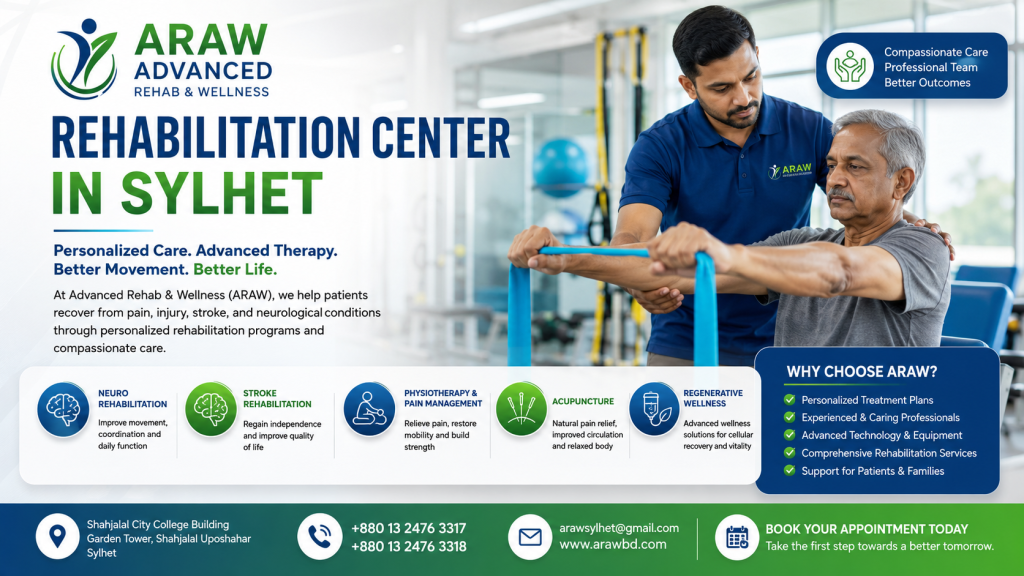
The center’s listed services include neuro rehabilitation, stroke rehabilitation, physiotherapy and pain management, acupuncture, and regenerative wellness. ARAW describes its approach as patient-focused, combining personalized treatment planning with modern healthcare technology and professional supervision.
This article explains what rehabilitation means, who may need it, what services are available at ARAW, and what patients should consider when choosing a rehabilitation center in Sylhet.
What Is a Rehabilitation Center?
A rehabilitation center is a healthcare facility that helps people improve their ability to move, communicate, work, care for themselves, and participate in everyday life after an illness, injury, operation, or disabling health condition.
The World Health Organization defines rehabilitation as a group of interventions designed to improve functioning and reduce disability. Rehabilitation can help children, adults, and older people become as independent as possible in their daily activities.
Rehabilitation is not limited to athletes or people with permanent disabilities. It may benefit someone who is:
- Recovering after a stroke
- Living with a neurological condition
- Experiencing weakness or balance problems
- Recovering after an accident or surgery
- Managing chronic back, neck, or joint pain
- Experiencing difficulty walking
- Trying to regain strength after prolonged illness
- Living with reduced mobility because of age
- Managing a musculoskeletal injury
- Experiencing difficulty with coordination or daily activities
The purpose of rehabilitation is not simply to treat a diagnosis. Its broader goal is to help the patient function more safely and independently at home, at work, and in the community.
Why Rehabilitation Is Important
Many health conditions continue to affect a patient even after emergency care or medical treatment has ended. A person may survive a stroke but still experience weakness, speech difficulty, poor balance, stiffness, swallowing problems, or challenges completing basic activities.
Similarly, someone with a spinal, joint, muscle, or nerve condition may continue to experience pain and restricted movement without a structured recovery plan.
Rehabilitation can focus on practical outcomes such as:
- Walking more safely
- Improving balance
- Increasing muscle strength
- Reducing stiffness
- Restoring joint movement
- Improving hand coordination
- Managing pain
- Returning to work
- Completing household activities
- Building confidence
- Reducing the risk of falls
- Learning safe ways to perform daily tasks
According to the World Health Organization, rehabilitation expands healthcare beyond prevention and medical treatment by helping people remain independent and participate in meaningful areas of life, including education, employment, family responsibilities, and recreation.
Who May Need a Rehabilitation Center in Sylhet?
A patient does not necessarily need to be completely unable to walk before seeking rehabilitation. Early assessment may be helpful whenever a health problem begins to affect movement, balance, strength, coordination, comfort, or independence.
A rehabilitation assessment may be considered for people experiencing the following conditions or symptoms.
Stroke-related difficulties
A stroke can affect movement, speech, swallowing, memory, balance, coordination, and the ability to complete daily activities. Rehabilitation may help patients work toward recovering lost abilities and learning new ways to perform essential tasks.
Neurological conditions
Conditions affecting the brain, spinal cord, or nerves may create weakness, tremors, poor coordination, difficulty walking, muscle stiffness, or loss of fine motor skills.
Back and neck pain
Persistent back or neck pain can affect sleep, work, exercise, driving, and daily mobility. A rehabilitation program may include assessment, therapeutic exercise, posture education, movement training, and other appropriate interventions.
Joint and muscle problems
Arthritis, sports injuries, sprains, muscle weakness, joint stiffness, and repetitive strain conditions may benefit from physiotherapy and progressive rehabilitation.
Post-surgical recovery
After certain operations, patients may need help rebuilding movement, strength, flexibility, endurance, and confidence.
Balance and walking difficulties
Older adults and people recovering from neurological or physical conditions may experience poor balance or an increased risk of falling. Structured balance and gait training can help improve safety.
Long-term pain
Persistent pain may require more than temporary pain relief. Rehabilitation can help patients understand their condition, manage activity, improve movement, and work toward functional goals.
Physiotherapy is commonly used to improve movement and ease pain associated with injuries, illnesses, disabilities, joint conditions, back pain, sports injuries, stroke, neurological conditions, and post-operative weakness.
Advanced Rehab & Wellness: A Rehabilitation Center in Sylhet
Advanced Rehab & Wellness is located in Garden Tower, Shahjalal Uposhahar, Sylhet. The center presents itself as a patient-focused healthcare facility offering rehabilitation, physiotherapy, pain management, acupuncture, and wellness services.
Its website emphasizes clear communication, personalized treatment plans, advanced healthcare technology, and ongoing patient support.
Instead of using the same treatment plan for every patient, rehabilitation should be based on the person’s condition, limitations, daily responsibilities, recovery goals, medical history, and response to therapy.
At ARAW, the published patient journey includes four main stages:
- Scheduling an appointment
- Receiving an initial consultation and assessment
- Starting a personalized treatment plan
- Continuing with follow-up care and progress monitoring
This structured process is designed to move the patient from initial evaluation to ongoing recovery support.
Rehabilitation Services Available at ARAW
1. Neuro Rehabilitation in Sylhet
Neuro rehabilitation is designed for people whose movement, balance, coordination, cognition, or daily functioning has been affected by a neurological disease or injury.
ARAW’s neuro rehabilitation service focuses on helping patients recover, adapt, and regain independence. The program includes movement-based and sensory-focused activities intended to support motor, cognitive, and functional abilities.
The neuro rehabilitation services described by ARAW include:
Neuroplasticity-focused exercises
Neuroplasticity refers to the nervous system’s capacity to adapt and reorganize. Therapeutic activities may be used to repeatedly practise specific movements and improve coordination.
Balance and gait training
Patients with neurological conditions may have difficulty standing, walking, changing direction, or maintaining balance. Balance and gait activities can focus on safer mobility and fall prevention.
Fine motor coordination
Fine motor rehabilitation may include activities for the hands, fingers, and wrists. These skills are important for writing, holding objects, eating, dressing, using a phone, and performing other daily tasks.
Individual neurological assessment
A detailed assessment helps identify a patient’s current abilities, limitations, reflexes, movement patterns, and functional goals. The findings can then guide an individualized rehabilitation plan.
Neuro rehabilitation may be relevant for patients recovering from or living with neurological conditions, but the appropriate treatment depends on medical clearance and individual clinical assessment.
2. Stroke Rehabilitation in Sylhet
Stroke rehabilitation is one of the most important forms of rehabilitation care. The effects of a stroke vary widely. One patient may experience weakness on one side of the body, while another may have difficulty speaking, swallowing, balancing, remembering instructions, or completing everyday activities.
ARAW’s stroke rehabilitation pathway lists physical, occupational, speech-related, mobility, and functional adaptation support. The service focuses on concerns such as muscle weakness, spasticity, affected-limb movement, speech barriers, swallowing difficulties, and loss of independence.
A stroke rehabilitation program may involve the following areas.
Movement retraining
Repeated, goal-directed movement exercises may help a patient practise using an affected arm or leg.
Balance and walking practice
Therapy may focus on sitting balance, standing, transferring between surfaces, walking with support, and gradually improving safe mobility.
Spasticity management
Some stroke survivors experience increased muscle tightness or involuntary stiffness. Appropriate stretching, positioning, movement, and medically supervised interventions may help manage these problems.
Speech and swallowing support
A stroke can affect speech, voice, language, and swallowing. These problems require evaluation by suitably qualified healthcare professionals.
Daily activity training
The patient may need to relearn or adapt activities such as dressing, bathing, eating, using the toilet, preparing food, and moving safely around the home.
Caregiver involvement
Family members often play an important role in stroke recovery. ARAW states that its stroke rehabilitation service can include family and caregiver guidance to support the patient’s transition into everyday life.
Recovery after a stroke is different for every individual. Some patients improve rapidly, while others require longer-term rehabilitation. A realistic program should be based on assessment, consistent practice, safety, and measurable functional goals.
3. Physiotherapy and Pain Management in Sylhet
Physiotherapy can support people experiencing pain, weakness, stiffness, reduced mobility, poor posture, joint problems, sports injuries, and post-surgical limitations.
ARAW’s physiotherapy and pain management service focuses on musculoskeletal biomechanics, joint movement, core stability, mobility, and soft-tissue-related problems. The website lists manual joint techniques, electrotherapy, ultrasound, core-stabilization exercises, posture assessment, and ergonomics-focused support among its available approaches.
Depending on the patient’s condition, a physiotherapy program may include:
- Movement assessment
- Posture evaluation
- Range-of-motion exercises
- Strengthening exercises
- Core stability training
- Balance activities
- Stretching
- Manual therapy
- Pain education
- Workplace ergonomics
- Home exercise guidance
- Progressive return to normal activity
Physiotherapy should not be based only on where the patient feels pain. A proper assessment may also examine movement habits, muscle weakness, joint mobility, posture, activity level, previous injuries, work demands, and lifestyle factors.
The number of sessions required varies. A minor injury may improve relatively quickly, while neurological conditions, long-term pain, major surgery, or severe weakness may require a longer rehabilitation period.
4. Acupuncture Services
ARAW also lists clinical acupuncture among its services. Its published approach includes the use of sterile, single-use needles placed at selected points, with options such as electro-acupuncture, dry needling for trigger points, and auricular point techniques.
Acupuncture or dry needling may be considered as one part of a wider treatment plan for selected patients. It should be provided by an appropriately trained professional after reviewing the patient’s health condition, medications, medical history, and treatment goals.
Patients should inform the practitioner about:
- Pregnancy
- Bleeding disorders
- Blood-thinning medication
- Skin infection
- Pacemakers or implanted electrical devices
- Fainting episodes
- Previous reactions to needling
Acupuncture should not replace urgent medical treatment or an appropriately prescribed rehabilitation program.
5. Regenerative Wellness
ARAW’s website also presents a regenerative wellness service focusing on cellular recovery, nutritional support, hydration, tissue-repair modalities, metabolic screening, and wellness planning.
Because regenerative and infusion-based treatments may not be suitable for every individual, patients should receive a qualified medical assessment and clear information about:
- The exact treatment being recommended
- Why it is being recommended
- Possible benefits
- Potential risks
- Available alternatives
- Expected cost
- Required follow-up
- The professional qualifications of the provider
No treatment should be considered a guaranteed cure. Rehabilitation and wellness outcomes depend on the diagnosis, severity of the condition, general health, consistency, and individual response.
The Importance of a Personalized Rehabilitation Plan
Two patients with the same diagnosis may have very different needs.
For example, two stroke survivors may both have weakness on the left side. However, one may need help returning to office work, while the other may need to regain the ability to walk safely inside the home.
A personalized rehabilitation plan should consider:
- Medical diagnosis
- Severity of the condition
- Pain level
- Muscle strength
- Joint mobility
- Balance
- Walking ability
- Hand function
- Communication ability
- Home environment
- Occupation
- Family support
- Personal goals
- Existing health conditions
The treatment plan should also be reviewed regularly. Exercises and interventions may need to change as the patient improves or as new challenges become apparent.
What to Expect During Your First Rehabilitation Visit
Patients visiting a rehabilitation center in Sylhet for the first time may feel uncertain about what will happen. A typical first appointment may include several stages.
Discussion of the main problem
The healthcare professional may ask when the problem began, what makes it better or worse, and how it affects daily life.
Medical history review
The patient should provide information about previous illnesses, operations, accidents, medications, test reports, and existing medical conditions.
Physical and functional assessment
Depending on the condition, the assessment may examine:
- Muscle strength
- Joint movement
- Posture
- Balance
- Walking
- Coordination
- Reflexes
- Pain behaviour
- Ability to complete daily tasks
Goal setting
The patient and professional may identify practical goals. A goal might be walking to the bathroom safely, climbing stairs, returning to work, using an affected hand, or sitting comfortably for a certain period.
Treatment planning
After the assessment, the professional may explain the recommended treatment, approximate frequency of visits, home exercises, precautions, and progress measures.
Patients should bring relevant prescriptions, imaging reports, discharge papers, laboratory reports, medication lists, and previous therapy records to the appointment.
How to Choose the Right Rehabilitation Center in Sylhet
Choosing a rehabilitation center is an important healthcare decision. Patients and families should evaluate more than advertisements or pricing.
Qualified healthcare professionals
Check whether the center has professionals with relevant education, training, registration, and experience.
ARAW’s website currently lists Professor Dr. N M Kiron as an acupuncture specialist and Dr. Fatema Zohra Akhand under Physical Medicine and Rehabilitation. Patients may request further information about the professional who will assess or treat their particular condition.
Detailed assessment
A responsible rehabilitation center should assess the patient before beginning a treatment program. Treatment should not be selected only from a symptom description over the phone.
Individualized care
The program should reflect the patient’s diagnosis, current abilities, lifestyle, and goals.
Clear communication
Patients should understand what treatment is being provided, who is providing it, what it is intended to achieve, and whether there are risks or alternatives.
Measurable progress
Progress may be tracked through improvements in strength, walking distance, balance, range of motion, pain-related function, or the ability to complete daily activities.
Safe and accessible environment
A rehabilitation center should be reasonably accessible for patients with wheelchairs, walking aids, weakness, or balance difficulties.
Family education
For stroke, neurological conditions, and older patients, family members may need guidance about safe transfers, positioning, home exercises, and fall prevention.
Follow-up support
Rehabilitation is a process. Follow-up appointments help the team review progress, update exercises, and respond to problems.
Why Choose a Local Rehabilitation Center in Sylhet?
Receiving care locally can make it easier for patients to attend sessions consistently. This is particularly important when rehabilitation requires repeated appointments over several weeks or months.
A rehabilitation center in Sylhet may provide practical advantages for local patients, including:
- Reduced travel time
- Easier caregiver participation
- More consistent appointment attendance
- Faster access to follow-up care
- Better understanding of the patient’s home environment
- Easier coordination with local doctors
- Reduced physical strain from long-distance travel
For patients with major mobility limitations, even a simple journey can be exhausting. Selecting an accessible local center may make the rehabilitation process more manageable for both the patient and the family.
The Role of Family Members in Rehabilitation
Family involvement can significantly influence a patient’s daily rehabilitation experience. Therapists may see a patient for a limited period, but the family often provides support throughout the rest of the day.
Family members can help by:
- Encouraging the patient without creating pressure
- Following professional safety instructions
- Supporting prescribed home exercises
- Helping organize appointments
- Monitoring changes in symptoms
- Creating a safer home environment
- Celebrating gradual progress
- Allowing the patient to perform tasks independently when safe
- Reporting new concerns to the healthcare team
Families should avoid forcing painful movements or introducing exercises that have not been recommended by a qualified professional.
How Long Does Rehabilitation Take?
There is no single rehabilitation timeline that applies to every patient.
The duration may depend on:
- Type of illness or injury
- Severity of impairment
- Age and general health
- Time between the health event and rehabilitation
- Presence of other medical conditions
- Frequency of treatment
- Participation in home exercises
- Family support
- Personal goals
- Individual response to therapy
Some musculoskeletal conditions may improve within a limited number of sessions. Stroke, spinal cord injury, neurological disease, major trauma, or severe deconditioning may require longer-term rehabilitation.
Patients should focus on functional progress rather than comparing their recovery with someone else’s.
Tips for Getting Better Results from Rehabilitation
Attend sessions consistently
Missing appointments may interrupt the progression of the treatment plan.
Follow the home program
Home exercises are often an essential part of rehabilitation. Perform only the exercises prescribed for your condition.
Report changes honestly
Tell the healthcare professional about increased pain, dizziness, unusual weakness, swelling, falls, breathing problems, or other changes.
Set realistic goals
Smaller goals can help patients recognize progress and remain motivated.
Ask questions
Patients should understand the purpose of each exercise or treatment.
Maintain healthy daily habits
Adequate sleep, nutrition, hydration, medication adherence, and appropriate activity may support the wider recovery process.
Avoid unapproved treatment changes
Do not stop prescribed medication, begin intense exercise, or use unverified therapies without consulting the appropriate medical professional.
Frequently Asked Questions About Rehabilitation Centers in Sylhet
What conditions are treated at a rehabilitation center?
A rehabilitation center may help patients recovering from stroke, neurological conditions, physical injury, surgery, muscle weakness, joint stiffness, mobility problems, balance difficulties, and persistent pain. Available services vary by facility.
Is rehabilitation only for stroke patients?
No. Rehabilitation may benefit people with many different illnesses, injuries, disabilities, pain conditions, and age-related functional problems.
Does ARAW provide stroke rehabilitation in Sylhet?
Yes. ARAW lists stroke rehabilitation as one of its core services, including support related to movement, spasticity, speech, swallowing, mobility, functional independence, and caregiver guidance.
Is neuro rehabilitation available at ARAW?
Yes. ARAW provides neuro rehabilitation services that include neurological assessment, coordination activities, balance and gait training, and fine motor exercises.
Does ARAW offer physiotherapy and pain management?
Yes. Its listed physiotherapy and pain management services include movement assessment, manual techniques, electrotherapy, ultrasound, core stabilization, posture evaluation, and ergonomics-focused care.
Do I need an assessment before starting rehabilitation?
An initial assessment is important because it allows the professional to understand your condition, identify functional limitations, review safety concerns, and prepare an appropriate treatment plan.
How many rehabilitation sessions will I need?
The number of sessions depends on your diagnosis, severity, goals, progress, and response to treatment. Ask the treating professional to review your progress regularly rather than guaranteeing a fixed recovery timeline.
Can family members participate?
Family involvement may be particularly helpful for stroke and neurological rehabilitation. ARAW states that caregiver and family guidance may be included in its stroke rehabilitation pathway.
What should I bring to my first appointment?
Bring medical prescriptions, test reports, X-rays or scans, hospital discharge papers, a list of medications, previous therapy records, and any walking aid or support device you currently use.
Where is Advanced Rehab & Wellness located?
Advanced Rehab & Wellness is located at Shahjalal City College Building, Garden Tower, Shahjalal Uposhahar, Sylhet. The center lists two appointment numbers: +880 13 2476 3317 and +880 13 2476 3318. Its published email address is arawsylhet@gmail.com. Patients should confirm the relevant service schedule before visiting.
Begin Your Recovery Journey at Advanced Rehab & Wellness
Recovery is not always immediate or straightforward. It may require professional assessment, consistent practice, family support, realistic goals, and regular review.
Choosing the right rehabilitation center in Sylhet can help patients access structured support close to home. Advanced Rehab & Wellness offers services covering neuro rehabilitation, stroke rehabilitation, physiotherapy and pain management, acupuncture, and regenerative wellness.
Whether you are recovering from a stroke, experiencing neurological movement problems, managing persistent pain, rebuilding strength after an injury, or trying to regain independence, the first step is an appropriate professional assessment.
Contact Advanced Rehab & Wellness to discuss your condition, confirm the suitable specialist, and schedule an appointment.
Advanced Rehab & Wellness
Address: Shahjalal City College Building, Garden Tower, Shahjalal Uposhahar, Sylhet
Phone: +880 13 2476 3317, +880 13 2476 3318
Email: arawsylhet@gmail.com
Medical Disclaimer
This article is provided for general educational and informational purposes. It is not a diagnosis, medical prescription, or substitute for consultation with a qualified healthcare professional. Treatment suitability, risks, expected outcomes, and rehabilitation duration vary from person to person. Seek emergency medical assistance for sudden weakness, facial drooping, difficulty speaking, severe chest pain, loss of consciousness, breathing difficulty, major trauma, or other urgent symptoms.