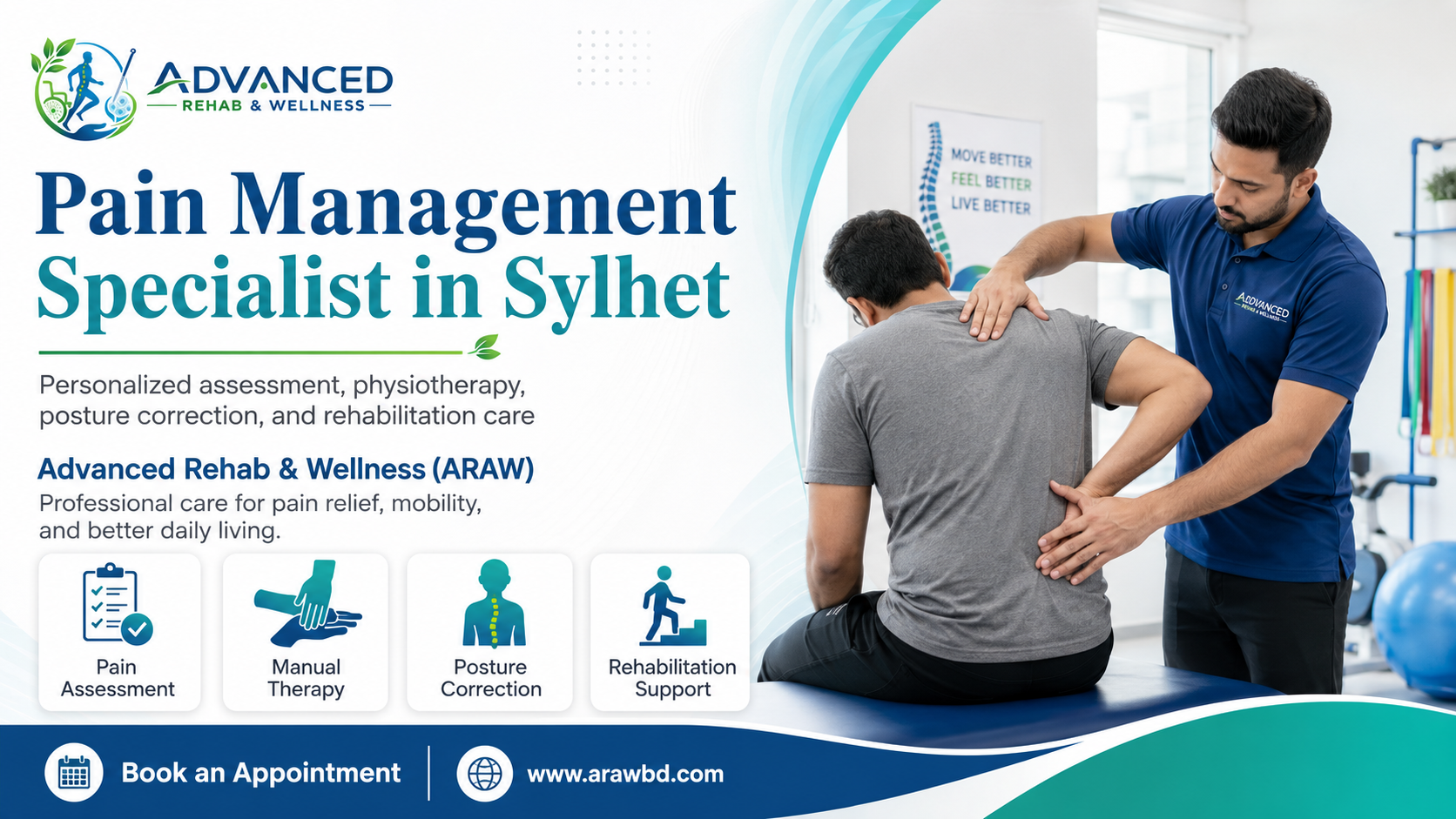
Pain can affect almost every part of a person’s life. It may interfere with sleep, movement, work, exercise, family responsibilities, concentration, and emotional well-being. While mild pain may improve with rest and basic care, persistent or recurring pain often requires a professional assessment.
People searching for a pain management specialist in Sylhet may be experiencing back pain, neck pain, knee pain, shoulder stiffness, nerve-related discomfort, sports injuries, arthritis, muscle weakness, post-surgical pain, or another condition affecting normal movement.
Advanced Rehab & Wellness, also known as ARAW, provides physiotherapy and pain-management services at Shahjalal Uposhahar in Sylhet. Its published approach focuses on personalized assessment, musculoskeletal biomechanics, joint mechanics, core stability, mobility, and physical rehabilitation rather than relying only on temporary symptom relief.
This article explains what pain management involves, when you should seek professional care, which conditions may benefit from rehabilitation, and what patients can expect when visiting Advanced Rehab & Wellness.
What Is Pain Management?
Pain management is a healthcare approach used to assess, reduce, and control pain while helping the patient improve movement, physical function, independence, and quality of life.
The goal is not always to make every sensation disappear immediately. In many cases, effective pain management focuses on helping the patient move safely, sleep better, complete everyday activities, return to work, and manage the condition more confidently.
A pain-management plan may involve:
- Medical assessment
- Physiotherapy
- Therapeutic exercises
- Manual therapy
- Posture correction
- Movement retraining
- Pain education
- Lifestyle adjustments
- Ergonomic guidance
- Medication prescribed by an appropriate doctor
- Rehabilitation after injury or surgery
- Referral for diagnostic testing when necessary
- Acupuncture or other complementary treatments for suitable patients
The appropriate approach depends on the type of pain, its cause, duration, severity, location, and effect on the patient’s daily life.
Understanding Acute and Chronic Pain
Pain is commonly divided into acute pain and chronic pain.
Acute pain
Acute pain usually begins suddenly and may be connected to a clear cause, such as:
- A fall
- A sports injury
- A muscle strain
- A ligament sprain
- A fracture
- Surgery
- An accident
- Sudden back or neck injury
Acute pain often improves as the affected tissue heals. However, professional assessment may still be necessary when the pain is severe, movement is significantly restricted, or symptoms do not improve as expected.
Chronic pain
Chronic pain continues for an extended period and may last beyond the expected healing time. It can be constant or may come and go.
Examples may include:
- Long-term lower-back pain
- Persistent neck pain
- Arthritis-related pain
- Recurrent knee pain
- Shoulder pain
- Nerve pain
- Chronic headaches
- Fibromyalgia-related symptoms
- Long-term pain following an injury
- Pain associated with neurological conditions
The World Health Organization describes chronic primary lower-back pain as pain lasting more than three months when it is not explained by another underlying disease or condition. WHO recommends a person-centred and coordinated approach that may include education, exercise, selected physical therapies, psychological support, and appropriate medication.
Why You Should Not Ignore Persistent Pain
Pain is the body’s way of communicating that something may require attention. Taking pain medicine without understanding the cause may temporarily reduce discomfort, but it may not address the underlying problem.
Untreated or poorly managed pain can lead to:
- Reduced movement
- Muscle weakness
- Joint stiffness
- Poor posture
- Sleep disturbance
- Reduced work performance
- Fear of movement
- Loss of physical confidence
- Dependence on family members
- Reduced participation in social activities
- Emotional stress
- Lower quality of life
When people avoid movement because they fear pain, the muscles may become weaker and the joints may become stiffer. This can create a cycle in which reduced activity contributes to further discomfort and physical limitation.
A professional assessment can help determine whether the patient needs physiotherapy, rehabilitation, medication review, imaging, specialist referral, or another form of care.
When Should You Consult a Pain Management Specialist in Sylhet?
You should consider seeking professional advice when pain:
- Lasts for more than a few days without improvement
- Returns repeatedly
- Continues for several weeks or months
- Limits walking, sitting, lifting, bending, or sleeping
- Interferes with work or household activities
- Begins after an accident or sports injury
- Is accompanied by weakness or reduced movement
- Spreads into an arm or leg
- Causes numbness, tingling, or burning sensations
- Becomes worse despite rest or basic care
- Returns after previous treatment
- Develops after surgery
- Affects balance or increases the risk of falling
A qualified healthcare professional should assess the patient before recommending a specific treatment plan.
Conditions That May Require Pain-Management Care
A pain-management and physiotherapy service may support patients with a variety of musculoskeletal, neurological, and post-surgical conditions.
Lower-back pain
Lower-back pain is one of the most common reasons people seek physiotherapy or pain-management care. It may be associated with:
- Muscle strain
- Poor posture
- Prolonged sitting
- Heavy lifting
- Weak core muscles
- Reduced spinal mobility
- Disc-related problems
- Sciatic nerve irritation
- Arthritis
- Previous injury
Lower-back pain treatment should be based on an assessment rather than a general exercise program copied from the internet.
Neck pain
Neck pain may develop because of desk work, prolonged mobile-phone use, poor sleeping positions, muscle tension, joint stiffness, injury, or nerve irritation.
Some patients may also experience:
- Shoulder discomfort
- Headaches
- Arm pain
- Tingling
- Reduced neck movement
- Difficulty driving or working at a computer
Knee pain
Knee pain can affect people of all ages. It may be related to:
- Osteoarthritis
- Sports injuries
- Ligament problems
- Muscle weakness
- Poor movement mechanics
- Patellofemoral pain
- Meniscus injuries
- Previous surgery
- Excessive physical activity
Pain-management care may focus on improving strength, joint movement, balance, and safe loading of the knee.
Shoulder pain
Shoulder pain may make it difficult to lift the arm, wear clothes, carry objects, sleep comfortably, or perform household tasks.
Common causes include:
- Frozen shoulder
- Rotator cuff problems
- Tendon irritation
- Muscle weakness
- Poor posture
- Joint stiffness
- Injury
Arthritis and joint pain
Arthritis can cause pain, swelling, stiffness, reduced movement, and difficulty completing daily activities. Rehabilitation cannot reverse every form of arthritis, but an appropriate program may help patients maintain strength, mobility, and independence.
Sports injuries
Athletes and physically active individuals may experience:
- Muscle strains
- Ligament sprains
- Tendon problems
- Joint injuries
- Overuse injuries
- Back pain
- Knee pain
- Shoulder injuries
Sports rehabilitation should progress gradually and include a safe return-to-activity plan.
Post-surgical pain and weakness
After some surgical procedures, patients may experience pain, weakness, swelling, reduced movement, or fear of using the affected area.
A rehabilitation plan may help the patient:
- Restore movement
- Improve strength
- Reduce stiffness
- Return to daily activities
- Walk more safely
- Follow post-operative precautions
Nerve-related pain
Nerve pain may feel like burning, electric shocks, tingling, pins and needles, numbness, or pain that travels into an arm or leg.
Because nerve symptoms can have different causes, professional assessment is important before starting treatment.
Pain Management at Advanced Rehab & Wellness
Advanced Rehab & Wellness provides a dedicated physiotherapy and pain-management service in Sylhet. According to its website, the service considers joint mechanics, core stability, deep-tissue problems, posture, and functional movement when creating a patient’s care plan.
ARAW also states that it uses a patient-focused approach, combining personalized treatment planning with modern healthcare technology and clear communication. Its broader services include neuro rehabilitation, stroke rehabilitation, physiotherapy and pain management, acupuncture, and regenerative wellness.
The exact treatment recommended will depend on the assessment findings and the patient’s medical condition.
Pain-Management Services Available at ARAW
1. Initial physical and functional assessment
The first step in managing pain should be identifying how the condition affects movement and daily function.
An assessment may examine:
- Location of pain
- Type and intensity of pain
- Joint range of motion
- Muscle strength
- Posture
- Walking pattern
- Balance
- Flexibility
- Nerve-related symptoms
- Previous injuries
- Occupational demands
- Daily activity limitations
The clinician may also ask about previous treatments, medical conditions, medication, imaging reports, and the patient’s recovery goals.
2. Manual joint mobilization
Manual therapy involves carefully applied hands-on techniques designed to improve joint mobility, reduce stiffness, and support more comfortable movement.
ARAW lists controlled manual joint-mobilization techniques within its physiotherapy and pain-management service.
Manual therapy should be selected only after an appropriate assessment. It is often combined with exercises rather than used as the only treatment.
3. Therapeutic exercise
Therapeutic exercise is one of the most important parts of physical rehabilitation.
Depending on the patient’s condition, exercises may focus on:
- Strength
- Flexibility
- Core stability
- Joint mobility
- Balance
- Coordination
- Endurance
- Posture
- Safe movement patterns
Physiotherapy can include exercises, stretching, strengthening, supervised movements, manual techniques, and selected physical modalities. It may help improve strength, flexibility, mobility, and confidence following an injury, operation, or health condition.
4. Core-stability training
The core includes muscles around the abdomen, lower back, pelvis, and hips. These muscles help support the spine and control movement.
Weakness or poor coordination in these areas may contribute to difficulties with:
- Lifting
- Bending
- Sitting
- Standing
- Walking
- Sports
- Household activities
ARAW lists kinetic core stabilization as one of its approaches for supporting load-bearing areas of the body.
5. Electrotherapy and ultrasound
Selected patients may be offered physical modalities such as electrotherapy or therapeutic ultrasound as part of a broader rehabilitation program.
These treatments should not automatically be used for every type of pain. Their suitability depends on the diagnosis, symptoms, medical history, and professional assessment.
6. Posture and spinal assessment
Poor posture does not explain every painful condition, but prolonged or repeated positions may contribute to discomfort in some patients.
A posture and movement assessment may examine:
- Sitting position
- Standing alignment
- Spinal mobility
- Shoulder position
- Workstation arrangement
- Lifting technique
- Repeated movement habits
ARAW lists spinal-alignment and posture-focused evaluations as part of its pain-management service.
7. Workplace ergonomics
Office workers may spend many hours sitting at a desk, using a computer, or looking at a mobile device.
This can contribute to:
- Neck stiffness
- Shoulder tension
- Wrist discomfort
- Lower-back pain
- Headaches
- Reduced flexibility
Ergonomic guidance may include recommendations about chair height, screen position, keyboard placement, work breaks, posture changes, and simple workplace exercises.
ARAW lists a corporate desk-ergonomics package that combines physical adjustments with muscle-preservation training.
8. Acupuncture for selected patients
ARAW also offers acupuncture as a separate service. Some patients may consider acupuncture or dry needling as part of a wider pain-management program.
These techniques should be performed by an appropriately trained professional using sterile equipment and after reviewing medical history, medication, pregnancy status, bleeding risks, and other relevant health concerns.
Acupuncture should not replace urgent medical care, necessary diagnostic testing, or treatment recommended by a qualified doctor.
The Importance of Personalized Pain Management
The same treatment does not work for every patient.
For example, two people may both report lower-back pain, but the cause and contributing factors may be completely different. One person may have developed pain after heavy lifting, while another may have muscle weakness associated with prolonged desk work.
A personalized treatment plan may consider:
- Age
- Medical history
- Type of pain
- Duration of symptoms
- Physical examination findings
- Lifestyle
- Occupation
- Sleep
- Stress
- Physical activity
- Previous treatment
- Personal goals
WHO recommends a holistic and person-centred approach for chronic lower-back pain because physical, psychological, and social factors can all influence a patient’s pain experience.
What to Expect During Your First Appointment
When visiting a pain-management service for the first time, the appointment may include several stages.
Medical history discussion
The professional may ask:
- When did the pain begin?
- Was there an injury?
- What makes the pain worse?
- What reduces the pain?
- Does the pain spread?
- Is there numbness or weakness?
- How does the pain affect daily activities?
- Have you received treatment before?
Physical assessment
The assessment may involve checking movement, strength, balance, posture, flexibility, and painful activities.
Review of reports
Patients should bring relevant:
- Prescriptions
- X-rays
- MRI or CT reports
- Blood-test reports
- Hospital discharge documents
- Surgical records
- Previous physiotherapy records
- Medication lists
Goal setting
Pain-management goals should be practical and measurable.
Examples include:
- Sitting comfortably for 30 minutes
- Walking without severe discomfort
- Sleeping better
- Returning to work
- Climbing stairs
- Lifting household items safely
- Returning to exercise
- Reducing reliance on support from family members
Treatment planning
After the assessment, the professional may explain:
- The possible cause of symptoms
- Recommended treatment
- Exercise instructions
- Activity precautions
- Expected follow-up
- When medical referral may be necessary
ARAW describes its general patient process as appointment scheduling, initial consultation, personalized treatment planning, and follow-up monitoring.
How Many Treatment Sessions Will You Need?
There is no universal number of sessions for pain management.
Treatment duration may depend on:
- Cause of pain
- Duration of symptoms
- Severity
- Age
- General health
- Type of injury
- Previous surgery
- Muscle strength
- Joint mobility
- Consistency with home exercises
- Daily activities
- Response to treatment
A minor muscle strain may improve relatively quickly, while long-term back pain, arthritis, neurological conditions, or post-surgical weakness may require a longer rehabilitation program.
Patients should avoid healthcare providers who guarantee a complete cure or promise an exact recovery date without conducting a detailed assessment.
Benefits of Physiotherapy-Based Pain Management
A properly designed rehabilitation plan may help patients:
- Reduce pain-related limitations
- Improve joint mobility
- Increase muscle strength
- Improve flexibility
- Develop better movement habits
- Return to work
- Resume exercise
- Improve balance
- Reduce stiffness
- Become more independent
- Understand how to manage symptoms
- Reduce the risk of repeated injury
The World Health Organization explains that rehabilitation can reduce or manage complications associated with acute and chronic health conditions, address pain, support self-management, and help individuals remain independent or return to work.
Why Choose a Local Pain Management Center in Sylhet?
Pain treatment may require several appointments. Choosing a center close to home can make regular attendance more manageable.
Potential benefits include:
- Reduced travel time
- Easier follow-up
- Lower physical strain during travel
- Better appointment consistency
- Easier family participation
- Faster access when symptoms change
- Convenient communication with the care team
Advanced Rehab & Wellness is located at Shahjalal City College Building, Garden Tower, Shahjalal Uposhahar, Sylhet. Its website lists physiotherapy and pain-management appointment hours from Saturday to Wednesday, 9:00 AM–2:00 PM and 4:00 PM–9:00 PM. Patients should confirm the current schedule before visiting.
How to Choose a Pain Management Specialist in Sylhet
Before selecting a pain-management provider, consider the following points.
Professional qualifications
Ask who will assess and treat you, and check whether the professional has appropriate training and experience.
Detailed assessment
Treatment should begin with a proper clinical assessment rather than starting the same therapy for every patient.
Personalized treatment plan
The plan should reflect your diagnosis, lifestyle, limitations, and goals.
Clear explanation
You should understand why a treatment is recommended and what results are realistically expected.
Focus on function
Effective pain management should aim to improve your ability to move and complete meaningful activities—not only provide temporary relief.
Home guidance
You may need advice about exercises, posture, work habits, activity levels, and symptom management between appointments.
Progress monitoring
The professional should review whether strength, movement, pain-related function, and daily activities are improving.
Tips for Supporting Your Recovery
Follow your prescribed exercise program
Complete only the exercises recommended for your condition. Performing unsuitable exercises may aggravate symptoms.
Stay active within safe limits
Complete bed rest is not appropriate for every condition. Ask your healthcare professional what activities are safe.
Improve your workstation
Adjust your chair, desk, screen, and keyboard when prolonged sitting contributes to discomfort.
Take movement breaks
Change position regularly instead of remaining in the same posture for several hours.
Maintain healthy sleep habits
Poor sleep can increase pain sensitivity and make recovery more difficult.
Communicate honestly
Tell your clinician if treatment increases your symptoms or if you experience new weakness, numbness, swelling, dizziness, or other concerns.
Avoid self-medication
Do not repeatedly use pain medicine without medical advice. Some medicines may have side effects or interact with other medications.
Warning Signs Requiring Urgent Medical Attention
Pain sometimes indicates a serious medical problem. Seek urgent or emergency medical care when pain is accompanied by:
- Chest pain
- Difficulty breathing
- Sudden facial weakness
- Sudden arm or leg weakness
- Difficulty speaking
- Loss of consciousness
- Severe pain after a major accident
- Loss of bladder or bowel control
- Numbness around the groin
- Rapidly worsening weakness
- High fever with severe pain
- Unexplained weight loss
- Severe abdominal pain
- A visibly deformed or unstable joint
- Suspected fracture
A physiotherapy appointment should not delay emergency medical treatment.
Frequently Asked Questions
Who is the best pain management specialist in Sylhet?
The appropriate specialist depends on the cause of your pain. A patient may need a physical medicine and rehabilitation doctor, physiotherapist, orthopaedic specialist, neurologist, rheumatologist, or another healthcare professional. Begin with a detailed assessment and ask the clinic to confirm which professional is appropriate for your condition.
Does ARAW provide pain-management services?
Yes. Advanced Rehab & Wellness lists physiotherapy and pain management among its main services. Its published approaches include musculoskeletal assessment, manual joint mobilization, core stabilization, electrotherapy, ultrasound, posture assessment, and ergonomic support.
Can physiotherapy help lower-back pain?
Physiotherapy may help some patients improve strength, flexibility, mobility, movement confidence, and pain-related function. The treatment should be selected after assessing the cause of symptoms.
Can pain be treated without surgery?
Many musculoskeletal pain conditions can be managed through nonsurgical approaches. WHO’s chronic lower-back pain guidance includes education, exercise, selected physical therapies, psychological support, and appropriate medication. Surgery or invasive treatment may still be necessary for certain conditions.
Do I need an MRI before physiotherapy?
Not every patient requires an MRI before physiotherapy. The need for imaging depends on symptoms, medical history, examination findings, and warning signs. A qualified healthcare professional should decide whether diagnostic testing is necessary.
Is physiotherapy painful?
Some exercises or movements may cause temporary discomfort, particularly when an area is stiff or weak. However, treatment should not cause uncontrolled or severe pain. Inform your therapist immediately if symptoms increase significantly.
How soon will I feel better?
Recovery differs from person to person. It depends on the condition, severity, duration of symptoms, general health, treatment consistency, and response to rehabilitation.
Can I continue working during treatment?
Many patients can continue working with suitable modifications. A clinician may recommend changes to sitting, lifting, standing, driving, or computer use.
Where is Advanced Rehab & Wellness located?
Advanced Rehab & Wellness is located at Shahjalal City College Building, Garden Tower, Shahjalal Uposhahar, Sylhet.
How can I book an appointment?
You can contact ARAW using the following details:
Phone: +880 13 2476 3317 or +880 13 2476 3318
Email: arawsylhet@gmail.com
Address: Shahjalal City College Building, Garden Tower, Shahjalal Uposhahar, Sylhet
Consult a Pain Management Specialist in Sylhet
Living with pain can make simple daily activities feel difficult. However, pain should not automatically be accepted as a permanent part of life.
A professional assessment can help identify physical limitations, contributing factors, warning signs, and suitable treatment options. Depending on the condition, a personalized plan may combine therapeutic exercise, manual therapy, mobility training, posture correction, ergonomic guidance, selected physical modalities, and medical referral.
For people searching for a pain management specialist in Sylhet, Advanced Rehab & Wellness provides local access to physiotherapy, rehabilitation, pain-management assessment, acupuncture, neuro rehabilitation, and stroke rehabilitation services.
Contact ARAW to discuss your symptoms, confirm the appropriate healthcare professional, and schedule an initial consultation.
Contact Advanced Rehab & Wellness
Advanced Rehab & Wellness—ARAW
Address:
Shahjalal City College Building
Garden Tower, Shahjalal Uposhahar
Sylhet, Bangladesh
Phone:
+880 13 2476 3317
+880 13 2476 3318
Email:
arawsylhet@gmail.com
Medical Disclaimer
This article is intended for general information and health education only. It does not provide a diagnosis, prescription, or guarantee of treatment results. Pain may have many possible causes, and treatment must be selected after an appropriate assessment by a qualified healthcare professional. Seek emergency medical attention for sudden weakness, chest pain, breathing difficulty, major trauma, loss of consciousness, or other urgent symptoms.