Looking for an Orthopaedic Doctor in Sylhet? Consult Dr. Md. Almahir Ferdous for bone and joint problems, knee pain, back and neck pain, fractures, trauma, sports injuries and musculoskeletal conditions at Advanced Rehab & Wellness—ARAW.
Orthopaedic Doctor in Sylhet: When Should You See a Bone and Joint Specialist?
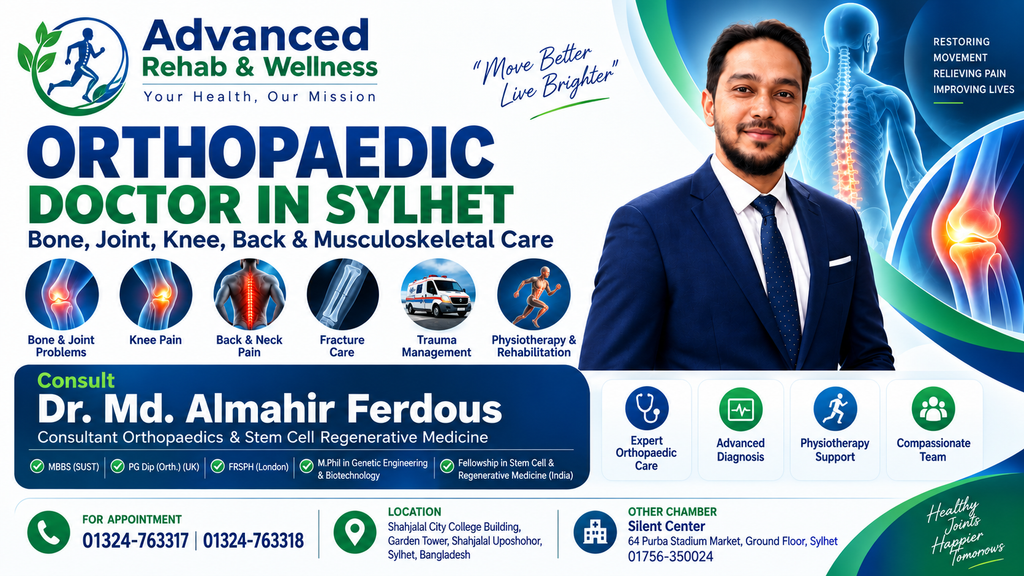
Orthopaedic Doctor in Sylhet: Persistent knee pain, back pain, neck discomfort, shoulder stiffness, fractures, sports injuries and other bone or joint problems can gradually interfere with normal life.
At first, a patient may only notice discomfort during activity. Over time, the problem may affect:
- Walking
- Climbing stairs
- Working
- Sleeping
- Exercise
- Driving
- Lifting
- Standing from a chair
- Daily household activities
Orthopaedic Doctor in Sylhet, These problems are broadly known as musculoskeletal conditions because they affect structures such as bones, joints, muscles, tendons, ligaments and surrounding connective tissues.
The World Health Organization estimates that around 1.71 billion people worldwide live with musculoskeletal conditions, making them the leading contributor to disability globally. These conditions include back pain, neck pain, fractures, osteoarthritis and many other disorders affecting movement and physical function.
For people searching for an Orthopaedic Doctor in Sylhet, Advanced Rehab & Wellness—ARAW currently lists Dr. Md. Almahir Ferdous as a Consultant in Orthopaedics and Stem Cell Regenerative Medicine. His professional interests include bone and joint disorders, fractures, trauma, knee and shoulder problems, hand conditions, musculoskeletal rehabilitation and related orthopaedic concerns.
Orthopaedic Doctor in Sylhet, This guide explains what an orthopaedic doctor does, which symptoms may require consultation, how common conditions are assessed and what patients should know before visiting an orthopaedic specialist in Sylhet.
What Is Orthopaedics?
Orthopaedic Doctor in Sylhet, Orthopaedics is the branch of medicine concerned with the musculoskeletal system.
This includes:
- Bones
- Joints
- Muscles
- Ligaments
- Tendons
- Cartilage
- Related connective tissues
WHO describes musculoskeletal conditions as more than 150 diseases and disorders affecting muscles, bones, joints and adjacent tissues. These conditions can cause pain, reduced mobility, loss of dexterity and temporary or long-term limitations in daily activities.
An orthopaedic doctor therefore does more than treat broken bones.
Patients may seek orthopaedic assessment for pain, injury, reduced joint movement, degenerative disease, sports-related problems and complications following trauma.
What Does an Orthopaedic Doctor Do?
An orthopaedic doctor evaluates conditions affecting bones, joints and surrounding musculoskeletal structures.
The assessment usually begins with:
- Medical history
- Description of symptoms
- Previous injuries
- Previous operations
- Physical examination
- Review of existing X-rays, MRI or CT scans when available
Further investigation may be recommended when necessary.
Treatment depends on the diagnosis and may involve:
- Activity modification
- Medication
- Physiotherapy
- Exercise and rehabilitation
- Braces or other support
- Follow-up imaging
- Selected procedures
- Surgical referral or surgery where appropriate
The important point is that orthopaedic treatment does not automatically mean surgery.
Orthopaedic Doctor in Sylhet, Many musculoskeletal problems can initially be managed non-surgically depending on the diagnosis and severity.
Orthopaedic Doctor in Sylhet – Dr. Md. Almahir Ferdous
For patients searching for an Orthopaedic Doctor in Sylhet, Dr. Md. Almahir Ferdous currently provides orthopaedic consultation through Advanced Rehab & Wellness.
ARAW lists him as a Consultant in Orthopaedics and Stem Cell Regenerative Medicine and Chairman of Advanced Rehab & Wellness.
Listed Academic Qualifications
According to his current ARAW profile, his qualifications include:
- MBBS – Shahjalal University of Science and Technology
- PG Diploma in Orthopaedics – UK
- FRSPH – London
- M.Phil in Genetic Engineering and Biotechnology
- Fellowship in Stem Cell & Regenerative Medicine – India
Orthopaedic Doctor in Sylhet, His profile also lists specialised training in orthopaedics, trauma, and hand surgery.
What Conditions Can an Orthopaedic Doctor Assess?
1. Knee Pain
Knee pain is one of the most common reasons patients seek orthopaedic care.
It may be associated with:
- Osteoarthritis
- Previous injury
- Ligament problems
- Meniscus injuries
- Sports injuries
- Fractures
- Repetitive strain
- Joint inflammation
- Age-related changes
Orthopaedic Doctor in Sylhet, The knee is the most frequently affected joint in osteoarthritis. WHO estimates that around 365 million people worldwide have knee osteoarthritis.
An orthopaedic assessment may be especially useful when knee pain:
- Continues for several weeks
- Keeps returning
- Causes swelling
- Makes walking difficult
- Interferes with stairs
- Causes the knee to give way
- Follows an injury
- Limits normal activity
Orthopaedic Doctor in Sylhet, Treatment should depend on the underlying cause rather than simply the location of the pain.
2. Knee Osteoarthritis
Knee osteoarthritis can cause:
- Pain
- Swelling
- Stiffness
- Reduced movement
- Weakness
- Difficulty walking
- Difficulty climbing stairs
WHO describes osteoarthritis as a condition affecting the entire joint and surrounding tissues rather than simply “wear and tear.”
Many patients worry that an osteoarthritis diagnosis automatically means knee replacement.
It does not.
Depending on severity, management may involve:
- Exercise
- Muscle strengthening
- Weight management where appropriate
- Physiotherapy
- Medication
- Activity modification
- Assistive devices
Joint replacement may be considered when disease is severe and pain or loss of function significantly affects daily life.
3. Back Pain
Back pain can affect people of almost any age.
Possible contributors include:
- Muscle strain
- Heavy lifting
- Reduced physical conditioning
- Repetitive work
- Previous injury
- Degenerative changes
- Disc-related problems
- Nerve irritation
Orthopaedic Doctor in Sylhet, Persistent back pain may require an assessment to determine whether the problem is likely musculoskeletal or whether additional investigation is necessary.
Patients should mention symptoms such as:
- Pain spreading into the leg
- Numbness
- Tingling
- Weakness
- Significant trauma
Orthopaedic Doctor in Sylhet, because these details may influence the clinical assessment.
4. Neck Pain
Neck pain can affect:
- Computer work
- Driving
- Sleeping
- Reading
- Head movement
Possible causes include muscle and joint problems, previous trauma and degenerative cervical changes.
Orthopaedic Doctor in Sylhet, An orthopaedic evaluation may be appropriate when neck pain is persistent or associated with:
- Arm pain
- Numbness
- Tingling
- Weakness
- Restricted movement
Progressive neurological symptoms should be evaluated promptly.
5. Shoulder Pain
Shoulder problems can make simple activities difficult.
Patients may struggle to:
- Raise an arm
- Dress
- Reach overhead
- Carry objects
- Sleep on the affected side
Possible causes include:
- Frozen shoulder
- Rotator cuff disorders
- Tendon problems
- Sports injuries
- Arthritis
- Previous fractures
- Trauma
An orthopaedic assessment can help determine whether treatment should involve rehabilitation, medication, further investigation or another approach.
6. Bone Fractures
A fracture can result from:
- Road accidents
- Falls
- Sports injuries
- Workplace injuries
- Direct trauma
- Fragile bones in older adults
Symptoms may include:
- Severe pain
- Swelling
- Bruising
- Difficulty moving the limb
- Inability to bear weight
- Visible deformity
Fractures require appropriate diagnosis because treatment varies depending on:
- Which bone is affected
- Fracture pattern
- Displacement
- Joint involvement
- Age
- Overall health
Treatment may involve immobilisation, casting, fixation or surgery depending on the injury.
Dr. Md. Almahir Ferdous’s published profile includes training and professional interests related to trauma and fracture management.
7. Fracture Healing Problems
Most fractures gradually heal, but some take longer than expected.
Possible problems include:
- Delayed healing
- Persistent pain
- Reduced function
- Abnormal movement
- Difficulty returning to normal activity
An orthopaedic doctor may review:
- Previous X-rays
- Treatment history
- Current symptoms
- Limb alignment
- Functional ability
Further investigations may be required when healing is delayed.
ARAW’s current orthopaedic information specifically includes bone-healing and union-related problems among the areas evaluated in orthopaedic care.
8. Sports Injuries
Football, cricket, badminton, running and gym activities can lead to injuries involving:
- Ligaments
- Muscles
- Tendons
- Joints
- Bones
Common symptoms include:
- Swelling
- Pain
- Instability
- Weakness
- Reduced movement
Returning to sport should ideally depend on recovery of function rather than simply waiting until pain decreases.
Treatment may involve orthopaedic assessment followed by physiotherapy and progressive sports rehabilitation.
9. Hand and Wrist Problems
The hand and wrist contain many small bones, joints, tendons, nerves and ligaments.
Problems may affect:
- Grip
- Writing
- Lifting
- Finger movement
- Work activities
Dr. Md. Almahir Ferdous’s current professional profile lists specialised training related to hand surgery, supporting his professional interest in relevant hand and upper-limb problems.
10. Trauma-Related Orthopaedic Problems
Road traffic accidents and falls may cause more than a single fracture.
Patients may experience combinations of:
- Bone injury
- Joint injury
- Soft-tissue injury
- Restricted mobility
- Muscle weakness
- Post-traumatic pain
Orthopaedic trauma care may therefore involve both initial treatment and subsequent rehabilitation.
ARAW’s current orthopaedic page highlights trauma assessment and rehabilitation needs as part of Dr. Ferdous’s professional area of interest.
When Should You See an Orthopaedic Doctor?
Consider an orthopaedic consultation when:
- Pain persists
- Symptoms repeatedly return
- A joint remains swollen
- Movement is restricted
- Walking becomes difficult
- Pain affects sleep
- You cannot return to sport
- An old fracture remains painful
- A joint repeatedly gives way
- Pain follows significant trauma
- Daily activities are increasingly difficult
Earlier assessment may help determine whether the problem requires simple rehabilitation, investigation or specialist treatment.
When Should You Seek Emergency Care?
Some injuries should not wait for a routine orthopaedic appointment.
Seek urgent medical attention after serious trauma if:
- A limb looks deformed
- Bone may be exposed
- You cannot bear weight
- There is severe uncontrolled pain
- The affected limb becomes cold or numb
- Significant bleeding is present
- There is sudden major weakness
A very hot, swollen joint accompanied by fever can also require urgent assessment because joint infection must be considered.
What Happens During an Orthopaedic Consultation?
A consultation usually begins with a detailed history.
The doctor may ask:
- When did the symptoms start?
- Was there an injury?
- Where exactly is the pain?
- What makes it worse?
- Does the joint swell?
- Is there numbness?
- Do you experience weakness?
- Have you had surgery before?
- What medication are you taking?
- What treatment have you already received?
Physical examination may include:
- Joint movement
- Strength
- Tenderness
- Stability
- Swelling
- Walking
- Neurological examination when relevant
The findings help determine the next step.
Do You Need an X-Ray?
Not every orthopaedic condition requires an X-ray.
An X-ray may be useful when there is concern about:
- Fracture
- Joint alignment
- Degenerative changes
- Bone abnormalities
The need should be determined according to the clinical situation.
When Is an MRI Useful?
MRI can provide detailed information about soft tissues.
It may be considered for selected:
- Ligament injuries
- Meniscus problems
- Tendon injuries
- Disc-related conditions
- Other soft-tissue problems
An MRI should be interpreted alongside the patient’s symptoms and examination findings rather than being treated as the diagnosis by itself.
Orthopaedics and Physiotherapy
Orthopaedic care and physiotherapy often work together.
WHO identifies musculoskeletal conditions as the largest overall contributor to rehabilitation needs worldwide.
After an appropriate diagnosis, physiotherapy may help patients improve:
- Strength
- Joint movement
- Balance
- Walking
- Physical endurance
- Function after surgery
- Return to work
- Return to sport
At Advanced Rehab & Wellness, orthopaedic assessment can be connected with broader physiotherapy and rehabilitation services when clinically appropriate. ARAW currently describes itself as providing coordinated musculoskeletal assessment and rehabilitation-related care in Sylhet.
Rehabilitation After a Fracture
Even after the bone has healed, a patient may experience:
- Joint stiffness
- Muscle weakness
- Reduced balance
- Difficulty walking
- Reduced confidence
Rehabilitation may therefore include:
- Joint mobility
- Strengthening
- Walking practice
- Balance training
- Functional exercises
The rehabilitation plan should respect healing status and orthopaedic precautions.
Rehabilitation After Orthopaedic Surgery
Patients may require physiotherapy following:
- Knee surgery
- Hip surgery
- Shoulder surgery
- Fracture fixation
- Ligament reconstruction
- Joint replacement
Goals may include:
- Restoring movement
- Increasing muscle strength
- Improving walking
- Returning to daily activities
The exact programme should follow surgical precautions and individual recovery.
Orthopaedic Care Is Not Always Surgery
A common misconception is:
“If I visit an orthopaedic doctor, I will be advised to have surgery.”
This is not necessarily true.
Treatment depends on the diagnosis.
Many conditions can be managed initially with:
- Education
- Activity modification
- Exercise
- Physiotherapy
- Medication
- Weight management
- Appropriate follow-up
Surgery becomes relevant when there is a clear indication based on severity, structural damage, functional limitation or failure of suitable conservative treatment.
A Note About Regenerative Medicine
Dr. Md. Almahir Ferdous’s listed qualifications include a fellowship in Stem Cell & Regenerative Medicine, and regenerative medicine is included among his professional interests.
However, regenerative treatment is not automatically appropriate for every bone or joint problem.
For example, WHO currently states that there is insufficient evidence to establish stem-cell therapy as beneficial for osteoarthritis.
Patients considering any regenerative procedure should therefore discuss:
- The exact diagnosis
- Evidence for the proposed treatment
- Potential benefits
- Risks
- Alternatives
- Expected outcomes
- Cost
- Uncertainties
with an appropriately qualified clinician before deciding.
Why Consider ARAW When Looking for an Orthopaedic Doctor in Sylhet?
Orthopaedic Consultation
ARAW currently lists Dr. Md. Almahir Ferdous as a Consultant in Orthopaedics and Stem Cell Regenerative Medicine.
Bone, Joint and Trauma Assessment
His listed professional interests include bone and joint disorders, fractures, trauma, knee and shoulder pain, hand problems and musculoskeletal rehabilitation.
Physiotherapy and Rehabilitation Support
ARAW provides rehabilitation-oriented services, which may support patients requiring physical recovery after orthopaedic injury or treatment.
Local Sylhet Location
ARAW is located in Shahjalal Uposhahar, Sylhet, with appointment contact information currently published on its website.
About Dr. Md. Almahir Ferdous
Dr. Md. Almahir Ferdous
Consultant: Orthopaedics & Stem Cell Regenerative Medicine
Listed qualifications:
- MBBS (SUST)
- PG Dip (Orth.) (UK)
- FRSPH (London)
- M.Phil in Genetic Engineering & Biotechnology
- Fellowship in Stem Cell & Regenerative Medicine (India)
He currently serves as Chairman of Advanced Rehab & Wellness, Sylhet.
Book an Orthopaedic Consultation at ARAW
Advanced Rehab & Wellness—ARAW
Address:
Shahjalal City College Building / Garden Tower
Shahjalal Uposhahar
Sylhet, Bangladesh
Appointment:
01324-763317
01324-763318
General Email:
arawsylhet@gmail.com
Patients should call before visiting to confirm the latest consultation day and time.
Additional Chamber
Dr. Md. Almahir Ferdous is also currently listed as consulting at:
Silent Center
64, Purba Stadium Market
Ground Floor
Sylhet
Appointment:
01756-350024
Professional Contact
ARAW’s current doctor profile also lists:
Mobile:
01711-042145
Email:
roktokorobi@hotmail.com
Office:
209 Excel Tower, 1st Floor
Subid Bazar, Sylhet-3100
Bangladesh
Frequently Asked Questions About Orthopaedic Doctor in Sylhet
Where can I consult an Orthopaedic Doctor in Sylhet?
Dr. Md. Almahir Ferdous currently provides orthopaedic consultation through Advanced Rehab & Wellness in Shahjalal Uposhahar, Sylhet. He is also listed as consulting at Silent Center, Purba Stadium Market.
Who is Dr. Md. Almahir Ferdous?
He is currently listed by ARAW as a Consultant in Orthopaedics and Stem Cell Regenerative Medicine and Chairman of Advanced Rehab & Wellness.
Can an orthopaedic doctor treat knee pain?
Yes. Orthopaedic specialists assess knee problems including injury, arthritis and other joint conditions. Treatment depends on the diagnosis.
Can I see an orthopaedic doctor for back pain?
Yes, particularly for persistent musculoskeletal back pain, injury or symptoms that may require specialist assessment. Depending on findings, another speciality may sometimes be more appropriate.
Does every fracture need surgery?
No. Some fractures can be managed without surgery, while others require operative treatment. The decision depends on fracture type, alignment, location and patient factors.
Can an orthopaedic doctor treat sports injuries?
Yes. Sports-related bone, joint, ligament and tendon injuries are commonly assessed in orthopaedic care.
Is physiotherapy useful after an orthopaedic injury?
Yes, for many conditions. Rehabilitation may help restore strength, movement and everyday function after injury or surgery. WHO identifies musculoskeletal disorders as a major source of rehabilitation need worldwide.
Does arthritis always require surgery?
No. Many people with osteoarthritis are managed initially through exercise, healthy weight management, rehabilitation and appropriate medical treatment. Joint replacement is generally reserved for more severely affected joints.
Does stem-cell treatment cure knee arthritis?
Current evidence does not support a guarantee of cure. WHO states that evidence is insufficient to conclude that stem-cell therapy is beneficial for osteoarthritis. Patients should discuss evidence, risks and alternatives before considering such treatment.
Should I take my previous reports to the appointment?
Yes. If available, take relevant:
- X-rays
- MRI reports
- CT reports
- Previous prescriptions
- Surgical documents
- Physiotherapy records
- Current medication list
This can help the doctor understand your previous investigations and treatment.
Choosing an Orthopaedic Doctor in Sylhet
When selecting an orthopaedic doctor, consider more than advertising.
Look for:
- Appropriate medical qualifications
- Relevant orthopaedic training
- Clear assessment
- Explanation of diagnosis
- Appropriate use of investigations
- Realistic treatment expectations
- Access to rehabilitation where required
- Referral when another specialist is more appropriate
A good consultation should help you understand:
What may be causing the problem, what options are available and what the next step should be.
Conclusion
Bone, joint and musculoskeletal problems can significantly affect mobility, work, exercise and quality of life.
An appropriate Orthopaedic Doctor in Sylhet can assess conditions involving:
- Knee pain
- Joint pain
- Back and neck pain
- Shoulder problems
- Fractures
- Trauma
- Sports injuries
- Hand problems
- Restricted movement
- Bone-healing concerns
For patients seeking orthopaedic consultation in Sylhet, Dr. Md. Almahir Ferdous is currently listed as Consultant Orthopaedics & Stem Cell Regenerative Medicine at Advanced Rehab & Wellness—ARAW, with professional interests covering orthopaedics, trauma, musculoskeletal care and rehabilitation.
Good orthopaedic care should not focus only on reducing pain. The aim is to understand the underlying problem, protect or restore physical function and help patients return safely to meaningful daily activities.
If persistent bone, joint or injury-related symptoms are affecting your movement or everyday life, a specialist assessment may help identify the appropriate next step.
Medical Disclaimer
This article is intended for general health education and website information. It does not provide an individual diagnosis, prescription or guarantee of treatment outcomes. Bone, joint and musculoskeletal symptoms can have many causes, and management should be based on an appropriate clinical assessment. Seek urgent medical attention for major trauma, severe deformity, inability to bear weight, significant bleeding, a cold or numb injured limb, or a hot swollen joint accompanied by fever.