Looking for acupuncture treatment in Sylhet? Learn about acupuncture for back pain, neck pain, knee pain, osteoarthritis, headaches and muscle tension, plus safety, electro-acupuncture, dry needling and integrated physiotherapy at Advanced Rehab & Wellness—ARAW.
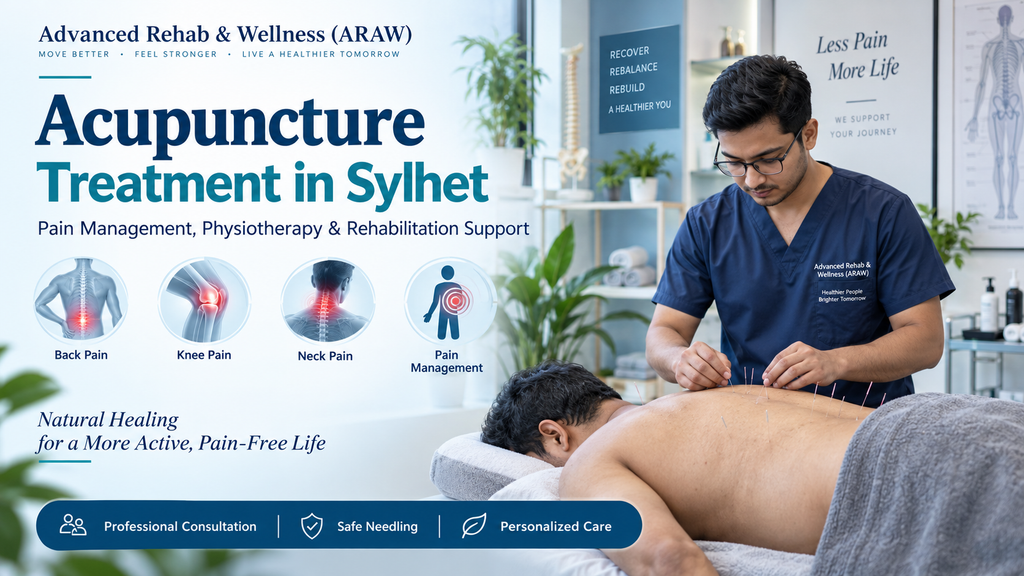
Acupuncture Treatment Sylhet: What Patients Should Know Before Starting Treatment
Persistent pain can gradually affect almost every area of life.
Back pain may make sitting or bending difficult. Knee pain can interfere with walking and stairs. Neck pain may affect sleep and office work, while recurring headaches or muscle tension can reduce concentration and quality of life.
For these reasons, many people now search for acupuncture treatment in Sylhet as a non-drug or complementary option for managing pain.
Acupuncture is a technique in which very fine needles are inserted into selected points of the body. Depending on the approach, the needles may be stimulated manually or with a mild electrical current known as electro-acupuncture.
The United States National Center for Complementary and Integrative Health states that acupuncture is most commonly used for pain and that research suggests it may help selected people with conditions such as back pain, neck pain and knee pain related to osteoarthritis. However, the size of the benefit varies, and not every condition responds in the same way.
For people seeking acupuncture treatment in Sylhet, Advanced Rehab & Wellness—ARAW currently provides a dedicated acupuncture service at Garden Tower, Shahjalal Uposhahar, Sylhet. ARAW also provides Physiotherapy & Pain Management, Neuro Rehabilitation and Stroke Rehabilitation within the same facility.
This guide explains how acupuncture works, what it may help with, what its limitations are, how to choose a safe clinic and when medical assessment should come before acupuncture.
What Is Acupuncture?
Acupuncture involves inserting very thin needles through the skin at carefully selected points.
The technique originated within traditional Chinese medicine but is now also used in many modern pain-management and rehabilitation settings.
A practitioner may select points based on:
- Pain location
- Anatomy
- Muscle tension
- Trigger points
- Nerve pathways
- Functional symptoms
- The broader treatment plan
The needles may be:
- Left in place for a short period
- Gently manipulated
- Connected to controlled electrical stimulation
- Combined with exercise or physiotherapy
NCCIH explains that acupuncture may influence nervous-system function and local tissues, although the exact biological mechanisms are still being studied. It also notes that non-specific factors, including treatment expectations and the patient-practitioner interaction, may contribute to the overall effect.
What Conditions Is Acupuncture Commonly Used For?
Acupuncture is most often used for pain.
Research has examined it for:
- Lower-back pain
- Neck pain
- Knee osteoarthritis
- Headaches
- Migraine
- Post-operative pain
- Selected muscle-related pain conditions
NCCIH reports evidence of benefit for several chronic pain conditions, while also emphasizing that effectiveness differs by condition and that benefits compared with sham acupuncture are sometimes modest.
For this reason, acupuncture should be considered a possible treatment option rather than a guaranteed cure.
Acupuncture Treatment in Sylhet at ARAW
ARAW currently operates a dedicated acupuncture service in Sylhet.
Its published service page lists the following techniques:
- Neuroanatomical point stimulation
- Electro-acupuncture
- Dry needling for trigger points
- Auricular point approaches.
ARAW also states that it uses ultra-fine single-use needles within a controlled clinical setting.
The appropriate technique should depend on the patient’s assessment.
A patient with chronic knee pain may need a different plan from someone with local muscular trigger-point pain or recurrent lower-back discomfort.
Acupuncture for Back Pain
Lower-back pain is one of the most common reasons people seek acupuncture.
Symptoms may include:
- Dull aching
- Stiffness
- Muscle tightness
- Pain during bending
- Pain after prolonged sitting
- Reduced walking tolerance
- Recurrent flare-ups
NCCIH reports that acupuncture has shown benefit for some people with back pain. Large reviews have found greater improvement compared with no treatment, while differences compared with sham acupuncture tend to be smaller.
This means acupuncture may help selected patients with symptom management, but it should not be described as physically “putting the spine back into place” or permanently repairing a slipped disc.
For persistent back pain, rehabilitation may also need to address:
- Strength
- Mobility
- Activity tolerance
- Exercise
- Work demands
- Sleep
- General physical conditioning
Acupuncture for Neck Pain
Neck pain can interfere with:
- Driving
- Sleeping
- Computer work
- Reading
- Turning the head
- Looking up or down
NCCIH includes neck pain among pain conditions for which acupuncture may be helpful in some patients.
However, acupuncture should not delay further medical assessment if neck pain is associated with:
- Progressive arm weakness
- Significant numbness
- Loss of hand coordination
- Balance problems
- Serious trauma
These symptoms may suggest a problem requiring a broader medical or neurological evaluation.
Acupuncture for Knee Pain
Knee pain may be caused by:
- Osteoarthritis
- Muscle weakness
- Repetitive stress
- Previous injury
- Sports injury
- Tendon problems
- Ligament injury
- Other joint conditions
Knee osteoarthritis is one of the better-studied areas of acupuncture.
NCCIH reports that acupuncture has shown benefit for osteoarthritis pain, with the strongest body of research involving knee osteoarthritis. However, the effect compared with sham treatment is generally smaller than the effect compared with receiving no acupuncture.
Acupuncture may therefore be considered for symptom management in selected patients.
It cannot reliably:
- Regrow damaged cartilage
- Reverse advanced arthritis
- Guarantee avoidance of knee surgery
For many knee-pain patients, strengthening and rehabilitation remain important.
Acupuncture for Headache and Migraine
Acupuncture has also been studied for migraine and tension-type headaches.
NCCIH reports moderate-quality evidence that acupuncture may help reduce migraine frequency and may also help some people with tension headaches.
However, a new or unusual headache should not automatically be treated with acupuncture.
Urgent medical assessment is important for:
- Sudden severe headache
- Headache with weakness
- Speech difficulty
- Confusion
- Loss of consciousness
- Headache following serious trauma
- Fever with severe neurological symptoms
Acupuncture for Muscle Tension and Trigger Points
Persistent muscle tightness may occur in the:
- Neck
- Shoulder
- Upper back
- Lower back
- Hip region
ARAW currently lists dry needling for trigger points as part of its acupuncture-related service offering.
Dry needling and acupuncture both use thin needles, but they are not necessarily the same treatment.
Dry needling is commonly directed toward anatomical muscle trigger points, while acupuncture may use a broader system of point selection.
Patients should ask:
- Which technique is being used?
- Why is it recommended?
- What is the goal?
- Is exercise also needed?
What Is Electro-Acupuncture?
Electro-acupuncture involves connecting acupuncture needles to a device that provides controlled, mild electrical stimulation.
ARAW currently lists electro-acupuncture among its acupuncture services.
The stimulation should be adjusted to a comfortable level.
Before electro-acupuncture, tell the practitioner if you have:
- A pacemaker
- An implanted electrical device
- Significant heart problems
- Reduced sensation
- Pregnancy
- Other significant medical conditions
This information can influence whether the treatment is suitable.
Acupuncture and Chronic Pain
Chronic pain can be influenced by many factors.
These may include:
- Physical deconditioning
- Poor sleep
- Stress
- Reduced confidence in movement
- Previous injury
- Work demands
- Long-term illness
NCCIH notes that acupuncture may help some chronic pain conditions, but complementary approaches should still be considered in the context of the individual patient’s overall health and medical care.
A broader chronic pain plan may include:
- Acupuncture
- Physiotherapy
- Exercise
- Education
- Sleep management
- Medical treatment
- Psychological support when appropriate
Acupuncture should not automatically become the only treatment for a complex chronic pain condition.
Can Acupuncture Be Combined With Physiotherapy?
Yes, when clinically appropriate.
This can be particularly useful when pain relief alone is not enough.
For example, a patient with painful knee osteoarthritis may also have:
- Weak thigh muscles
- Poor balance
- Difficulty walking
- Trouble using stairs
Acupuncture may be considered for symptom management, while physiotherapy can address strength, mobility and function.
ARAW currently provides Physiotherapy & Pain Management in addition to acupuncture, allowing selected patients to receive an integrated rehabilitation plan.
Why Active Rehabilitation Still Matters
Pain management is important, but long-term improvement often depends on restoring physical function.
A rehabilitation programme may include:
- Strengthening
- Mobility exercises
- Balance training
- Walking practice
- Core exercises
- Functional movement
- Home exercise
The goal is not simply to make pain disappear for a few hours.
The goal is to help the person move, work and function better.
For this reason, patients should be cautious about becoming dependent on repeated passive treatment without addressing physical capacity.
Is Acupuncture Safe?
Acupuncture is generally considered safe when performed appropriately by a competent practitioner using sterile needles.
However, it is not risk-free.
NCCIH reports that improper acupuncture can result in serious complications such as:
- Infection
- Puncture of internal organs
- Injury to the nervous system.
Such complications are uncommon, but they explain why appropriate training and sterile technique matter.
Why Single-Use Needles Are Important
Acupuncture needles penetrate the skin.
Therefore, infection control is essential.
A professional clinic should use:
- Sterile needles
- Single-use needles
- Appropriate sharps disposal
- Clean treatment surfaces
- Proper hand hygiene
NCCIH notes that acupuncture needles regulated in the United States must be sterile and labeled for single use.
ARAW’s current service page states that it uses medical-grade, pre-sterilized, single-use needles that are discarded after use.
Possible Side Effects of Acupuncture
Minor temporary effects may include:
- Mild soreness
- Small bruises
- Minor bleeding
- Temporary fatigue
- Dizziness
- Feeling faint
- Temporary increase in discomfort
More serious complications are rare when treatment is performed correctly.
Patients should report severe or unusual symptoms after treatment.
Who Needs Extra Caution?
Acupuncture may require modification or may not be appropriate for everyone.
The NHS advises particular caution in people who:
- Take blood-thinning medicines
- Have an increased risk of bleeding
- Have certain skin conditions
- Have a skin infection.
Patients should also tell the practitioner if they:
- Are pregnant
- Have diabetes
- Have reduced sensation
- Have an implanted device
- Recently had surgery
- Have a weakened immune system
- Have significant medical conditions
Do not stop prescribed medication simply because you want acupuncture.
Acupuncture During Pregnancy
Pregnancy should always be disclosed before acupuncture.
Some acupuncture may be used during pregnancy, but appropriate precautions and technique modifications may be necessary.
Acupuncture should never replace:
- Routine antenatal care
- Obstetric assessment
- Emergency medical care
Pregnant patients should discuss treatment with an appropriate healthcare professional when there is uncertainty.
Acupuncture and Blood-Thinning Medication
Patients taking anticoagulants or other medicines that increase bleeding risk should always tell the practitioner.
The NHS specifically identifies blood-thinning medication and increased bleeding risk as reasons acupuncture may not be suitable without additional consideration.
Do not stop blood-thinning medication without instruction from the healthcare professional who prescribed it.
What Happens During an Acupuncture Consultation?
A responsible treatment session should normally begin with assessment rather than immediate needling.
The practitioner may ask about:
- Main symptoms
- Pain location
- How long the problem has been present
- Previous injuries
- Medical conditions
- Current medication
- Previous treatment
- Pregnancy
- Bleeding risk
- Implanted devices
- Treatment goals
The practitioner should also consider whether acupuncture is actually appropriate.
What Happens During the Procedure?
The patient is positioned comfortably.
The practitioner identifies the treatment area and inserts fine needles at selected points.
Patients may feel:
- Mild pinching
- Dull aching
- Pressure
- Tingling
- Warmth
- Heaviness
Severe pain should be reported immediately.
Depending on the plan, the needles may remain in place for a limited period and may be stimulated manually or electrically.
Does Acupuncture Hurt?
Most patients do not describe acupuncture as severely painful.
ARAW’s current service page states that its ultra-fine needles typically cause only mild sensations such as warmth or heaviness.
Individual experiences vary.
A patient should feel comfortable telling the practitioner if a needle produces sharp or severe pain.
How Many Acupuncture Sessions Are Needed?
There is no universal number.
Treatment duration may depend on:
- Diagnosis
- Symptom duration
- Severity
- Treatment response
- General health
- Whether physiotherapy is also being used
- Functional goals
A responsible clinic should periodically review whether treatment is helping.
Patients should be cautious of guaranteed statements such as:
- “One session cures every pain.”
- “Six sessions permanently cure arthritis.”
- “Acupuncture permanently fixes every slipped disc.”
Reliable medical evidence does not support such universal guarantees.
How Should Progress Be Measured?
Improvement should not be judged only by pain intensity.
Patients may also monitor:
- Walking tolerance
- Sleep
- Ability to work
- Joint movement
- Stair climbing
- Exercise tolerance
- Daily activity
- Medication requirements when medically appropriate
If repeated acupuncture provides no meaningful benefit, the treatment plan should be reconsidered.
Can Acupuncture Cure Arthritis?
Acupuncture may help with pain in selected people with osteoarthritis.
However, it does not reliably reverse the structural changes of advanced arthritis.
Patients with arthritis may also need:
- Exercise
- Strengthening
- Weight management
- Medical treatment
- Physiotherapy
- Assistive devices
- Orthopaedic assessment
Acupuncture is best presented as a possible symptom-management option rather than a cure.
Can Acupuncture Cure a Slipped Disc?
Acupuncture cannot be claimed to physically “put a disc back into place.”
Some people with back pain may experience symptom improvement, but disc-related conditions vary considerably.
A patient with significant weakness, progressive numbness or bladder and bowel changes requires medical evaluation rather than routine acupuncture.
Is Acupuncture a Replacement for Medicine?
Not necessarily.
Acupuncture can sometimes be used alongside conventional treatment.
Patients should not stop:
- Pain medication
- Blood-pressure medication
- Diabetes medicine
- Anticoagulants
- Other prescribed treatment
without advice from the prescribing healthcare professional.
NCCIH specifically advises people not to use acupuncture as a reason to postpone appropriate medical care.
When Acupuncture Should Not Be the First Treatment
Seek urgent medical care instead of routine acupuncture when symptoms include:
- Sudden weakness
- Facial drooping
- Speech difficulty
- Loss of consciousness
- Severe chest pain
- Significant breathing difficulty
- Major trauma
- Suspected fracture
- Rapidly worsening neurological symptoms
- Severe infection
- A hot, swollen joint with fever
Acupuncture is not emergency treatment.
How to Choose an Acupuncture Center in Sylhet
When searching for acupuncture treatment Sylhet, do not judge a clinic only by advertisements.
Consider the following.
Proper Assessment
Treatment should begin after the practitioner understands your symptoms and medical history.
Sterile Single-Use Needles
Needle hygiene is essential.
Clear Explanation
You should know:
- Why acupuncture is recommended
- Which technique will be used
- What sensations to expect
- What the risks are
- What alternatives exist
Realistic Expectations
Avoid clinics claiming guaranteed permanent cures.
Appropriate Referral
A responsible service should recognise conditions requiring medical, orthopaedic or neurological assessment.
Access to Rehabilitation
Many pain conditions also need strengthening, mobility or functional exercise.
Progress Monitoring
Treatment should continue because it is producing meaningful improvement, not simply because a package was purchased.
Why Consider ARAW for Acupuncture Treatment in Sylhet?
Advanced Rehab & Wellness currently provides a dedicated Acupuncture service at Shahjalal Uposhahar, Sylhet.
ARAW’s published service lists:
- Single-use acupuncture needles
- Neuroanatomical point stimulation
- Electro-acupuncture
- Trigger-point dry needling
- Auricular techniques.
The center also provides:
- Physiotherapy & Pain Management
- Neuro Rehabilitation
- Stroke Rehabilitation
- Regenerative Wellness.
This can be useful when the patient requires more than pain relief alone.
For example, acupuncture may be considered for symptoms while physiotherapy focuses on movement, strength and everyday function.
Frequently Asked Questions About Acupuncture Treatment Sylhet
Where can I get acupuncture treatment in Sylhet?
Advanced Rehab & Wellness—ARAW currently provides acupuncture at Garden Tower, Shahjalal Uposhahar, Sylhet.
Is acupuncture scientifically proven?
Evidence varies by condition. NCCIH reports that acupuncture may help some people with back pain, neck pain, knee osteoarthritis and certain headache disorders. Benefits can be modest, and it is not effective for every condition or every patient.
Can acupuncture help back pain?
Yes, some research suggests acupuncture may help selected people with back pain, particularly chronic lower-back pain. However, it should not be considered a guaranteed cure.
Can acupuncture help knee pain?
Evidence suggests acupuncture may provide some pain relief for people with knee osteoarthritis.
Can acupuncture help neck pain?
Acupuncture may help some patients with neck pain. Significant weakness, numbness or balance problems should receive medical evaluation.
Is acupuncture safe?
It is generally considered safe when performed by a competent practitioner using sterile needles. Serious complications are uncommon but can include infections and organ injury when treatment is performed improperly.
Are acupuncture needles reused?
They should not be. ARAW states that it uses single-use, pre-sterilized needles.
Can I receive acupuncture while taking blood thinners?
Extra caution is needed. The NHS advises that acupuncture may not be suitable for people taking blood-thinning medication or those with increased bleeding risk without appropriate professional consideration.
Can acupuncture be combined with physiotherapy?
Yes, when appropriate. ARAW currently provides both acupuncture and Physiotherapy & Pain Management.
What is electro-acupuncture?
Electro-acupuncture uses mild electrical stimulation through selected acupuncture needles. ARAW currently lists this among its acupuncture services.
Is dry needling the same as acupuncture?
Not exactly. Both use thin needles, but dry needling commonly focuses on anatomical muscle trigger points, while acupuncture may use different point-selection approaches.
How many sessions will I need?
There is no fixed number. Treatment should be determined by the condition and reviewed according to response.
Does acupuncture permanently cure pain?
No responsible clinic should guarantee permanent pain relief for every patient. Acupuncture may help manage symptoms for some conditions, but outcomes vary.
Book Acupuncture Treatment in Sylhet at ARAW
If pain, stiffness or recurring muscle discomfort is affecting your work, sleep, exercise or daily activity, an appropriate assessment can help determine whether acupuncture is a reasonable option.
For people searching for acupuncture treatment Sylhet, Advanced Rehab & Wellness—ARAW currently offers a dedicated acupuncture service alongside Physiotherapy & Pain Management and other rehabilitation services.
Advanced Rehab & Wellness—ARAW
Address:
Shahjalal City College Building
Garden Tower
Shahjalal Uposhahar, Sylhet
Bangladesh
Appointment Numbers:
+880 13 2476 3317
+880 13 2476 3318
Email:
arawsylhet@gmail.com
Current Acupuncture Schedule
ARAW’s current acupuncture service page lists:
Monday & Wednesday:
10:00 AM–03:00 PM
Tuesday & Thursday:
01:00 PM–06:00 PM.
Patients should call before visiting to confirm the latest schedule and practitioner availability.
Conclusion
Acupuncture is a widely used complementary treatment, particularly for pain.
Current research suggests it may help some people with:
- Back pain
- Neck pain
- Knee osteoarthritis
- Headaches
- Selected chronic pain conditions.
However, acupuncture should not be presented as a guaranteed cure.
Good acupuncture treatment in Sylhet should involve:
- Proper assessment
- Sterile single-use needles
- Appropriate practitioner training
- Realistic expectations
- Medical referral when necessary
- Progress monitoring
- Physiotherapy or exercise when needed
ARAW currently provides acupuncture in Sylhet within a wider rehabilitation setting that also includes Physiotherapy & Pain Management, Neuro Rehabilitation and Stroke Rehabilitation.
The most useful treatment plan is one that focuses not only on reducing symptoms but also on helping the patient return to meaningful movement, work and everyday life.
Medical Disclaimer
This article is intended for general health education and website information. It does not provide an individual diagnosis, prescription or guarantee of treatment results. Evidence for acupuncture varies by condition and patient. Acupuncture should be performed using appropriate sterile techniques by a suitably trained practitioner. Do not delay emergency or medically necessary treatment in order to receive acupuncture. Patients taking blood thinners, those with skin infection, pregnancy, implanted electrical devices or significant medical conditions should discuss these issues with the practitioner before treatment.