Acupuncture for Knee Pain Sylhet: Pain Management, Physiotherapy and Rehabilitation at ARA
Looking for acupuncture for knee pain in Sylhet? Learn how acupuncture may help selected patients with knee osteoarthritis and chronic knee pain, what the evidence says, safety precautions, physiotherapy, exercise and rehabilitation at Advanced Rehab & Wellness—ARAW.
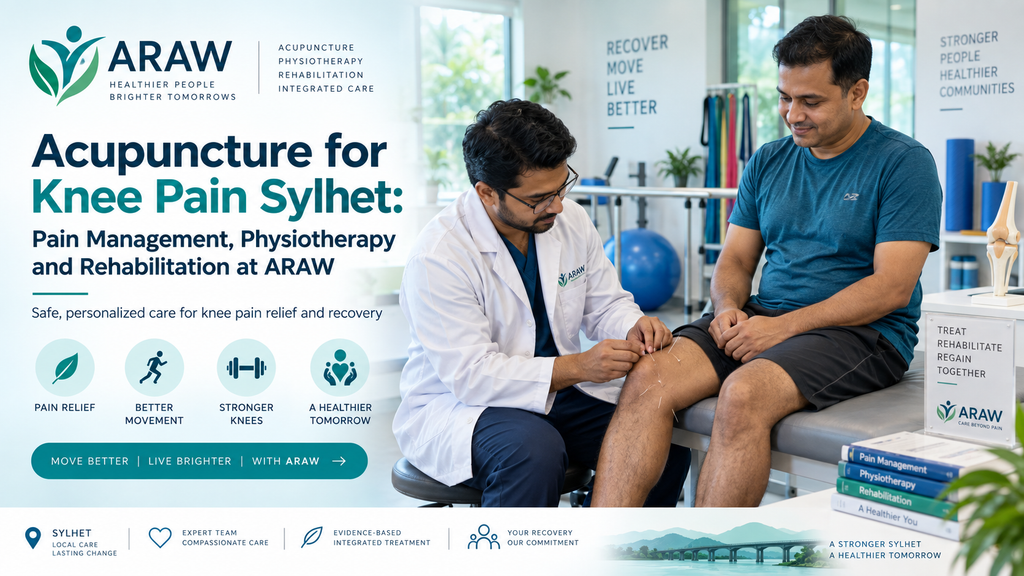
Acupuncture for Knee Pain Sylhet: A Complete Guide to Pain Relief and Functional Recovery
Knee pain can gradually make everyday activities difficult. Walking, climbing stairs, standing from a chair, praying, shopping, exercising or standing for long periods may become uncomfortable when the knee is painful, stiff or weak.
For some people, knee pain begins after an injury. For others, it develops gradually because of osteoarthritis, muscle weakness, repetitive physical stress, previous trauma or another joint condition.
One treatment people increasingly search for is acupuncture for knee pain.
Acupuncture involves inserting very fine needles into selected points of the body. Research suggests that it may provide pain relief for some people with osteoarthritis, particularly knee osteoarthritis, although the size of the benefit varies and guideline recommendations are not completely consistent.
For people searching for “acupuncture for knee pain Sylhet,” Advanced Rehab & Wellness—ARAW provides a dedicated acupuncture service in Shahjalal Uposhahar, Sylhet. ARAW’s current service page also lists Physiotherapy & Pain Management, meaning acupuncture may be combined with strengthening, mobility and functional rehabilitation where appropriate.
This guide explains the common causes of knee pain, how acupuncture may help selected patients, what current research says, when physiotherapy is important, safety precautions and when knee pain requires urgent medical assessment.
Why Does Knee Pain Happen?
The knee is a major weight-bearing joint.
It is made up of bones, cartilage, ligaments, tendons, muscles and other supporting tissues.
Knee pain may develop because of:
- Osteoarthritis
- Previous injury
- Ligament damage
- Meniscus injury
- Tendon-related pain
- Muscle weakness
- Sports injuries
- Repetitive physical stress
- Previous fractures
- Reduced physical conditioning
- Post-operative weakness
- Inflammatory joint disease
- Other musculoskeletal conditions
Because many different problems can produce similar symptoms, treatment should begin with appropriate assessment rather than assuming that all knee pain is simply “arthritis.”
Knee Osteoarthritis: One of the Most Common Causes of Knee Pain
Osteoarthritis is a degenerative joint condition that can cause pain, stiffness, swelling and reduced movement.
According to the World Health Organization, around 528 million people worldwide were living with osteoarthritis in 2019, and the knee is the most frequently affected joint, with an estimated 365 million people affected.
Common symptoms of knee osteoarthritis include:
- Pain when walking
- Pain on stairs
- Morning stiffness
- Difficulty standing from a chair
- Reduced knee movement
- Swelling
- Weakness around the knee
- Reduced walking distance
- Difficulty bending or squatting
When pain leads to reduced activity, the surrounding muscles may become weaker and physical function may decline further. WHO specifically notes that reduced movement can lead to loss of muscle strength.
Does Knee Osteoarthritis Mean the Joint Is “Worn Out”?
Not exactly.
Osteoarthritis is often described as simple “wear and tear,” but the condition affects the whole joint and surrounding tissues.
Risk factors include:
- Previous joint injury
- Repeated physical stress
- Older age
- Obesity
- Genetics
- Other joint disease.
Having osteoarthritis does not automatically mean the patient should stop exercising or will need surgery.
WHO recommends activity, muscle strengthening, healthy weight management and a rehabilitation plan tailored to the patient’s needs.
What Is Acupuncture?
Acupuncture is a treatment technique in which thin needles are inserted through the skin at selected points.
Traditional acupuncture developed from Chinese medicine, while modern clinical approaches may select points based on:
- Anatomy
- Pain location
- Muscle tension
- Trigger points
- Nervous-system pathways
ARAW describes its current acupuncture service as combining traditional acupuncture concepts with modern neuroanatomical understanding and using sterile, ultra-fine single-use needles.
Depending on the treatment plan, the practitioner may also use:
- Manual needle stimulation
- Electro-acupuncture
- Trigger-point needling
- Auricular approaches.
How Might Acupuncture Help Knee Pain?
The exact mechanisms of acupuncture are still being studied.
Possible effects may involve:
- Stimulation of sensory nerves
- Changes in pain-processing pathways
- Release of naturally occurring pain-modulating chemicals
- Local muscle effects
- Reduced pain sensitivity
NCCIH notes that acupuncture appears to influence nervous-system function and pain processing, although non-specific treatment effects may also contribute.
Acupuncture should not be described as rebuilding cartilage or permanently reversing arthritis.
Does Acupuncture Work for Knee Osteoarthritis?
Evidence suggests acupuncture may help some people, but the degree of benefit varies.
NCCIH reports that a 2018 review involving more than 2,400 people found acupuncture more effective than no treatment for osteoarthritis pain, and more effective than sham acupuncture, although the difference compared with sham was smaller. Most participants had knee osteoarthritis.
Another NCCIH review notes that acupuncture may help relieve osteoarthritis pain and that evidence is strongest for knee osteoarthritis.
A 2023 evidence summary also reported that acupuncture used alongside oral medication was associated with short-term improvements in knee pain and function.
However, clinical guidance is not completely uniform. NCCIH notes that some professional guidelines conditionally support acupuncture for knee osteoarthritis, while others recommend against routine use. This reflects uncertainty about how large and clinically meaningful the benefit is.
For patients, the practical message is:
Acupuncture may be worth considering as an optional adjunct for selected knee-pain patients, but it should not replace exercise, rehabilitation or necessary medical care.
Acupuncture for Chronic Knee Pain
Chronic knee pain can persist for months or years.
Patients may experience:
- Constant aching
- Pain during walking
- Pain on stairs
- Morning stiffness
- Reduced activity
- Sleep disturbance
- Fear of movement
Acupuncture may be considered when the patient wants an additional non-drug approach to pain management.
NCCIH notes that acupuncture has shown promise for chronic pain conditions, including osteoarthritis.
However, long-term improvement usually requires more than passive pain-relief treatment alone.
A broader plan may include:
- Strengthening
- Physical activity
- Physiotherapy
- Weight management if relevant
- Activity modification
- Medical treatment
- Acupuncture as an optional adjunct
Acupuncture for Knee Pain After Overuse
Knee pain can also occur after:
- Running
- Gym training
- Repetitive stairs
- Long periods of standing
- Increased sports activity
- Sudden training-load changes
In these cases, acupuncture may help some patients manage discomfort, but treatment should also identify whether the real problem involves:
- Training load
- Muscle weakness
- Poor recovery
- Tendon irritation
- Previous injury
- Inadequate conditioning
Pain relief alone does not necessarily prepare a person to return safely to exercise.
Acupuncture for Sports-Related Knee Pain
Sports involving running, jumping, turning or rapid changes of direction can place high demands on the knee.
Examples include:
- Football
- Cricket
- Badminton
- Running
- Gym training
An athlete may ask for acupuncture because pain is preventing return to sport.
Acupuncture may be used for symptom management in selected cases, but sports rehabilitation should also assess:
- Strength
- Balance
- Joint stability
- Running ability
- Jumping
- Landing control
- Change of direction
Treatment should not simply suppress pain so an athlete can return before an injury has recovered adequately.
Acupuncture for Knee Pain at ARAW in Sylhet
Advanced Rehab & Wellness currently offers a dedicated Acupuncture service.
According to ARAW’s current service page, available approaches include:
- Neuroanatomical Point Stimulation
- Electro-Acupuncture Loops
- Dry Needling for Trigger Points
- Auricular Protocol Mapping.
The clinic states that it uses ultra-fine, single-use needles.
Which technique is appropriate should depend on assessment rather than automatically using the same protocol for every patient.
What Is Electro-Acupuncture?
Electro-acupuncture involves connecting selected acupuncture needles to a device that provides mild electrical stimulation.
ARAW currently lists electro-acupuncture among its acupuncture approaches.
The stimulation should be controlled and adjusted to the patient’s tolerance.
Tell the practitioner if you have:
- A pacemaker
- An implanted electrical device
- Significant heart problems
- Pregnancy
- Reduced sensation
Electro-acupuncture may not be suitable for every patient.
Dry Needling and Knee Pain
ARAW also lists dry needling for trigger points.
Dry needling and acupuncture both use thin needles, but they are not necessarily the same technique.
Dry needling typically focuses on:
- Muscle trigger points
- Myofascial pain
- Local muscle tightness
Patients should ask:
- Which method is being recommended?
- Why?
- What problem is being targeted?
Why Physiotherapy Is Important for Knee Pain
Acupuncture may help manage pain, but physiotherapy addresses other important physical problems.
WHO emphasises that exercise can strengthen muscles and improve mobility in osteoarthritis.
Physiotherapy for knee pain may focus on:
- Knee movement
- Quadriceps strength
- Hip strength
- Balance
- Walking
- Stair climbing
- Functional activities
ARAW currently provides Physiotherapy & Pain Management alongside acupuncture. Its listed physiotherapy approaches include joint mobilisation, electrotherapy, ultrasound, core-stability work and mobility assessment.
Acupuncture Plus Physiotherapy
For selected patients, combining acupuncture with active rehabilitation may be more useful than relying on repeated acupuncture sessions alone.
For example:
Acupuncture may help with:
- Pain modulation
- Short-term symptom relief
- Muscle tension
Physiotherapy may help with:
- Strength
- Mobility
- Balance
- Walking
- Stair climbing
- Functional recovery
This combination can help move treatment from temporary pain relief toward improved everyday function.
Strengthening for Knee Osteoarthritis
Muscle weakness is common in knee osteoarthritis.
When pain causes patients to become less active, quadriceps strength may decline.
WHO specifically recommends exercise to strengthen affected muscles and support mobility.
A 2026 randomized trial also reinforced the importance of strengthening in knee osteoarthritis rehabilitation, showing improvement in pain, quadriceps strength and disability with structured exercise, with additional early benefit when mobilisation was combined with exercise.
Exercises may include:
- Isometric quadriceps work
- Sit-to-stand
- Controlled step exercises
- Hip strengthening
- Calf strengthening
The programme should be progressed according to the patient’s condition.
Should You Exercise If the Knee Hurts?
Appropriate exercise is usually important for osteoarthritis.
WHO states that regular physical activity and muscle strengthening can help manage symptoms and maintain mobility.
Exercise does not mean forcing through severe pain.
The correct programme should consider:
- Pain level
- Swelling
- Strength
- Balance
- Age
- General health
- Previous injury
Patients with severe acute injury may need medical assessment before beginning exercises.
Weight Management and Knee Pain
Body weight can influence the load placed on the knee.
WHO identifies obesity as a significant risk factor for knee and hip osteoarthritis and recommends maintaining a healthy weight as part of management.
For patients who are overweight, gradual weight management may support:
- Reduced joint loading
- Easier walking
- Better overall health
- Improved exercise tolerance
Weight should never be treated as the only explanation for pain, and recommendations should remain respectful and individualised.
Does Acupuncture Regrow Knee Cartilage?
There is no good evidence that routine acupuncture regrows damaged cartilage or reverses advanced knee osteoarthritis.
Acupuncture should be viewed primarily as a possible method for managing symptoms.
WHO notes that osteoarthritis treatment may involve exercise, medicines, assistive devices and, in severe disease, joint replacement surgery.
Patients should be cautious about claims that acupuncture can permanently rebuild a severely damaged joint.
Can Acupuncture Prevent Knee Replacement?
It cannot be guaranteed.
Some patients with knee osteoarthritis can manage symptoms successfully for long periods without surgery.
Others eventually need knee replacement because pain and mobility loss become severe.
Acupuncture may help selected patients manage pain, but it cannot reliably prevent surgery when the joint is severely affected.
WHO notes that joint replacement can reduce pain and restore mobility in people with severe joint disease.
Is Acupuncture Safe?
Acupuncture is generally considered safe when performed by an experienced practitioner using sterile needles.
However, NCCIH warns that improperly performed acupuncture can cause:
- Infection
- Organ injury
- Other serious complications.
This is why needle hygiene and practitioner training matter.
Needle Safety at ARAW
ARAW states that it uses single-use, medical-grade, pre-sterilized needles that are discarded immediately after use.
Patients should never accept acupuncture with reused needles.
A professional clinic should also maintain:
- Clean treatment surfaces
- Appropriate hand hygiene
- Safe sharps disposal
- Proper skin preparation
Possible Side Effects
Temporary side effects may include:
- Mild soreness
- Small bruises
- Minor bleeding
- Dizziness
- Feeling tired
- Temporary discomfort
- Feeling faint
Severe or unexpected symptoms should be reported immediately.
Who Needs Extra Caution?
Before acupuncture, tell the practitioner if you:
- Take blood-thinning medicine
- Have a bleeding disorder
- Have diabetes
- Have reduced sensation
- Have a skin infection
- Are pregnant
- Have a pacemaker
- Recently had surgery
- Have a weakened immune system
- Have severe osteoporosis
- Frequently faint during needle procedures
Do not stop prescribed medicines simply to receive acupuncture.
What Happens During an Acupuncture Consultation?
Before treatment, the practitioner should ask about:
- Where your knee hurts
- How long the pain has been present
- Whether there was an injury
- Swelling
- Locking
- Instability
- Medical conditions
- Medication
- Previous treatment
- Treatment goals
A knee that locks repeatedly or becomes unstable after trauma may require orthopaedic assessment before routine acupuncture.
What Happens During Treatment?
The patient is positioned comfortably.
Fine needles are inserted into selected points.
You may feel:
- Brief pinching
- Mild aching
- Pressure
- Warmth
- Tingling
The needles may remain for a limited period.
Where appropriate, mild electrical stimulation may be applied.
Severe pain should be reported immediately.
How Many Acupuncture Sessions Are Needed?
There is no fixed number.
Treatment duration depends on:
- Cause of knee pain
- Severity
- Duration
- Response to treatment
- General health
- Whether physiotherapy is being used
- Functional goals
The treatment plan should be reviewed according to progress.
Do not assume that a large prepaid package is automatically necessary.
How Should Improvement Be Measured?
Treatment success should not be measured only by pain.
Useful signs of improvement include:
- Walking further
- Easier stair climbing
- Better sleep
- Improved knee movement
- Greater strength
- Easier sit-to-stand
- Return to exercise
- Improved confidence
If acupuncture is not producing meaningful improvement after an appropriate trial, the treatment approach should be reconsidered.
Does Every Knee Pain Patient Need an X-Ray or MRI?
No.
Imaging may be considered when there is:
- Major trauma
- Suspected fracture
- Significant instability
- Persistent locking
- Severe unexplained swelling
- Suspected structural injury
- Consideration of surgery
Many common knee-pain problems can first be evaluated through medical history and physical examination.
When Is Knee Pain an Emergency?
Acupuncture should never delay urgent medical assessment.
Seek prompt medical care if:
- The knee becomes very hot, red and swollen
- You have fever with knee swelling
- You cannot bear weight after an injury
- The knee appears deformed
- There was a major accident
- Pain becomes suddenly severe
- The leg becomes numb or unusually cold
- There is significant calf swelling or sudden breathlessness
A hot swollen joint with fever can indicate infection and requires urgent evaluation.
Knee Pain After Injury
If the knee became painful immediately after:
- Twisting
- Falling
- Sports injury
- Road accident
and you experience:
- Rapid swelling
- Locking
- Giving way
- Inability to bear weight
do not begin acupuncture simply because the knee hurts.
An orthopaedic or appropriate medical assessment may be needed first.
Acupuncture for Older Adults With Knee Pain
Knee osteoarthritis is common in older adults.
WHO reports that around 73% of people with osteoarthritis are over age 55.
Older adults may also have:
- Muscle weakness
- Reduced balance
- Diabetes
- Cardiovascular conditions
- Medication-related considerations
Treatment should therefore include broader health screening.
Acupuncture may be considered for pain, while physiotherapy can help address strength and mobility.
Acupuncture and Pain Medication
Acupuncture may be used alongside conventional care in some cases.
It should not automatically replace medication prescribed by a doctor.
Do not stop:
- Anti-inflammatory medication
- Blood-pressure medicine
- Diabetes medicine
- Anticoagulants
- Other prescribed treatment
without discussing it with the prescribing healthcare professional.
How to Choose Acupuncture for Knee Pain in Sylhet
Look beyond advertising claims.
Proper Assessment
The practitioner should understand why your knee hurts.
Safe Needles
Sterile, single-use needles are essential.
Realistic Expectations
Avoid claims such as:
- “Permanent cure in one session”
- “Cartilage regrows immediately”
- “No knee replacement will ever be needed”
Integration With Rehabilitation
Patients with weakness or reduced mobility may also need exercise.
Referral When Necessary
A reputable clinic should recognise when orthopaedic or emergency care is required.
Progress Monitoring
Treatment should continue because it provides measurable benefit.
Why Consider ARAW for Acupuncture for Knee Pain in Sylhet?
Advanced Rehab & Wellness currently provides a dedicated acupuncture service in Shahjalal Uposhahar, Sylhet.
ARAW’s acupuncture service currently lists:
- Single-use sterile needles
- Neuroanatomical point stimulation
- Electro-acupuncture
- Trigger-point dry needling.
The same centre also provides Physiotherapy & Pain Management, allowing selected patients to receive active rehabilitation alongside pain-management strategies.
This may be particularly relevant for knee pain because muscle strength and mobility are important components of long-term function.
Frequently Asked Questions About Acupuncture for Knee Pain Sylhet
Where can I get acupuncture for knee pain in Sylhet?
Advanced Rehab & Wellness—ARAW provides acupuncture at Garden Tower, Shahjalal Uposhahar, Sylhet.
Does acupuncture work for knee arthritis?
Research suggests acupuncture may provide pain relief for some people with knee osteoarthritis, although the degree of benefit varies.
Is acupuncture recommended for every knee arthritis patient?
No. Guideline recommendations differ, and treatment should be individualised.
Can acupuncture cure osteoarthritis?
No. It may help manage symptoms, but it does not reverse all structural joint changes.
Can acupuncture regrow cartilage?
There is no reliable evidence that routine acupuncture regrows damaged knee cartilage.
Can acupuncture replace physiotherapy?
Not always. Physiotherapy may be important for strength, mobility, balance and functional recovery.
Can I exercise while receiving acupuncture?
Often yes, if the exercise is appropriate for your condition. Exercise is an important part of knee osteoarthritis management.
Is acupuncture painful?
Most people experience mild pinching, pressure, aching or tingling rather than severe pain.
Are acupuncture needles reused?
They should not be. ARAW states that it uses single-use, pre-sterilized needles.
Can I have acupuncture while taking blood thinners?
Extra caution is needed. Inform the practitioner and do not stop medication without medical advice.
Can acupuncture help after knee replacement?
Acupuncture may be considered for selected pain problems after appropriate medical clearance, but post-operative rehabilitation should primarily follow the surgeon’s recovery plan.
How many sessions will I need?
There is no fixed number. Progress should be reviewed according to your response.
Book Acupuncture for Knee Pain in Sylhet at ARAW
If knee pain is affecting your walking, stairs, exercise or daily activities, proper assessment is the first step.
For selected patients, acupuncture may be considered as part of a broader pain-management programme.
For people searching for acupuncture for knee pain Sylhet, Advanced Rehab & Wellness—ARAW provides acupuncture alongside Physiotherapy & Pain Management.
Advanced Rehab & Wellness—ARAW
Address:
Shahjalal City College Building
Garden Tower
Shahjalal Uposhahar, Sylhet
Bangladesh
Appointment Numbers:
+880 13 2476 3317
+880 13 2476 3318
Email:
arawsylhet@gmail.com
Current Acupuncture Schedule
ARAW’s current acupuncture page lists:
Monday & Wednesday:
10:00 AM–03:00 PM
Tuesday & Thursday:
01:00 PM–06:00 PM.
Patients should contact the centre before visiting to confirm the latest practitioner availability and whether acupuncture is suitable for their condition.
Conclusion
Knee pain can have many causes, and no single treatment is appropriate for everyone.
For knee osteoarthritis, current evidence suggests acupuncture may help some patients with pain, but benefits are generally modest and guidelines do not completely agree on routine use.
At the same time, exercise, muscle strengthening, healthy weight management and personalised rehabilitation remain important parts of knee osteoarthritis care.
For effective acupuncture for knee pain in Sylhet, treatment should therefore include:
- Proper assessment
- Safe single-use needles
- Realistic expectations
- Appropriate medical referral
- Progress monitoring
- Exercise and physiotherapy when indicated
Advanced Rehab & Wellness—ARAW provides acupuncture and Physiotherapy & Pain Management within the same rehabilitation setting in Sylhet.
The goal should not simply be temporary pain reduction. Whenever possible, treatment should help the patient improve movement, strength, walking and everyday function.
Medical Disclaimer
This article is intended for general health education and website information. It does not provide an individual diagnosis, medical prescription or guarantee of recovery. Scientific evidence for acupuncture varies by condition and patient. Acupuncture should be performed by an appropriately trained practitioner using sterile techniques after suitable assessment. Seek urgent medical care for severe knee pain after major trauma, inability to bear weight, obvious deformity, a hot swollen knee with fever, significant neurological symptoms or sudden unexplained swelling.